Hotels & Businesses
$1,710,000
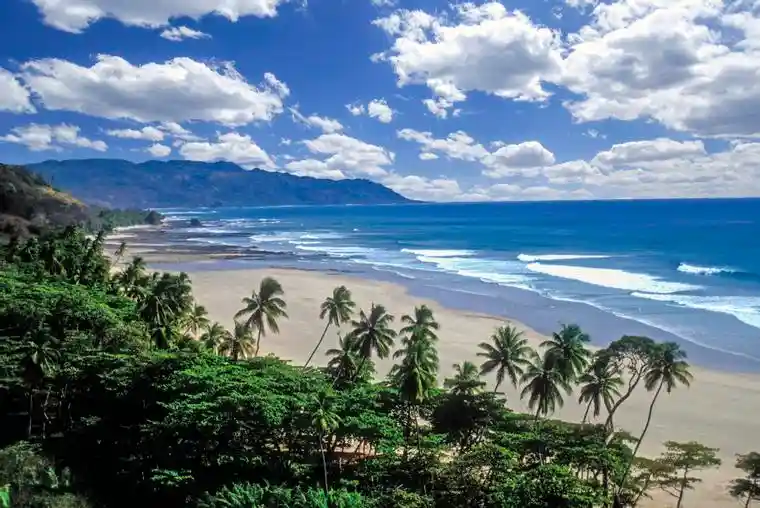
Santa Teresa sits on the Pacific edge of the Nicoya Peninsula, a former fishing village that became one of Costa Rica's most magnetic beach towns. The main road runs parallel to a four-kilometre stretch of surf, threading together yoga shalas, open-air restaurants, surf shops, and barefoot luxury hotels. It is rustic by design — power lines still sway over pot-holes, monkeys cross the road at dusk, and the rhythm of the town tracks the swell more than any clock.
What started in the late 1990s as a surfers' secret is now a global crossover destination drawing wellness seekers, remote workers, chefs, and investors from Europe, North America, and Brazil. The crowd skews international and creative. You will hear Spanish, English, Italian, French, Hebrew, and Portuguese in the same café before noon.
The real estate market reflects that pull. It is also the deepest market on this coast: a brokerage's listing data (2 Costa Rica Real Estate) showed about 200 properties for sale in Santa Teresa in August and early September 2026, and the main road through town is now paved.
Santa Teresa is not for everyone. There is no airport in town, the nearest hospital is in Cobano, and rainy season can isolate the back roads. But for those who want world-class surf, vibrant food, a tight wellness community, and more property to choose from than anywhere nearby, few places on the Pacific coast offer the same combination.
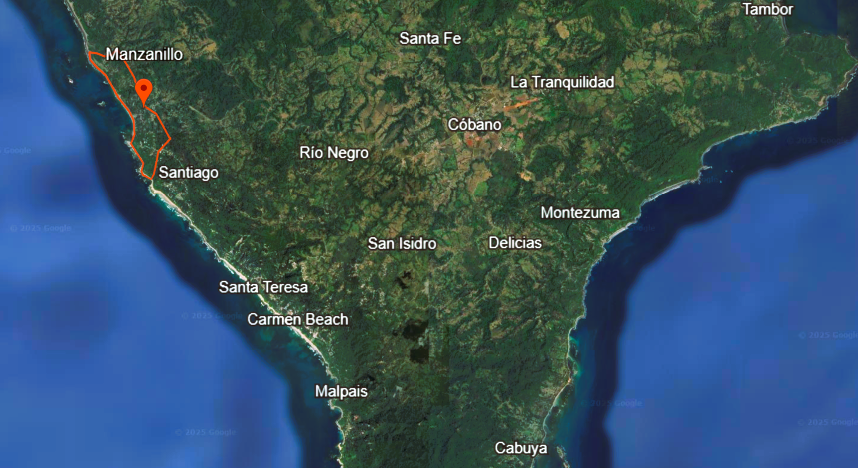
Santa Teresa sits on the southwestern tip of the Nicoya Peninsula in Puntarenas province, about 150 km west of San José as the crow flies but a half-day journey by road and ferry.
Drive west via Highway 27 to Puntarenas (~2 hrs), take the Naviera Tambor car ferry to Paquera (~70 min), then drive about an hour through Cobano. Total: 4.5–5.5 hrs depending on ferry schedule.
Drive south on Highway 1 then west via Nicoya and the Río Bongo bridge (paved year-round since 2022). ~4 hrs.
The commercial heart of Santa Teresa. Restaurants, surf schools, the main supermarket, and beach access converge at the Carmen crossroad. Walkable, social, and the easiest base if you don't want to drive.
North of Carmen, a quieter four-kilometre stretch of beach lined with boutique hotels, wellness retreats, and a handful of modern villas. Sunsets here are unobstructed and the surf works at most tides.
Not to be confused with Playa Hermosa in Guanacaste. This is the wide, palm-fringed beach immediately north — long-board friendly, less crowded, and surrounded by jungle lots prized by builders.
The elevated jungle behind Playa Carmen. Panoramic ocean views and cooler breezes. Tight inventory and many off-market deals.
The fishing village at the southern end of the peninsula, ten minutes from Carmen. Calmer, more local, and home to the protected Cabo Blanco reserve. Land here is less developed.
Playa Carmen, Santa Teresa, and Hermosa offer waves for every level, year-round. Multiple surf schools and board rentals on the main road.
Beachfront restaurants positioned for the nightly ritual — locals and visitors gather on the sand as the sun drops into the Pacific.
Dozens of shalas from Pranamar to Casa Zen offer drop-in classes, teacher trainings, and multi-day retreats in vinyasa, ashtanga, and breathwork.
Costa Rica's oldest protected area, with its main entrance near Cabuya. A 4.5 km trail through primary forest ends at a remote beach with howler monkeys overhead.
Several local outfitters run sunrise and sunset rides along Playa Hermosa and Santa Teresa — one of the best ways to see the coast.
Santa Teresa punches far above its weight on food. Burgers at The Bakery, fresh sashimi at Koji's, wood-fired pizza at Brisa del Mar, and farm-to-table at Drift.
Imported goods, restaurants, and rentals run notably higher than inland Costa Rica. Local produce, fish, and household services remain affordable. Sources: the couple's monthly budget and the rent for a two-bedroom near the beach are from The Tico Times expat cost survey (June 2026); the build cost is Hábita's 2026 table for a premium finish. Our Santa Teresa cost-of-living and building-cost guides have the detail.
December–April: dry, sunny, biggest crowds, peak prices, cleanest surf conditions.
May–November: warm rain in afternoons, lush jungle, fewer tourists, best value on rentals and tours. October is the wettest month.
May, June, and November often deliver the best mix — empty beaches, green hills, and reliable mornings.
Nantipa · Pranamar Villas · Latitude 10 · Florblanca
Hotel Tropico Latino
Casa Marbella · Cuesta Arriba · Selina Santa Teresa North
Most accommodations are walking distance from the beach. Booking 2–3 months ahead is essential for December–March.

New-listing alerts
Choose what you're looking for. We'll email you when a matching property is listed, and only then.
Santa Teresa is one of the safer beach towns in Costa Rica, with a strong expat presence and visible tourist police. Standard precautions apply: don't leave valuables in cars or on the beach, lock your house, and be aware of riptides when swimming.
The most common route is to drive 2 hours west to Puntarenas, take the 70-minute Naviera Tambor car ferry to Paquera, then drive about an hour through Cobano. Total time is 4.5–5.5 hours. A faster option is the daily Sansa flight from San José to the Cóbano aerodrome (ACO), listed as Santa Teresa-Malpais, followed by a road transfer.
Yes. Costa Rica grants foreigners the same property rights as citizens, including fee-simple ownership of titled land. The only exception is the maritime zone (the first 200 m from high tide), which is concession-based. Most Santa Teresa inventory above the beach is fully titled.
Deep, and expensive. A brokerage's listing data (2 Costa Rica Real Estate) showed about 200 properties for sale in Santa Teresa from August 6 to September 6, 2026, at an average asking price of about $1.56 million and $4,303 per square meter, and the same firm counted inventory up about a third during 2025. For rentals, AirROI's data for the whole Cóbano district shows an average of $291 a night at 35.9% occupancy over the year to July 2026. Our vacation rental ROI guide works that through: about 2.5% net a year on a $400,000 house that earns the district average, and about 7.9% for a well-run one at $350 a night and 55% occupancy. We can run the same numbers for any house you are considering.
Yes. Fibre internet from Kolbi and CableTica covers most of Santa Teresa and Carmen, with 100–300 Mbps plans widely available. Power is grid (ICE) and reliable for a beach town, though brief outages happen in green season. Many homes have backup batteries or solar.
The CCSS public clinic and the private CMI Cobano hospital are both about 20 minutes inland in Cobano. For major procedures, residents travel to private hospitals in San José (CIMA, Clínica Bíblica) which are 5 hours away or a 1-hour flight.
Strongly recommended. The main road through Santa Teresa and Playa Hermosa is now paved; many side roads are still gravel, with seasonal river crossings. A high-clearance SUV is the standard. Many homes on the hills are inaccessible to low cars in rainy season.
Yes — there is a strong school-age expat community, bilingual private schools in the Santa Teresa and Cobano area, and plenty of family-friendly beaches, surf lessons, and activities.
Tell us what you're looking for in Santa Teresa and we'll send you the listings that fit, and answer your questions about living here.
Talk to us