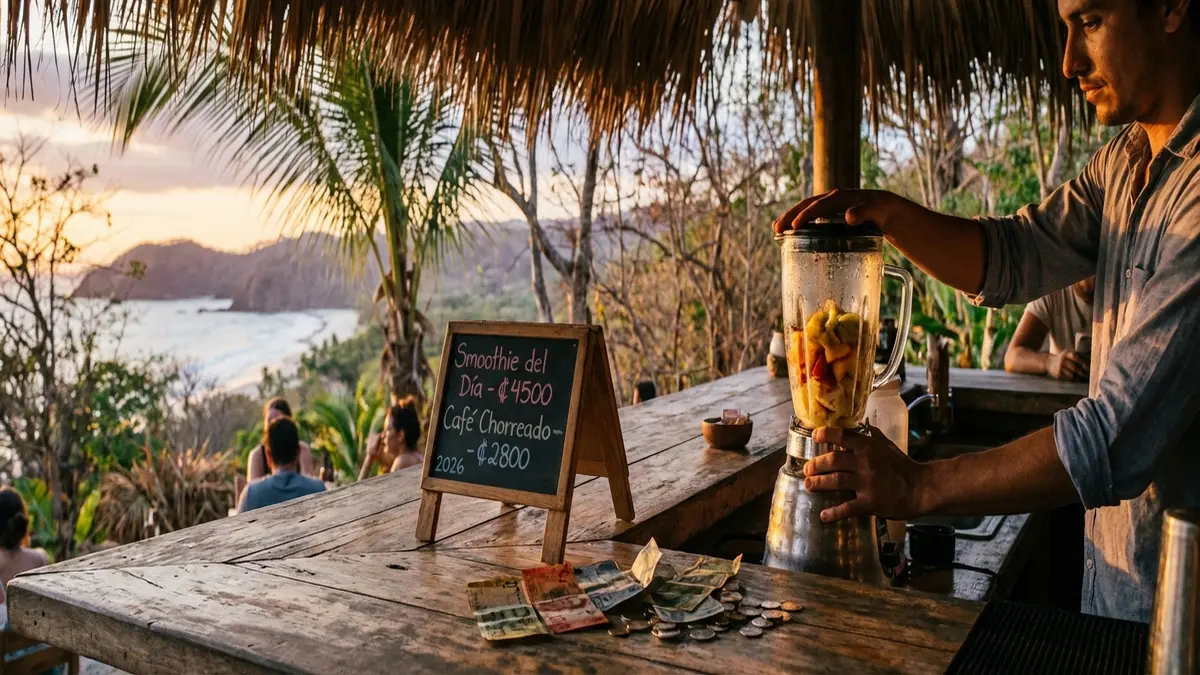
The Real Cost of Living in Santa Teresa, Costa Rica: What Expats Actually Spend in 2026

The cheapest thing about Santa Teresa is the part that gets photographed. The beach is free, the sunset is free, the casado at the soda is eleven dollars, and none of that is what your bank statement will look like at the end of the month. Housing here is priced like a resort town because it is one, and the things that arrive by ferry, which is everything, cost more than they do in San José. This is what it actually costs in 2026, with each number tied to a public tariff, a dated survey or a live market dataset, and with the exchange rate stated, because that has moved more this year than any price.
The rate that changed everything
Start with the colón. It traded near ₡510 to the dollar in January 2026 and near ₡448 in early September, a move of roughly 12 percent in the wrong direction for anyone paid in dollars. Rent and property here are priced in dollars, so they did not move. Groceries, electricity, fuel, wages, the ferry and the Caja are in colones, and every one of them is now about 12 percent dearer in dollar terms than it was at New Year. Every colón figure below is converted at ₡448.
Housing, which is most of it
We will not quote you a rent range we made up. The Tico Times' June 2026 cost-of-living survey puts a two-bedroom near the beach in Tamarindo, Nosara or Santa Teresa at $1,200 to $2,500 and up a month, against $500 to $900 for the same house in an inland town like Atenas or Grecia, and it puts a couple's all-in budget in a beach town at $4,000 to $5,000 and above. That matches what we see. The "and up" is doing real work: a three-bedroom with a pool, fiber and a view on the Mal País side of town will clear $3,000, and furnished houses in the December to April season are often simply not available long-term because they earn more by the night.
Three things keep the floor high. The Maritime Zone removes the first 200 meters of coast from private title, so the buildable stock is the hillside behind the road. The short-term rental market absorbs the best houses: AirROI counts 1,555 active listings across the Cóbano district at an average nightly rate of $291. And the buyers who set land prices are not local: the regional listing service shows around 200 properties for sale in Santa Teresa at an average asking price of $1.56 million, at $2,800 to $4,200 per square meter, with inventory up about a third during 2025. For honesty's sake, our own shelf in Santa Teresa proper is thin this month, a single listing at $1.71 million, and our four Mal País listings sit at a median of $650,000. If you want the price of entry to this town, it is the MLS figure, not ours.
The rent workarounds are real. Move up the hill, or ten minutes down the road to Mal País, or twenty to Montezuma, and the same money buys more house and less noise. Sign in June, not December. And know that landlords here quote rent without electricity, which brings us to the bill everyone complains about.
Electricity, and why the air conditioner is the whole story
Costa Rica's regulator cut residential tariffs for 2026 by between 4.9 and 16.4 percent depending on the utility. The 2026 residential tariff that ICE publishes is a rising block: ₡56 per kWh for the first 140 kWh, climbing through four steps to ₡99.70 for everything above 370 kWh, plus 13 percent VAT once a home passes 280 kWh.
That structure is the answer to the question. A fan-cooled two-bedroom that uses 250 kWh pays around ₡17,000, under $40. Run air conditioning in two bedrooms through the March heat and a house can easily pass 800 kWh, at which point most of the consumption is billed at the top rate and the bill lands around ₡70,000 to ₡80,000, roughly $155 to $180 with tax, before a pool pump. That is the $300 bill people post about, and it is a lifestyle decision, not a utility problem. Ceiling fans, cross-ventilation and a house built to breathe are worth more here than a solar array.
Food, from one dataset
Numbeo's Costa Rica basket, updated September 2026 from 96 contributors, gives a national baseline: an inexpensive restaurant meal ₡5,000, about $11; a mid-range dinner for two ₡25,500, about $57; a cappuccino ₡2,040, about $4.55; a liter of milk ₡1,078, about $2.40; a dozen eggs ₡1,825, about $4; a kilo of chicken breast ₡4,712, about $10.50.
Santa Teresa runs above that baseline on anything packaged and imported, because it comes over on the Naviera Tambor ferry, and at or below it on fish, fruit and the Saturday market in Cóbano. The practical result for a couple who cook is $600 to $900 a month; a couple who eat out most nights and shop for European cheese will double that without noticing. The old advice holds: the supermarket on the main strip is for convenience, the Cóbano feria is for the food bill.
Getting around
Regular gasoline was set at ₡707 a liter from September 10, 2026, about $1.58, or just under $6 a gallon; diesel ₡688. A scooter or small motorcycle is the default vehicle in town and costs almost nothing to run. A car becomes necessary the moment you have children, live up a hill, or need to leave the peninsula in October, and cars here cost more to buy than at home because of import duty and more to maintain because of the road.
Leaving means the ferry or the plane. The Paquera to Puntarenas crossing runs eight times a day; an adult passenger pays ₡810 and a light vehicle ₡11,400 plus VAT, about $29 for the car, with a drive of roughly an hour and a quarter from Santa Teresa to the dock. Sansa and Green Airways fly Cóbano to San José in about half an hour.
Internet
The connection is no longer the constraint it was. Kölbi's symmetric fiber starts at 200 Mbps for ₡24,500 a month, about $55, where the network reaches, and Numbeo's national average for a 60 Mbps-plus plan is ₡26,784, about $60. The main corridor and most of the hillsides above it are served. The lot you are considering may or may not be; test it standing on it, and budget a satellite or mobile backup for the storms of September and October.
Healthcare
If you become a resident you join the Caja, the public system, and the contribution is set on the income you declared in your application: roughly 7 to 11 percent, so a Pensionado at the $1,000 minimum pays somewhere around $100 to $190 a month, more if you add a spouse. Private care alongside it is cheap by North American standards: the Tico Times survey puts a general practitioner visit at $40 to $80 and a specialist at $80 to $150, and private insurance typically runs $80 to $280 a month depending on age and deductible.
What money does not buy here is proximity. Day-to-day care is the Caja clinic in Cóbano and a few private doctors in town. The regional hospital is the new Hospital Monseñor Sanabria in Puntarenas, across the gulf by ferry, or San José by air. Count on two to three hours to an emergency room by road and boat. We tell every buyer this before we tell them about the view.
Help around the house
The 2026 legal minimum for domestic work is ₡268,731 a month, about $600, and by the hour cleaners and gardeners on this coast ask ₡3,000 to ₡5,000, roughly $7 to $11, at the top of the national range because the cost of living is theirs too. A gardener once a week and a cleaner twice a week is $250 to $400 a month. Employ anyone regularly and the Caja contribution, insurance, holiday pay and the December bonus are legal obligations, not tips.
Three budgets, added up
| Monthly, 2026 | Frugal single | Couple, comfortable | Family, house with pool |
|---|---|---|---|
| Rent | $1,200 | $2,200 | $3,500 |
| Electricity and water | $50 | $120 | $250 |
| Food | $450 | $750 | $1,200 |
| Internet and phones | $75 | $100 | $130 |
| Transport | $80 scooter | $300 car | $450 car |
| Healthcare | $110 Caja | $250 Caja + visits | $450 Caja + insurance |
| Household help | 0 | $120 | $350 |
| Eating out, surf, life | $250 | $600 | $900 |
| Total | about $2,200 | about $4,400 | about $7,200 |
These are our sums from the figures above, not a survey, and they will be wrong for you in the direction of your own habits. They line up with the Tico Times' $3,000-plus for a single on the coast and $4,000 to $5,000-plus for a couple once you allow for a car. The number that surprises people is not the food or the doctor. It is that a family here spends what a family spends in a mid-sized American city, with the savings hiding in what you no longer buy rather than in what things cost.
Is it worth it
For the people it suits, plainly yes, and they are not the people who came for a bargain. They came for a life organized around the tide and the light, took a house that breathes instead of one that hums, learned the ferry timetable, and stopped converting prices in their head by the second year. The ones who leave were promised cheap and got a resort town. If you are choosing between here and a quieter, cheaper village, our Montezuma versus Santa Teresa comparison is the honest version of that choice, and if you are past renting and want to know what buying costs to close and to hold, our guide to buying as a foreigner has the tax and fee schedule. Or ask us what your number buys this month; the shelf is thin in Santa Teresa right now and we would rather say so than pretend.
Where these numbers come from
- Exchange rate: Wise USD/CRC history, checked September 2, 2026.
- Rents and budgets: The Tico Times, June 12, 2026.
- Sales market: 2 Costa Rica Real Estate, Santa Teresa MLS insights; rentals, AirROI, Cóbano, July 30, 2026; Maritime Zone, Ley 6043.
- Electricity: ARESEP, December 2025 tariff decision; ICE residential tariff 2026.
- Food and internet baseline: Numbeo, Costa Rica, September 2026; Kölbi home fiber plans.
- Fuel: Delfino.cr on the ARESEP adjustment effective September 10, 2026; ARESEP current fuel tariffs.
- Ferry and flights: Naviera Tambor, fares from April 20, 2026; Sansa, Cóbano route.
- Healthcare: CRIE, Caja rates; CostaRicaBoard, July 18, 2026; El Observador on Hospital Monseñor Sanabria.
- Wages: El Financiero, 2026 minimum wage list.
Tierra Tropical is a real estate agency based in the Cóbano district of Costa Rica's southern Nicoya Peninsula, covering Santa Teresa, Mal País, Montezuma, Cabuya, Delicias and Tambor. Prices are as published on the dates given and will move; nothing here is financial advice.
Ready to Find Your Dream Property?
Explore our curated selection of properties in Costa Rica's beautiful Nicoya Peninsula.
Explore Properties