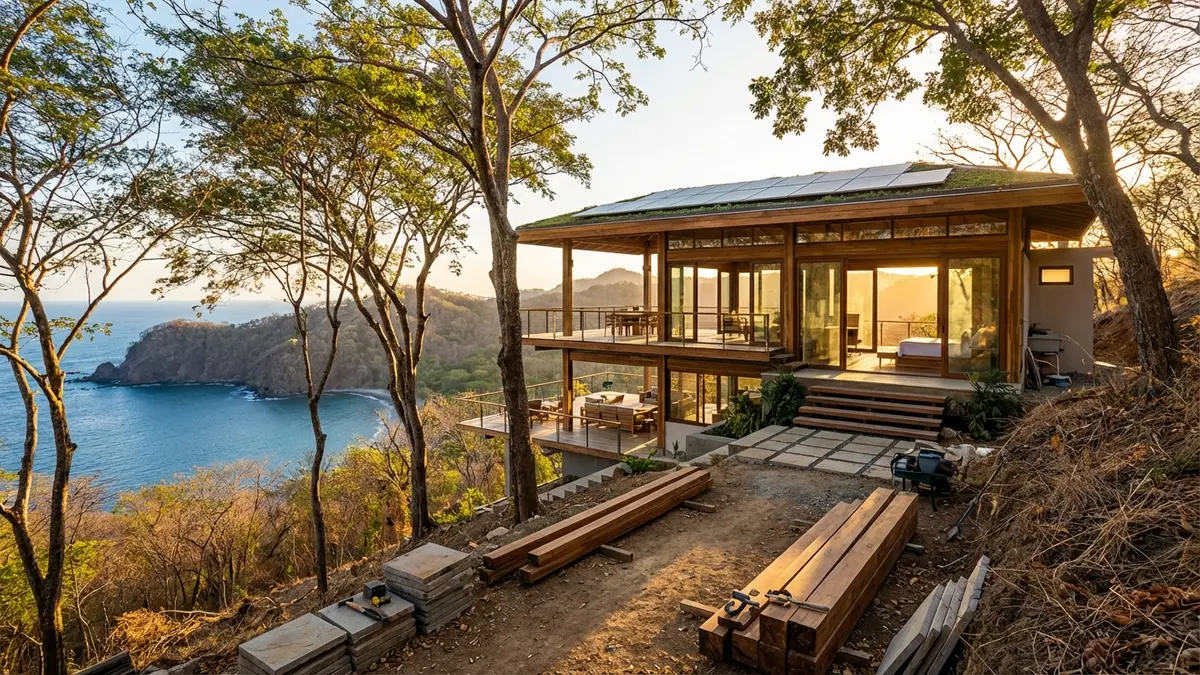
Building a Home in Santa Teresa: What It Actually Costs in 2026

Most people who buy a lot in Santa Teresa have never built a house, and most of the numbers they arrive with come from a contractor's first estimate, which covers the structure and little else. This page is the whole bill, in the order you will pay it: the land, the permits, the build, the twenty-odd percent nobody puts in the first quote, and the running costs that a house designed for this climate can cut in half. The figures are from published 2026 tariffs and cost guides, and the exchange rate is stated because it moved more this year than the price of cement.
The land
Land is the biggest variable and the least predictable. The regional MLS shows 200 active listings in Santa Teresa at an average asking price of $4,303 per square meter for August to September 2026, which is built land near the beach. A titled building lot ten minutes away is a different order of magnitude: our shelf has a flat titled lot 150 meters from the beach in Mal País at $525,000, a 1,494-square-meter titled lot in Delicias with a water meter at $109,000 and a 2.94-acre build-ready lot with a meter at $480,000. The words that move the price are in those titles: titled, flat, water meter. Our land guide goes through what each one means.
Two checks decide whether a lot can be built on at all. The first 200 meters from the high tide line is the Maritime Zone under Ley 6043, where you can only hold a concession, so anything you build there belongs to a lease. And forest cover cannot be cleared under Ley 7575, so a two-hectare parcel is buildable on the part that is already pasture.
The permits, and the letter that gates them
A residential build in Costa Rica needs a design stamped by a member of the engineers' and architects' college, the CFIA, a municipal construction permit from Cóbano, and a letter of water availability from the local ASADA or from AyA. The water letter is the one that stops projects. The CFIA's own magazine reported in May 2026 that missing letters were delaying housing nationally, and the Cóbano council's 2025 record acknowledges that some communities in the district are served by informal water committees with no legal standing to issue one. Get the letter before you pay for the lot, and treat a well as a long legal process rather than a substitute.
Timelines from the Cimenta cost guide of July 2026 are two to four months for design and permits and six to ten for construction, eight to fourteen months in total. On this coast add the rainy season: concrete does not pour in a September downpour and materials arrive by ferry.
The build, per square meter
Two guides published the same week in July 2026 give the range. Hábita's table, in dollars, runs $650 to $850 per square meter for an economic finish, $850 to $1,200 for mid-range, $1,200 to $1,800 for premium and $1,800 upward for luxury. Cimenta's table, in colones, puts a standard middle-class finish at ₡550,000 to ₡750,000 per square meter and medium-high at ₡750,000 to ₡950,000. Converted at this September's rate of about ₡448 to the dollar, the colón figures come out higher than Hábita's dollar ones, at roughly $1,230 to $2,100 for the same two bands. That gap is the exchange rate, which has strengthened from about ₡510 in January, and it matters more than any line in the tables: labor and most materials are paid in colones, so a dollar budget buys about 12 percent less house than it did at New Year.
Santa Teresa sits at the top of whichever table you use. Everything is trucked from the Central Valley and crossed by ferry, coastal air demands stainless fixings and hardwood or treated timber, and the good crews are booked. Plan on $1,200 to $1,800 per square meter for the house most buyers here want, with a pool and a view, before any of the costs below.
The costs the first quote leaves out
Both guides put the same items on the list, and Cimenta's arithmetic is that they add more than 20 percent to the structure:
- Professional fees for design, permits and site supervision, set by the CFIA tariff at about 10.5 to 12 percent of the work value.
- The municipal construction permit at 1 percent of the declared value.
- CFIA platform stamps, about ₡350,000.
- Soil and topographic studies, ₡500,000 to ₡1,500,000, which on a hillside lot here are not optional.
- Workplace insurance with the national insurer, about 1 percent of labor cost.
- A contingency of 5 to 10 percent, which the rain will spend for you.
A worked example, our arithmetic: a 150-square-meter house at $1,300 per square meter is $195,000 for the structure. Add 22 percent for the items above and it is about $238,000. Add a pool, a driveway that survives October and a water tank with a pump, which every house here needs, and a realistic all-in for a modest two-bedroom on a lot you already own is $260,000 to $300,000, plus the lot, plus the 3 to 3.5 percent it cost to close on it.
What "sustainable" is worth here, in numbers
The marketing word hides a set of decisions that pay for themselves on this coast.
Electricity is billed on a rising block. The 2026 residential tariff ICE publishes charges ₡56 per kilowatt-hour for the first 140 and ₡99.70 for everything above 370, plus VAT once you pass 280. A house that runs air conditioning in two bedrooms through March uses 800 kilowatt-hours or more and pays around $170 a month; a house designed with cross-ventilation, high ceilings, deep eaves and ceiling fans uses a third of that. Orientation and roof overhangs cost nothing extra at the design stage and save more over a decade than a solar array, and a solar array makes most sense as a way to keep the pump and the router running through a power cut.
Water is the other one. A rainwater tank and a pump are standard here because the ASADA supply pauses in the dry season; sizing the tank for a week rather than a day is a few hundred dollars that decides whether you host guests in April. Septic is universal; a properly built system is a permit requirement, not an upgrade.
None of it shows up as a premium in a listing. Houses here resell on title, water, view and condition. A house that is cheap to run and comfortable without air conditioning is easier to rent through the wet months, which is where the money is: AirROI's data for the district shows an average nightly rate of $291 at 35.9 percent annual occupancy, and the properties above that line are the ones that work in September.
After it is built
Property tax is 0.25 percent of registered value a year. The solidarity tax on high-value homes applies when the construction value exceeds ₡143 million, about $319,000 in 2026, which a $260,000 build does not reach and a $400,000 build does; once a house passes that line, the land's value is added to the base as well. Rental income falls under a 12.75 percent effective tax and the hosting rules of Ley 9742, covered in our rental ROI article.
If you want a specific lot read against the water map, the forest cover and the Maritime Zone line before you fall for the view, send it to us. We will tell you what it can carry and roughly what that will cost this year rather than last.
Where these numbers come from
- Land: 2 Costa Rica Real Estate, Santa Teresa market insights, August 6 to September 6, 2026; our shelf, week of September 8, 2026.
- Law: Ley 6043; Ley 7575.
- Water and permits: Revista CFIA, May 18, 2026; Cóbano Municipal Council, acta EXT-16-2025.
- Construction costs: Hábita, cost to build a house in Costa Rica 2026, July 24, 2026; Cimenta, cost guide, July 24, 2026. The worked example is our own arithmetic on those figures.
- Exchange rate: Wise USD/CRC history.
- Electricity: ICE residential tariff 2026.
- Taxes and rentals: AG Legal, solidarity tax 2026; AirROI, Cóbano, July 30, 2026.
Tierra Tropical is a real estate agency in the Cóbano district of Costa Rica's southern Nicoya Peninsula. We sell land and houses; we do not build, and we have no arrangement with any contractor. Get a stamped estimate from a CFIA member before you commit to a budget.
Ready to Find Your Dream Property?
Explore our curated selection of properties in Costa Rica's beautiful Nicoya Peninsula.
Explore Properties