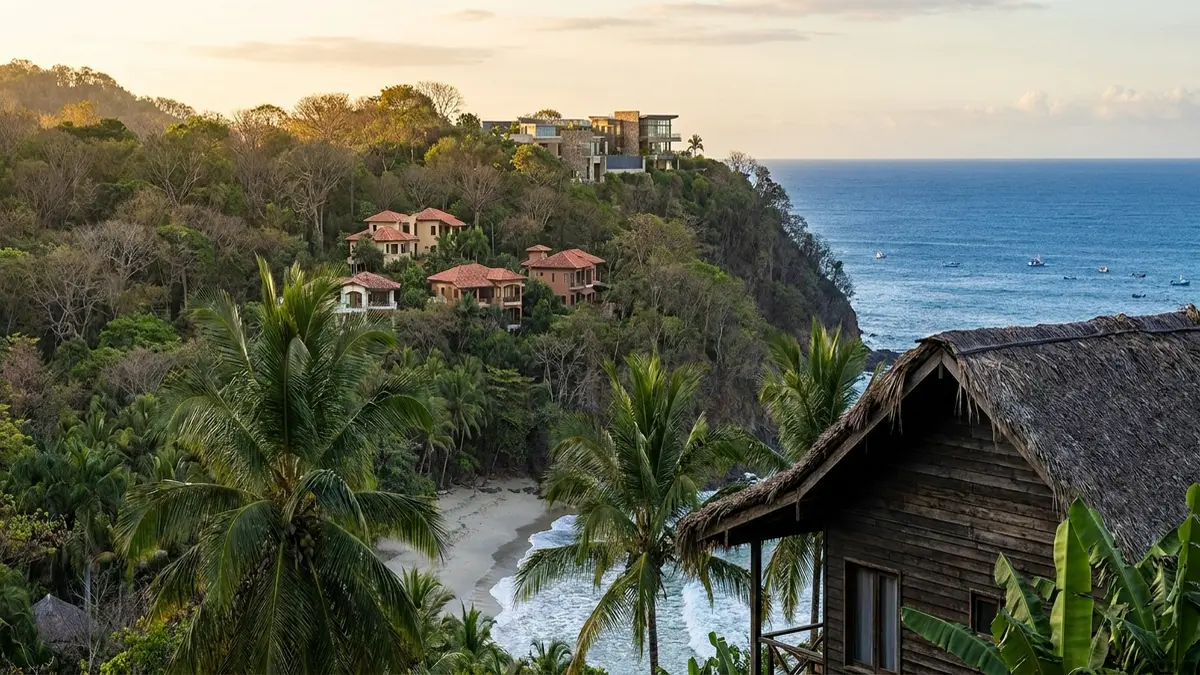
The Real Guide to Santa Teresa's Best Neighborhoods for Surfers, Retirees, and Families

"Santa Teresa" is one road. It starts in the fishing village of Mal País, runs north through Playa Carmen, through Santa Teresa proper, past Playa Hermosa and peters out at Manzanillo, and every stretch of it is priced, zoned and lived in differently. Buyers who treat the whole thing as one town buy the wrong stretch for their life and quietly list eighteen months later. This guide takes the road segment by segment, with the listing data for each, the zoning that applies, and what surfers, retirees and families actually find there. The market numbers are from one regional dataset with a stated period; the rest is what we see on the ground, labeled as such.
The road, segment by segment
The regional MLS run by 2 Costa Rica Real Estate tracks listings by segment. For the month to early September 2026:
| Segment | Active listings | Average asking | What the number hides |
|---|---|---|---|
| Mal País | 27 | $2,523,608 | A few estates pull the average; entry lots are far lower |
| Santa Teresa | 200 | $1,556,379 at $4,303 per m² | The deepest market on the coast, with a long luxury tail |
| Playa Hermosa | 23 | $2,860,007 | The most expensive segment per listing |
| Manzanillo | 12 | $493,929 | The cheapest, and the farthest from everything |
Those are asking prices, not sales; Costa Rica has no public register of sale prices by town. Our own shelf on this road is thin this month and we will say so: one listing in Santa Teresa proper at $1.71 million, a 3.9-hectare estate parcel above Playa Hermosa at $1.2 million, two in Manzanillo including a titled one-bedroom house with water at $365,000, and four in Mal País from a flat titled lot 150 meters from the beach at $525,000 to a two-home estate at $1.45 million.
Playa Carmen is the crossroads where the road from Cóbano meets the coast: the supermarkets, the surf schools, the highest density of restaurants and the beach break that works for beginners at most tides. It is the only stretch where you can live without a car, and it is priced for that.
Santa Teresa proper, north of Carmen, is the long beach with the trendier restaurants, the hotels and the one nightclub. The main strip is paved; the hill roads behind it are not, and that is where most of the 200 listings sit: houses with a view, a pool and a five-minute drive to the sand.
Playa Hermosa is the wide, quiet beach north of town, described in the travel guides as the "Beverly Hills" of Santa Teresa, and the listing data agrees: 23 properties at an average approaching $2.9 million, mostly estates on the hills above the beach.
Manzanillo, at the end, is a fishing hamlet with an empty beach, a rough road in, and the lowest prices on the coast because of both.
What the zoning says, which the travel guides do not
The first 200 meters from the high tide line on every beach is the Maritime Zone under Ley 6043: 50 meters public, 150 meters State land held only on a municipal concession, which a foreigner cannot hold until five years of legal residency. Concessions can only be granted where a coastal zoning plan is in force.
The coastal sector of Playa Santa Teresa has one, adopted by the council as its Zoning and Land Use Regulation on January 13, 1999, which divides the concession strip into public, green, protection, residential, commercial-tourist and hotel zones. Mal País, Playa Carmen, Playa Hermosa and Manzanillo have sector plans of their own, most of them from the early 2000s, and the council still grants new concessions under them. Parts of the coast still have no plan. The Manzanillo plan ends at boundary marker 302, near the cemetery at the north end of Playa Manzanillo, and the land north of it cannot be granted; the municipality's sworn 2025 report to the Constitutional Court also lists sectors toward the Cabo Blanco reserve with no plan. The Cóbano council's March 2025 record shows work started on a single plan for the whole coast from Mal País to Manzanillo.
So "beachfront" means something legally different from one stretch of the same road to the next. The rule on forest and wetland is the same everywhere: in letters of September and October 2024, the Attorney General's office reminded the council that this land is State natural heritage, administered by MINAE-SINAC, so Cóbano cannot grant or renew concessions on it. On every segment, the safe asset is titled land above the 200-meter line; our beachfront guide covers the rest.
For surfers
Playa Carmen for the forgiving beach break and the walk to everything. Santa Teresa proper and Mal País for more power and fewer people, which the guides agree on and the lineups confirm. The buying question is not the break, it is the tide and the commute: a wave that works at low tide is fine if you are retired and less fine if you are on calls until two. Buy within a few minutes' drive of the break you actually surf, on the hill if you want the view and the quiet, on the flat if you want to walk. And test the internet from the specific house before you sign, because the surfer who works remotely is the buyer this market is built for.
For retirees
The case is climate and community, with the Blue Zone label attached, though the cantons the longevity studies cover are in Guanacaste, north of this road; our Blue Zone article has the research. The caveat is medical distance. Costa Rica's Pensionado residency needs a $1,000 monthly pension and enrollment in the Caja, the public health system, at roughly 7 to 11 percent of declared income. Day-to-day care on this road is the Caja clinic in Cóbano and private doctors in town at $40 to $80 a visit. For anything serious you cross the gulf to the Hospital Monseñor Sanabria in Puntarenas by ferry, or fly Cóbano to San José. Two to three hours to an emergency room. We say this to every buyer over sixty before we say anything about the view.
Which segment: Playa Carmen or the flat part of Santa Teresa proper if you want to walk to dinner and the pharmacy; Playa Hermosa if budget allows and quiet matters more; Mal País if you are the kind of retiree who wants a village. Not Manzanillo unless you are very self-sufficient. Our retirement comparison with Mexico and Panama has the visa and tax side.
For families
There is no international school on the beach road, but there are two real bilingual schools in Cóbano, twenty to thirty minutes away, and families here build their lives around that drive. Futuro Verde is the bilingual, sustainability-focused school with an International Baccalaureate program for the upper grades; Hermosa Valley School is a private bilingual school recognized by the Ministry of Education since 2005, serving Santa Teresa, Mal País and Playa Hermosa. Montezuma has smaller Montessori and nature-based programs. Ask for current fees, waiting lists and the bus route before you choose a house; the school run decides the segment more than the surf does.
The rest of the family reality: a car is not optional, the pediatrician is in Cóbano, the inside section of Playa Carmen is the gentle water, and the tide pools toward Mal País are the afternoon plan. Families who thrive here wanted an outdoor childhood more than a structured one. Families who leave wanted a walkable town with a hospital, and this is not that.
What it costs to live and to hold
Rents on this road run $1,200 to $2,500 and up for a two-bedroom near the beach, electricity is the bill that surprises people, and the colón has strengthened from about ₡510 to about ₡448 per dollar this year, making every local cost roughly 12 percent dearer for dollar earners; our Santa Teresa cost-of-living piece has the tariffs and the budgets. To hold, property tax is 0.25 percent and the solidarity tax applies above ₡143 million of construction value, about $319,000, which most houses on this road exceed. Rentals across the Cóbano district average $291 a night at 35.9 percent annual occupancy; walkable Carmen and Santa Teresa houses with a pool beat that, hill houses and Manzanillo do not, and our rental ROI article has the arithmetic.
The short version
Carmen to walk. Santa Teresa proper for the view and the drive. Playa Hermosa for the quiet and the budget to match. Mal País for the village and the emptier waves, with land you must check for water and beachfront you must check against the coastal plan that covers it, if one does. Manzanillo for the price and the solitude, with eyes open. Whichever segment, buy titled land above the 200-meter line, with a water letter, after a September on the road. If you want the four segments priced against your actual life rather than against each other, ask us; the shelf is thin in Santa Teresa this month and we will tell you what is genuinely available.
Where these numbers come from
- Listing data: 2 Costa Rica Real Estate market insights for Santa Teresa, Mal País, Playa Hermosa and Manzanillo, periods August 6 or 7 to September 6 or 7, 2026. Our shelf: live listings on this site, week of September 8, 2026.
- Segments and surf: Mytanfeet, Santa Teresa; Two Weeks in Costa Rica, Santa Teresa.
- Zoning: Ley 6043; Playa Santa Teresa zoning regulation, 1999; Cóbano Municipal Council, coastal zoning plans; Cóbano Municipal Council, acta EXT-16-2025; Cóbano Municipal Council, acta 004-2024; Cóbano Municipal Council, acta 95-2026; Constitutional Court ruling 2025-021667, with the municipality's list of coastal plans; Semanario Universidad, December 2, 2024.
- Schools: Mal País Properties, schools in Mal País and Santa Teresa.
- Residency and healthcare: Golden Harbors, Costa Rica retirement visa 2026; The Tico Times, June 12, 2026; El Observador; Naviera Tambor; Sansa.
- Costs: Wise USD/CRC history; AG Legal, solidarity tax 2026; AirROI, Cóbano, July 30, 2026.
Tierra Tropical is a real estate agency based in the Cóbano district of Costa Rica's southern Nicoya Peninsula, covering Santa Teresa, Mal País, Montezuma, Cabuya, Delicias and Tambor. Nothing here is legal or investment advice.
Ready to Find Your Dream Property?
Explore our curated selection of properties in Costa Rica's beautiful Nicoya Peninsula.
Explore Properties