Costa Rica Property Taxes in 2026: What a Foreign Owner Actually Pays, With Worked Examples
 Sofía Valverde MoraNovember 17, 2026
Most foreign owners in Costa Rica pay one small yearly tax: 0.25% of the property's registered value, to the municipality. On a property registered at $300,000, that's $750 a year. This is the full guide to those yearly taxes, and to what you pay on a sale or on rental income. A second, national tax applies when the house itself, not the land, is valued above ₡143 million in 2026, about $319,000. This is the impuesto solidario, known in English as the luxury-home tax, and it is charged in bands from 0.25% to 0.55%. When you sell, you pay 15% on the gain. Rental income is taxed at an effective 12.75%, and 13% VAT is added to short stays. Foreigners pay exactly what citizens pay: the laws tax whoever owns the property, whatever their nationality. Below are the rules, the 2026 numbers and three worked examples. All conversions use the Central Bank selling rate of ₡448.34 per dollar on 15 November 2026.
How much is property tax in Costa Rica?
0.25% a year of the value registered with the municipality, under article 23 of Law 7509, the property-tax law. The rate is the same everywhere in the country. It covers the land and the permanent buildings on it, and the owner pays. Each municipality decides whether it collects the tax yearly, half-yearly or quarterly (article 22).
Owners must declare their property's value to the municipality at least every five years (article 16). A purchase also updates the value. Under article 7 of Law 6999, the transfer-tax law, the value declared in the deed updates the property-tax value.
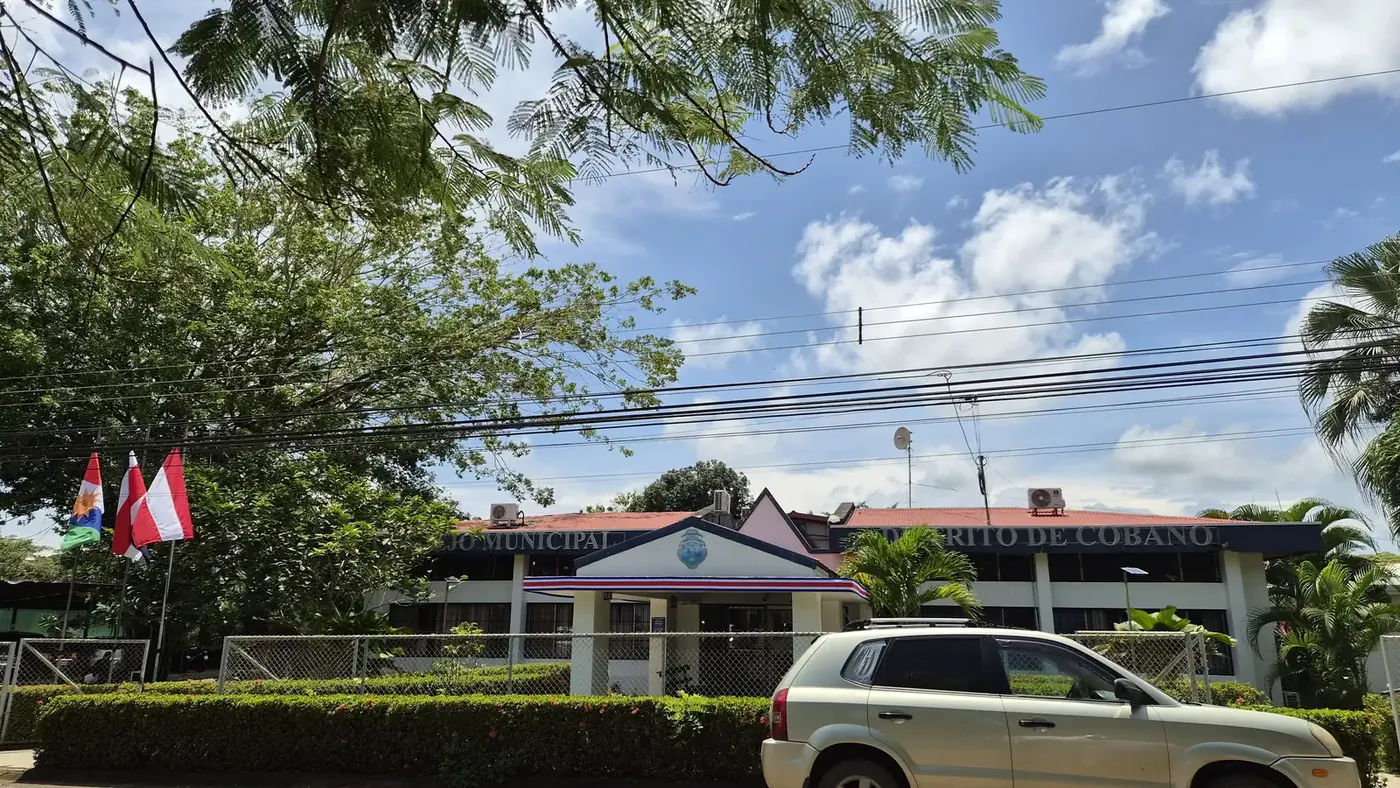
On the southern Nicoya Peninsula, the tax for Santa Teresa, Mal País, Montezuma, Cabuya, Delicias and Tambor is paid to the Concejo Municipal de Distrito de Cóbano, which takes property-tax payments online.
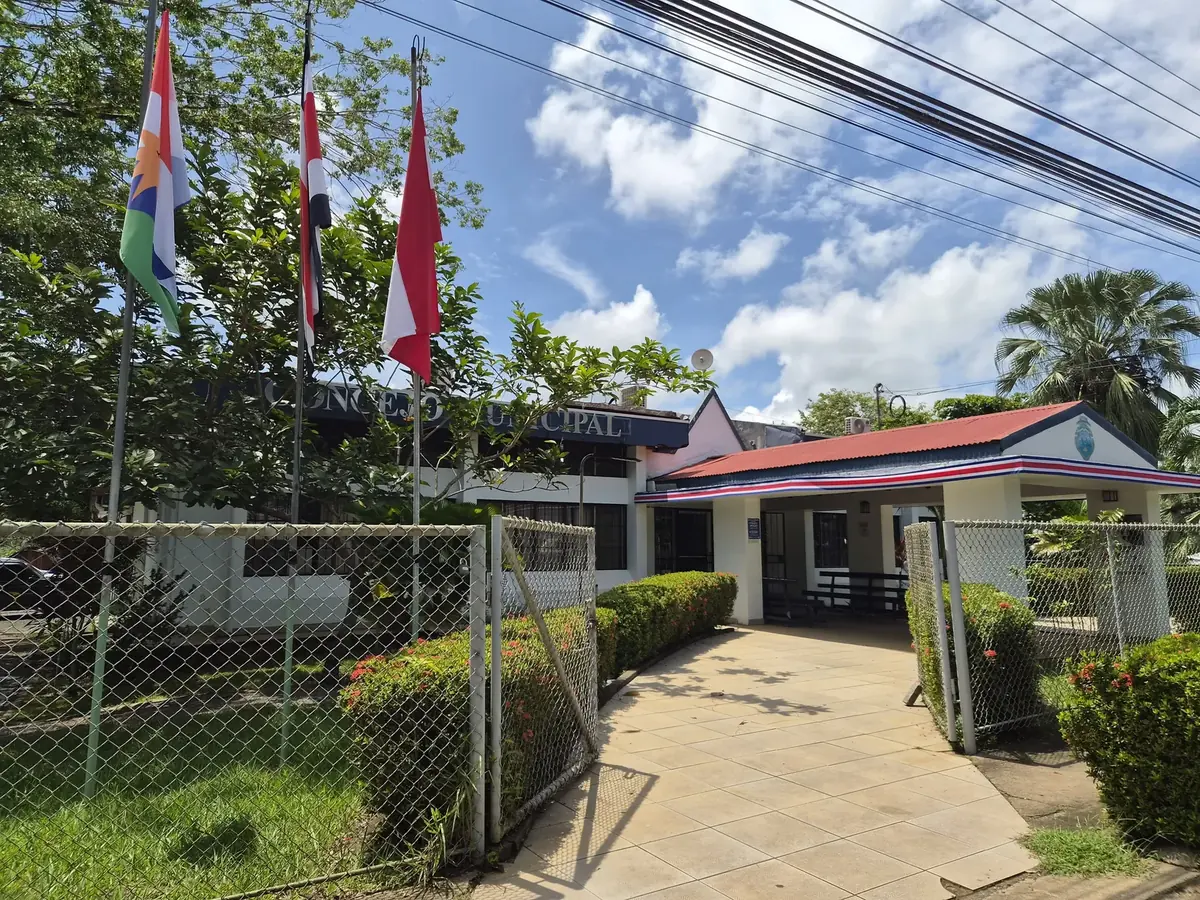
The entrance to the same municipal office in Cóbano.
What is the luxury-home tax, and does my house owe it?
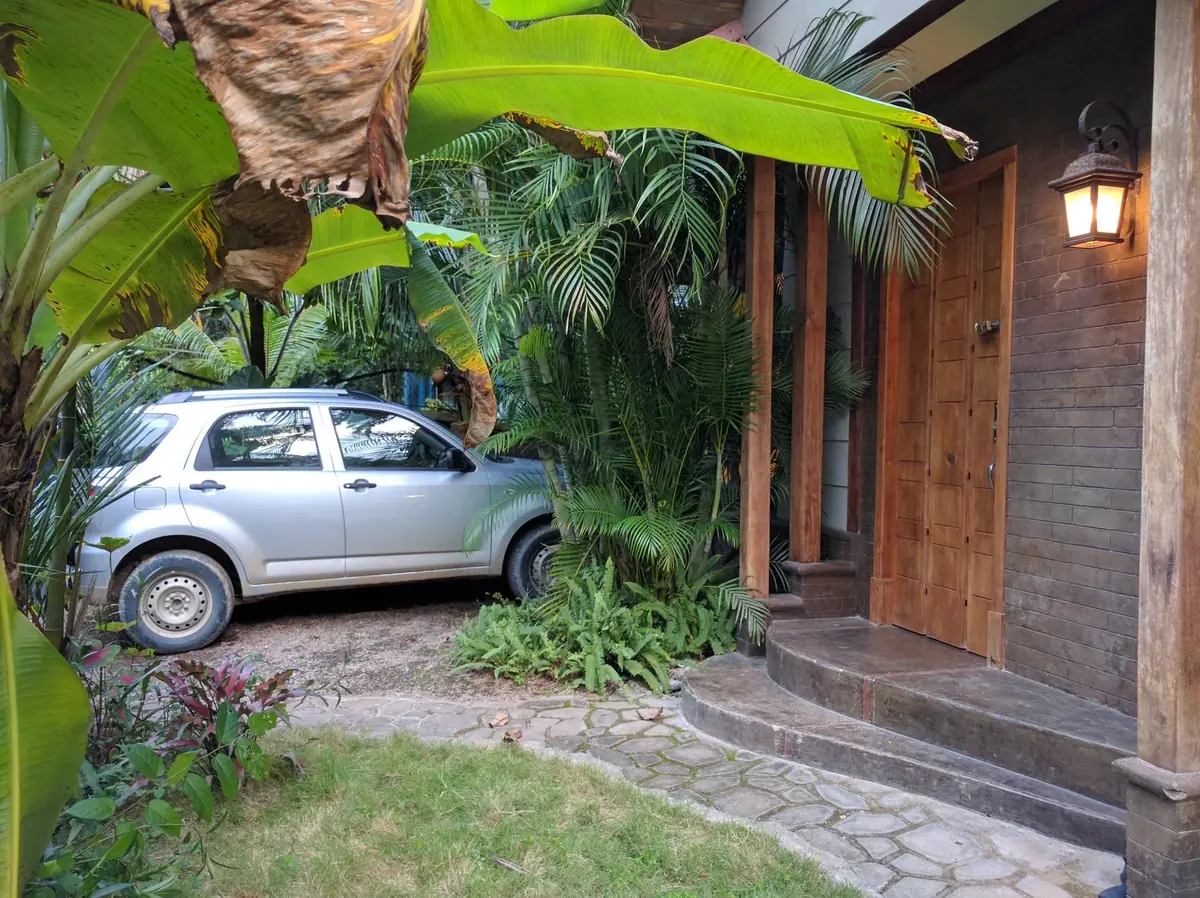
A house in Mal País. Photographed in October 2016. The luxury-home tax depends on the current official value of the construction, not on a photograph.
The Impuesto Solidario para el Fortalecimiento de Programas de Vivienda (Law 8683) is a national tax, collected by the Ministry of Finance, on homes used habitually, occasionally or for recreation.
The test is the house, not the land. In 2026, a home owes nothing if the fiscal value of its construction and permanent fixtures is ₡143,000,000 or less (article 6, as updated for 2026 by Decree 45358-H, published in La Gaceta on 19 December 2025). That's about $319,000 at ₡448.34. Above that line, the land value is added and the whole fiscal value is taxed in progressive bands. Each band's rate applies only to the slice of value inside it (article 5):
| Fiscal value of the property (2026) | Rate on that slice | About, in US$ at ₡448.34 |
|---|---|---|
| Up to ₡359,000,000 | 0.25% | up to ~$800,700 |
| ₡359M – ₡720M | 0.30% | ~$800,700 – $1.61M |
| ₡720M – ₡1,081M | 0.35% | ~$1.61M – $2.41M |
| ₡1,081M – ₡1,443M | 0.40% | ~$2.41M – $3.22M |
| ₡1,443M – ₡1,800M | 0.45% | ~$3.22M – $4.01M |
| ₡1,800M – ₡2,162M | 0.50% | ~$4.01M – $4.82M |
| Above ₡2,162M | 0.55% | above ~$4.82M |
Things to know:
- It's a self-assessed tax. The 2026 deadline to file and pay was 15 January 2026 (Ministry of Finance notice). A sworn declaration of the property's value is due every three years, in the first 15 days of January (article 7).
- The value is a fiscal value. It's worked out with the Ministry of Finance's valuation manual (article 10). It isn't your purchase price, and it isn't a broker's estimate.
- Concession holders pay too. Holders of Maritime Zone concessions are taxpayers like owners (article 3).
- Buyers inherit the current year. A new owner is jointly liable for the current year's tax plus interest (article 7), so the seller's filings are checked before closing. The lawyer we introduce does this as part of due diligence.
- It isn't deductible against income tax (article 13).
- The thresholds are updated every year by decree, so the 2027 figures will differ from these.
What will I pay in a year? Three worked examples
These assume the fiscal value equals the figures shown and that the municipality has the same value on file. Your real numbers depend on the official valuation.
| A. Hillside house | B. Ocean-view home | C. Estate | |
|---|---|---|---|
| Construction value | $250,000 (₡112.1M) | $450,000 (₡201.8M) | $1,000,000 (₡448.3M) |
| Land value | $50,000 | $150,000 | $500,000 |
| Total fiscal value | $300,000 (₡134.5M) | $600,000 (₡269.0M) | $1,500,000 (₡672.5M) |
| Construction over ₡143M? | No | Yes | Yes |
| Municipal tax, 0.25% | $750 | $1,500 | $3,750 |
| Luxury-home tax | $0 | ₡672,510, about $1,500 (all in the 0.25% band) | ₡897,500 on the first ₡359M + ₡940,530 on the next ₡313.5M = ₡1,838,030, about $4,100 |
| Total a year | about $750 | about $3,000 | about $7,850 |
Example B shows the cliff. Once the house crosses the line, the land is taxed too, so the luxury-home tax starts at roughly the same amount as the municipal tax.
Do I pay tax when I sell?
Yes. Since 1 July 2019, when the income-tax reform in Law 9635 took effect, gains on real estate are taxed at 15% (Income Tax Law 7092, article 31 ter). The details that matter:
- Bought before 1 July 2019? On the first sale of that property, the seller can instead choose to pay 2.25% of the sale price (article 31 ter).
- Your habitual home is exempt. A gain on the sale of the taxpayer's habitual home is exempt (article 28 bis). So is a home held in a company, when it is clearly the owners' habitual home. Holiday homes and rentals don't qualify.
- What counts as the gain. The acquisition value includes improvements and the taxes paid on the purchase, and is indexed to inflation. The seller's own sale costs are deducted too (article 30 bis).
- Non-resident sellers have 2.5% withheld. When the seller isn't domiciled in Costa Rica, the buyer must withhold 2.5% of the total price and pay it to the Ministry of Finance as a payment on account of the seller's tax (article 28 ter). The Registry won't record the transfer until it has been paid. The gain is declared and paid within the first 15 days of the following month.
Example: a non-resident buys a holiday home for $500,000 in 2027 and sells it for $700,000. The buyer withholds $17,500 (2.5% of $700,000). Fifteen percent of a $200,000 gain is $30,000, so the seller would owe about $12,500 more. Inflation indexing and deductible costs reduce the gain. Have an accountant prepare the return, including any claim for excess withholding.
Transfer tax. Every purchase pays a 1.5% transfer tax (Law 6999, article 8). It's charged on the real value of the sale, and never on less than the registered value (article 7). By law the buyer and seller owe it in equal parts and are jointly liable for it (article 6). The other deed costs (fees, stamps and registration duties) are also split equally unless the parties agree otherwise, under article 68 of the notaries' fee schedule, Decree 41457-JP. Our How-to-Buy guide has the full closing-cost table.
How is rental income taxed?
Rent is taxed as income from real-estate capital (Law 7092, article 27 ter). It's taxed at 15% (article 31 ter) after a flat 15% deduction that needs no receipts (article 29), so the effective rate is 12.75% of gross rent. On $1,000 of rent, you'd pay $127.50. You file and pay within the first 15 days of the month after the income.
Owners who have at least one employee for the rental can instead choose to be taxed under the regular profits regime. They must tell the Ministry of Finance before the fiscal year starts and stay in the regime for at least five years (article 28).
VAT. Short stays carry 13% VAT (VAT Law 6826, article 10). You add it to the guest's price, invoice electronically and declare it monthly. Long-term rental of a home is exempt when the monthly rent is no more than 1.5 base salaries. In 2026 that's ₡693,300, about $1,550 (article 8, item 9; 2026 base salary ₡462,200). Above that, VAT applies to the whole rent.
Two registrations apply to holiday rentals:
- ICT and the Ministry of Finance. Under article 8 of Law 9742 of 2019, anyone offering non-traditional lodging such as an Airbnb must register with the Costa Rican Tourism Institute and with the Ministry of Finance. Operating without registration is illegal under article 14.
- Platform reporting. Under resolution MH-DGT-RES-0025-2024, platforms have collected each host's identity, tax ID, property and payout details since 1 January 2025. They report them to the Ministry of Finance every year, and the first report was due by 30 April 2026. If you rent without filing, the Ministry now has the data.
For what this does to the numbers on a typical Cóbano rental, see our Vacation Rental ROI guide.
What if I own through a corporation?
You pay the same property taxes, plus a yearly tax on legal entities (Law 9428), due in the first 30 calendar days of January (article 4). In 2026 the deadline ran to 2 February (Ministry of Finance notice).
The tax is a share of the base salary (article 3). For 2026:
- 15% for an inactive company: ₡69,330, about $155
- 25%, 30% or 50% for active companies, depending on gross income: ₡115,550 to ₡231,100
Three consecutive unpaid years are grounds for dissolving the company (article 7). A property sitting in a dissolved company is exactly the kind of record fraudsters look for; see our guide to buying safely. Selling the shares of a property-owning company also counts as a transfer of the property and pays transfer tax (Law 6999, article 2).
Is property tax going up?
Not now. Bill 25.239, filed in the Legislative Assembly on 9 October 2025, proposes raising the property-tax rate to 0.75% (0.50% in the first year), with the municipalities keeping 0.25% and the rest going to the central government. It's a bill, not law: Law 7509, article 23, still sets the rate at 0.25% on SCIJ, the official legal database, as of 17 November 2026, and the bill is still in the Economic Affairs committee.
Key dates for owners
| When | What | Who |
|---|---|---|
| By 15 January | Luxury-home tax: file and pay | Ministry of Finance |
| First 30 days of January (2 Feb in 2026) | Tax on legal entities, if you own through a company | Ministry of Finance |
| Yearly, half-yearly or quarterly, as your municipality sets | Municipal property tax, 0.25% | Municipality |
| By the 15th of each month | Rental income tax and VAT for the previous month | Ministry of Finance |
| At least every 5 years | Declare the property's value to the municipality | Municipality |
| Every 3 years, first 15 days of January | Sworn valuation for the luxury-home tax | Ministry of Finance |
| At sale | 15% on the gain, or 2.25% of the price for pre-July-2019 purchases; 2.5% withheld from non-domiciled sellers | Ministry of Finance |
Frequently asked questions
What is the property tax rate in Costa Rica?
0.25% a year of the value registered with the municipality. It's the same nationwide, and the same for foreigners (Law 7509, art. 23). A property registered at $300,000 pays about $750.
What is the luxury tax in Costa Rica in 2026?
The impuesto solidario applies when a home's construction value is above ₡143 million, about $319,000 at ₡448.34 per dollar. The whole property is then taxed in progressive bands from 0.25% to 0.55%. The 2026 deadline was 15 January.
Do foreigners pay more property tax in Costa Rica?
No. Both property taxes fall on the owner at the same rates, whatever their nationality.
Is there capital gains tax on property in Costa Rica?
Yes. Since July 2019 it's 15% of the gain, or 2.25% of the price on the first sale of property bought before then. A gain on your habitual home is exempt, and buyers withhold 2.5% of the price when the seller isn't domiciled in Costa Rica.
How much tax do I pay on Airbnb income in Costa Rica?
An effective 12.75% of gross rent (15% after a flat 15% deduction), filed monthly, plus 13% VAT charged to guests. You also need to register with the ICT and the Ministry of Finance under Law 9742.
Where these facts come from
All on SCIJ (Sistema Costarricense de Información Jurídica) unless noted, checked on 15 November 2026; the 2026 luxury-tax threshold and bands and the bill's status were checked again on 17 November 2026.
- Municipal tax: Law 7509, arts. 16, 22, 23; Cóbano council, property tax.
- Luxury-home tax:
- Law 8683, arts. 3–7, 10, 13.
- The 2026 thresholds were set by Decree 45358-H, La Gaceta 239, 19 Dec 2025.
- Ministry of Finance notice, 2026 deadline.
- Transfer tax and deed costs: Law 6999, arts. 2, 6, 7, 8; Decree 41457-JP, art. 68.
- Capital gains and rental income:
- Law 7092, arts. 27 ter, 28, 28 bis, 28 ter, 28 quáter, 29, 30 bis, 31 ter.
- The income-tax reform's effective date is in Law 9635.
- VAT: Law 6826, arts. 8 and 10; base salary 2026, Ministry of Finance.
- Holiday-rental registration: Law 9742, arts. 8 and 14; MH-DGT-RES-0025-2024.
- Companies: Law 9428, arts. 3, 4 and 7; Ministry of Finance notice, 2026 deadline.
- Exchange rate: Banco Central de Costa Rica, selling rate ₡448.34, 15 Nov 2026.
Ready to Find Your Dream Property?
Explore our curated selection of properties in Costa Rica's beautiful Nicoya Peninsula.
Explore Properties