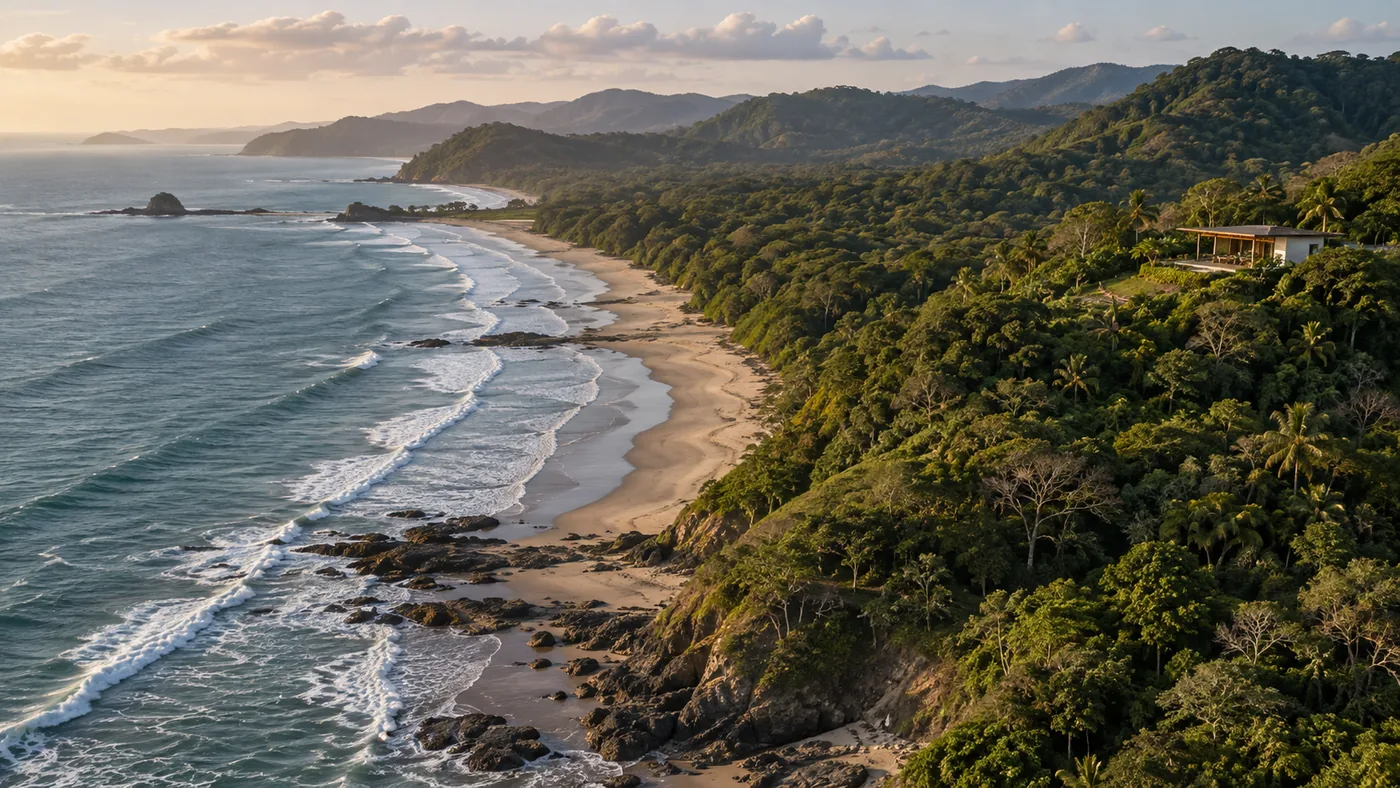
Beachfront Property on the Nicoya Peninsula: What "Beachfront" Legally Means Before You Pay for It

Every few weeks someone sends us a listing from another site with the word beachfront in the title and asks why it is so cheap. The answer is almost never the roof or the road. It is a line drawn 200 meters up the sand in 1977, and which side of it the property sits on.
This is the guide we wish we could hand every buyer before that first phone call. It is not a legal opinion (you will need a Costa Rican lawyer for that, and we say so again at the end), but it is the plain version of what "beachfront" means here, what it actually costs to hold, what the municipality and the courts have been doing about it lately, and why a surprising number of clients who came looking for sand end up buying the hill above it on purpose.
The 200-meter line
Costa Rica's coast is governed by the Maritime Zone law, Ley 6043 of 1977. It draws two bands from the ordinary high-tide mark:
- 0 to 50 meters: the public zone. Nobody owns it. Nobody builds on it. It belongs to everyone, which is why you can walk every beach in the country.
- 50 to 200 meters: the restricted zone. This is what most listings mean by "beachfront." The State owns it. The local municipality can grant a concession (a lease of between five and twenty years under Article 48, renewable) to use it.
Land beyond 200 meters is ordinary titled property. You own it the way you would own a house in Denver or Manchester: outright, in the National Registry, with a deed.
So the first question about any beachfront listing is not the price. It is: which band is it in, and if it is in the restricted zone, does a concession actually exist?
What a concession is, and is not
A concession is a right to use State land for a period, for a purpose, under conditions. It is real and it is valuable. It is also not ownership, and the differences show up in ways that surprise people.
You cannot hold one as a recent arrival. Article 47 of the law bars concessions to foreigners who have not been legal residents for at least five years, and to companies with more than half their capital in foreign hands. The common workaround (a Costa Rican majority partner, or a local trust) works, and it introduces exactly the kind of counterparty risk a lawyer exists to manage. Ask how the structure unwinds if the partner dies, divorces, or simply disagrees with you.
You pay rent on it. Instead of property tax, a concession carries an annual canon paid to the municipality in quarterly instalments. Officium Legal's plain-language summary of the rules puts the rate at 0.75% to 3% of assessed value for residential use and 1% to 4% for hotel or tourism use, set by the municipality. On a $900,000 assessment that is somewhere between $6,750 and $36,000 a year, every year, for as long as you hold it. Ask for the current canon in writing before you make an offer.
It needs a zoning plan to exist. Municipalities can only grant concessions where a plan regulador costero (a coastal zoning plan) has been approved and published. On our stretch of coast the picture is uneven. The Cabuya–Montezuma sector has had an integrated plan in force since its publication in La Gaceta in September 2016, after the Costa Rican Tourism Institute approved it that April, and Playa Santa Teresa has its own. Mal País, Playa Carmen, Playa Hermosa and Manzanillo have sector plans too, most published between 2001 and 2005, and the Tourism Institute still listed them as approved in August 2025.
The council keeps granting concessions under those plans. It approved a new twenty-year concession in Mal País in February 2026 and another in Manzanillo in April. The current plans from Mal País to Manzanillo lack environmental viability from SETENA, the national environmental review agency: a councillor said so at a council session in August 2026 and the district intendant confirmed it. No court has annulled or suspended them. Whether that affects a concession you are looking at is a question for your lawyer.
Some of the coast has no plan at all: the council's own internal audit of October 2024 found large parts of the maritime zone it administers without one. The gaps include the north end of Playa Manzanillo past boundary marker 302 and some sectors toward the Cabo Blanco reserve. There, no new concession can be granted, whatever a seller tells you about being "next in line." The council has started work on a single plan for the whole coast from Mal País to Manzanillo, but that plan is not in force yet.
It expires, and the deadline is unforgiving. Renewal is normal and usually granted, but the request has to be filed within three months of the municipality's notice of expiry. Miss that window and your renewal is legally treated as a brand-new application, back at the end of the queue. And if a concession lapses without renewal, the land and everything built on it revert to the municipality.
Banks treat it differently. You cannot mortgage what you do not own. Concession properties are almost always cash purchases, and that shrinks your buyer pool on the day you sell.
Transfer needs permission. Under Article 45, selling a concession requires the express authorisation of the municipality and the Tourism Institute. It happens; it is slower and less certain than a title transfer, and the new holder has to clear the same five-year residency test you did.
None of this makes concession property a bad purchase. Some of the best-run hotels on this coast sit on concessions and have for decades. It makes it a different purchase, priced differently. And the discount you noticed on that listing is the market pricing exactly these things.
What has been happening in Cóbano lately
This is the part most guides leave out, and it is the part that has changed the most.
In two letters dated 27 September and 30 October 2024, the Procuraduría General (the State's attorney) reminded the council that the Cóbano municipality cannot grant or renew concessions on Maritime Zone land that holds forest or wetland, because that land is State Natural Heritage and belongs under the national conservation system, not the town hall. The case behind the letters came from Playa Hermosa, where a residents' association reported five concessions. One of the parcels showed 99.3% forest cover in a 2023 survey. The concession on it had been granted in 2004; the forest was formally certified as natural heritage in 2018. Asked what would happen to any buildings on these parcels, Álvaro Sagot, the environmental lawyer handling the association's legal actions, told Semanario Universidad that because the land belongs to the State and should never have been conceded, lo procedente es la demolición (the proper course is demolition).
That fight is still in the courts: in August 2026 the Constitutional Court admitted a challenge by the Playa Hermosa association to the Forest Law regulation that allows low-impact tourism on State Natural Heritage land. But the direction of travel is clear, and the municipality has moved with it. The same March 2025 minutes record that Cóbano formally notified every concession holder and applicant that occupying the public 50-meter zone is illegal, met with the tourism chamber to explain why, and began physically clearing public zone that had been fenced or built on.
What this means for a buyer is simple. A concession that touches forest, wetland, or the public zone now carries a risk that did not show up in the paperwork five years ago. If a listing in the zone looks like a bargain, ask whether any of those three words apply to it.
The three kinds of "beachfront" you will actually see
Sort any coastal listing into one of these before you fall for the photographs.
1. Titled land at or near the beach. Rarer than the marketing suggests, but real. Some parcels were registered before the 1977 law and kept their titles; pockets of coastline in Cabuya and around Tambor are like this. A titled parcel that touches the sand is the closest thing to a unicorn on this peninsula, and it is priced like one. If a listing claims this, the proof is a title study (estudio registral) showing a folio real, not a seller's assurance.
2. A concession that exists. The property sits in the restricted zone and a concession has been granted, is current, matches the use, and sits in a sector with an approved zoning plan. This is a legitimate, established category. Your lawyer verifies the concession, its expiry, its canon, its permitted use, whether the structure holding it can be transferred to you, and whether any of it is forest or wetland.
3. "Beachfront, no concession yet." We have one of these on our shelf right now, listed honestly as exactly that: a beachfront home in Montezuma at $400,000 whose title field reads Beachfront – No Concession Yet. What you are buying is possession, a building, and the right to apply. Whether the application succeeds depends on a zoning plan, a municipality, and time. Price it as an option, not as a house.
We list all three because all three sell. We label them because the label is most of the information.
What it costs here right now
Two sets of numbers, because one set on its own would mislead you.
The first is the wider market. Santa Teresa is the most expensive beach market on this peninsula and one of the most expensive in the country. The regional MLS snapshot for August–September 2026 shows about 200 active listings there at an average asking price of $1.56 million and $4,303 per square meter. And that is asking, not sold. Those figures are dominated by hillside villas and estates, not by the Maritime Zone, because very little in the zone ever comes to market.
The second set is our own active listings this month, across the whole southern peninsula. They move; the pattern does not.
| What you are buying | Listings on our shelf | Median asking | Range |
|---|---|---|---|
| Titled, walking distance to a beach | 25 | $525,000 | $170,000 – $4.2M |
| Titled, ocean view | 34 | $662,500 | $185,000 – $4.7M |
| Titled, premium ocean view | 6 | $2.3M | $750,000 – $7.2M |
| Actually inside the Maritime Zone | 3 | — | $400,000 – $900,000 |
Read the last row twice. Across roughly fifty ocean-view and beach-walk listings, three sit inside the 200-meter zone. Two are in Montezuma. The third is a beachfront lot in Cabuya on a concession at $500,000, with public water already connected (which on this coast is a bigger deal than the beach). Of the Montezuma pair, one is a small hotel on the beach at $900,000 where the concession has been applied for but not yet granted.
That scarcity is not because we avoid the zone. It is because the zone is narrow, most of it is unbuildable public land, and the buildable part has been spoken for since before most of today's buyers were born.
The case for the hill
This is the conversation we have more than any other with beachfront buyers, and it usually ends with them buying something 100 to 400 meters uphill.
The view is better. From the sand you see the sea. From the ridge you see the coastline, the reserve, and the sun going down behind Cabo Blanco. An ocean-view lot 500 meters from Montezuma town at $185,000 is titled, on a public road, and looks at more water than most concession lots do.
The salt is expensive. Every hinge, every appliance, every reinforcing bar in your concrete is in a fight with the Pacific, and the Pacific wins. A May 2026 maintenance-cost breakdown from a Pacific-coast property manager puts coastal exterior upkeep 20–30% above an equivalent inland home: exterior repainting every two to three years at $2,000–$5,000 a cycle, against four to five years inland; roof inspections twice a year, before and after the rains; and an all-in budget of 1.5–3% of the property's value per year. On a $300,000 home they estimate $1,600–$2,400 a month at the coast against $1,200–$1,800 a few hundred meters up. Add the canon if it is a concession, and the running-cost gap between the sand and the ridge is not small.
The legal structure is simpler. Titled land, in your name or your company's, in the Registry: mortgageable, transferable on your say-so, with no renewal date on the calendar and no forest survey that can reopen the question of whether you should be there at all.
The money goes further. The median titled ocean-view listing on our shelf is $662,500. That buys a real house with a real view. Inside the zone, $662,500 buys a concession, a structure, a canon, and a lawyer's retainer.
Some buyers want the sand under the deck and nothing else will do. That is a legitimate want, and we will help you find it and tell you exactly what you are getting. Most buyers, once they understand the trade, want the hill.
Before you sign anything
The checklist we walk through on every coastal property, in this order, because each step can end the conversation:
- Where is the 200-meter line on this parcel? Get a surveyor's measurement from the high-tide mark. Sellers' estimates are optimistic in a consistent direction.
- Title study. Titled or concession? If concession: current, in whose name, expiring when, for what use, at what canon?
- Zoning plan. Is a plan regulador costero approved and published for this sector? Cabuya–Montezuma and Playa Santa Teresa, yes. Mal País to Manzanillo, yes for the main beaches, each under its own sector plan, with some stretches left uncovered, so ask which plan applies and which boundary markers (mojones) the parcel sits between. Where there is no plan, no new concession is possible, whatever anyone tells you.
- Forest, wetland, public zone. Any of the three can block a concession or its renewal. The public zone was never open to concessions, and the Procuraduría's 2024 letters reminded the council that forest and wetland are State land it cannot concede. Ask for the SINAC certification status, not the seller's opinion.
- Water. Our land buyer's guide covers this properly; the short version is that "the neighbor shares water" is worth nothing at the permit office.
- Access. A public road, or a registered easement with a document behind it. Beach access across someone else's land is not access.
- The holding structure. If you are not a five-year resident, how will the concession be held, and what happens to it when the Costa Rican partner's circumstances change?
- Walk it in October. Rainy season tells you what the drainage, the road and the seawall are actually made of.
We put title status, water and access on every listing we publish, and where the honest answer is "no concession yet" or "water pending," we write that, because a buyer who finds out at the notary's office is not a client we keep.
If you have a specific coastal property in mind, ours or anyone's, send it to us. We will tell you which band it is in and what that means, before you pay a lawyer to hear the same thing.
Where these numbers come from
- The law itself: Ley 6043, Ley sobre la Zona Marítimo Terrestre, Articles 45, 47 and 48, and the Tourism Institute's ZMT page.
- Canon rates, renewal deadlines and what happens on expiry: Officium Legal's explainer on ZMT concessions.
- Zoning-plan status and public-zone clearance: Cóbano Municipal Council, extraordinary session 16-2025, 10 March 2025.
- Sector plans from Mal País to Manzanillo: Costa Rican Tourism Institute, coastal zoning plan status list, 4 August 2025; Cóbano municipality, coastal zoning plans.
- Concessions granted under those plans: Cóbano Municipal Council, session 95-2026, 24 February 2026; session 101-2026, 7 April 2026.
- Sectors with no plan: Cóbano Municipal Council, extraordinary session 011-2024 (internal audit AIM-04-2024), 30 October 2024; Cóbano Municipal Council, session 004-2024; Constitutional Court ruling 2025-021667, with the council's sworn list of coastal plans.
- SETENA viability of the current plans: Cóbano Municipal Council, session 118-2026, August 2026.
- Cabuya–Montezuma zoning plan approval and publication dates: Costa Rican Tourism Institute, coastal zoning plan status list, October 2018.
- The Procuraduría's letters of 27 September and 30 October 2024 and the Playa Hermosa concessions: Semanario Universidad, 2 December 2024.
- The Playa Hermosa association's challenge to the Forest Law regulation: Constitutional Court, admitted 21 August 2026.
- Santa Teresa market figures: 2 Costa Rica Real Estate MLS, Santa Teresa market insights, period 6 August – 6 September 2026.
- Coastal maintenance costs: Osa Property Management, 23 May 2026.
- Our shelf: live listings on this site as of the week of publication.
Tierra Tropical is a real estate agency based in the Cóbano district of Costa Rica's southern Nicoya Peninsula, covering Montezuma, Santa Teresa, Mal País, Cabuya, Delicias and Tambor. Nothing here is legal advice; a Costa Rican attorney should review any Maritime Zone purchase.
Ready to Find Your Dream Property?
Explore our curated selection of properties in Costa Rica's beautiful Nicoya Peninsula.
Explore Properties