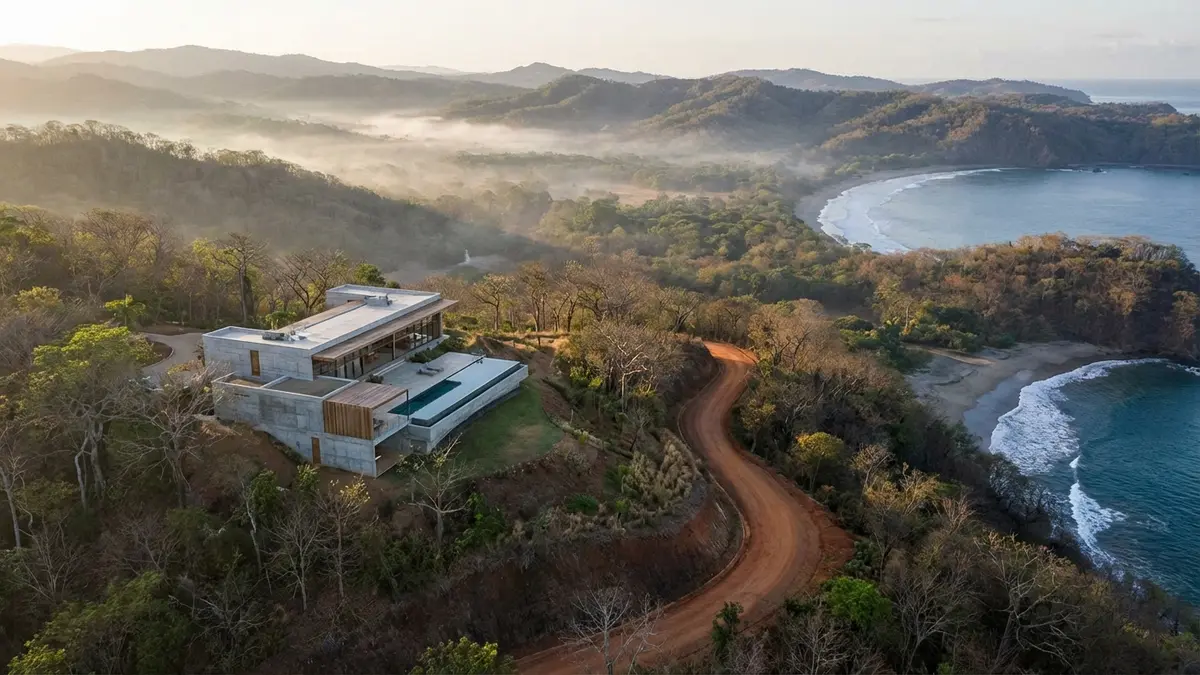
When to Buy Property on the Southern Nicoya Peninsula: Timing, Trends, and What the Market Actually Looks Like in 2026

There is no public record of sale prices by month on the southern Nicoya Peninsula, so any article that tells you green-season buyers get a precise discount is inventing the precision. An earlier version of this one did. What can be said honestly about timing is still useful: the climate has a documented calendar, tourism has a documented season, the listing data has a stated period, and three things that changed in 2026, the exchange rate, the residency law and the size of the inventory, each move the answer to "when." This is the timing conversation with those on the table and nothing else.
The calendar the weather sets
Costa Rica's meteorological institute divides the country into climate regions, and this peninsula is the Pacífico Norte. Its regional climatology is simple: a dry season from roughly December to April, with February the driest month; a rainy season from May to November with two peaks, in June and in September to October, separated by the drier weeks of July and August that Costa Ricans call the veranillo; and October usually the wettest month of the year.
That calendar is the single most important input to timing a purchase here, for a reason that has nothing to do with price. A property on this coast should be seen in the rain. Where the runoff goes on a hillside lot, whether the access road holds, whether the roof and the drainage were built for a September downpour, whether the internet survives a storm: none of that is visible in February. The engineers' college reported in May 2026 that water availability is the constraint stalling construction nationally, and the dry season is also when a well or a spring looks least honest. Inspect between June and October. Close whenever you like.
The calendar tourism sets
High season on this coast is the dry season plus Christmas. The hoteliers' association projected 72 percent occupancy for the Puntarenas coast for the 2025 to 2026 year-end period, against 88 percent for Guanacaste, and short-term rental data for the Cóbano district shows an annual average of 35.9 percent occupancy at $291 a night, which tells you how much of the year is the other season. National arrivals were flat in 2025, 2,943,991, up 0.8 percent, then started 2026 strongly, 653,969 in January and February, up 10.4 percent.
For timing, two consequences. If you intend to rent, a house bought and furnished by October is live for the December season; a house bought in January misses most of it. And sellers of rental houses know their own calendar: the owner who has just banked a high season is less motivated in April than the owner staring at a September of empty nights. That is not a discount you can quantify. It is a negotiation you can have.
The calendar the market sets, as far as it can be documented
The only town-level dataset with a stated period is the regional MLS. For August 6 to September 6, 2026 it shows 200 active listings in Santa Teresa at an average asking price of $1,556,379 and $4,303 per square meter, with the average down 1.5 percent on August; 27 in Mal País at $2,523,608; 8 in Montezuma at $637,468; 12 in Manzanillo at $493,929. Inventory in Santa Teresa grew through 2025 and is large now. That is the whole documented picture, and it is enough to say that a buyer in September 2026 has choice and leverage, and not enough to say by how much.
Our own shelf is where we can be exact: this week we have 49 listings in Montezuma at a median of $499,000, 25 in Delicias at $400,000, 29 in Cabuya at $360,000, and only one in Santa Teresa proper. Entry has moved inland and south. The Montezuma guide, Delicias guide and Cabuya guide have those shelves in detail.
Three things that changed the answer in 2026
The colón. It traded near ₡510 to the dollar in January and near ₡448 in early September. Property is priced in dollars, so the purchase itself has not moved; construction, labor, materials and every local bill are in colones and now cost a dollar buyer roughly 12 percent more than at New Year. If you are buying a lot to build, the exchange rate is a bigger timing variable than the season, and it is one nobody on this coast controls.
The residency law. The Law 9996 incentives, including the $150,000 investor threshold, expired on July 14, 2026, and the threshold now sits in a legal gap with the regulation's $200,000 floor as the working assumption; our investor visa guide has the position. Applications filed before the expiry kept the old rule. Anyone who was timing a purchase around residency has already missed that window and should now buy for the property and let the lawyer sort the category afterward.
The rules on renting. Ley 9742 requires every short-term host to register with the Tourism Institute and Hacienda, and from 2026 the platforms report income to the tax authority directly. A house bought as a rental in 2026 is bought into a compliant market with a 12.75 percent effective tax on gross rent and 13 percent VAT on the guest. That does not change when to buy. It changes what a rental projection has to include, and our ROI article has the worked version.
What has not changed
Foreigners own titled land on the same terms as citizens, the first 200 meters of coast is the State's under Ley 6043, closing runs about 3 to 3.5 percent in tax, stamps and notary, property tax is 0.25 percent, and the solidarity tax starts above ₡143 million of construction value, about $319,000. None of that is seasonal. Our how-to-buy guide has the process and the fees.
A practical answer
If you are optimizing for certainty about the property, look in the dry season and inspect in the rain, which means a first visit between January and April and a second between June and October before you release the deposit. If you are optimizing for negotiation, make your offer between June and September, when the seller has not had a viewing in weeks and the road has reminded them what they are selling. If you are optimizing for rental income, be closed and furnished by October. If you are building, watch the colón as closely as the calendar. And if you are waiting for a correction, know that nobody can show you the sales data that would tell you one has arrived; on this coast the honest signal is the inventory, and right now there is a lot of it.
If you want to know what your budget buys this month rather than this season, ask us. The shelf changes weekly and we would rather send you three real listings than a theory.
Where these numbers come from
- Climate: Instituto Meteorológico Nacional, regionalización climática de Costa Rica.
- Tourism: Cámara Costarricense de Hoteles, December 16, 2025; La Nación, January 15, 2026; La República on ICT figures, January to February 2026; AirROI, Cóbano, July 30, 2026.
- Listings: 2 Costa Rica Real Estate market insights for Santa Teresa, Mal País, Montezuma and Manzanillo, August to September 2026. Our shelf: live listings on this site, week of September 8, 2026.
- Water: Revista CFIA, May 18, 2026.
- Exchange rate: Wise USD/CRC history.
- Rules and taxes: ERP Lawyers on Ley 9742, July 22, 2025; Siempre al Día, capital income tax 2026; AG Legal, solidarity tax 2026; Ley 6043.
Tierra Tropical is a real estate agency based in the Cóbano district of Costa Rica's southern Nicoya Peninsula. Nothing here is investment advice, and we do not publish seasonal price figures we cannot source.
Ready to Find Your Dream Property?
Explore our curated selection of properties in Costa Rica's beautiful Nicoya Peninsula.
Explore Properties