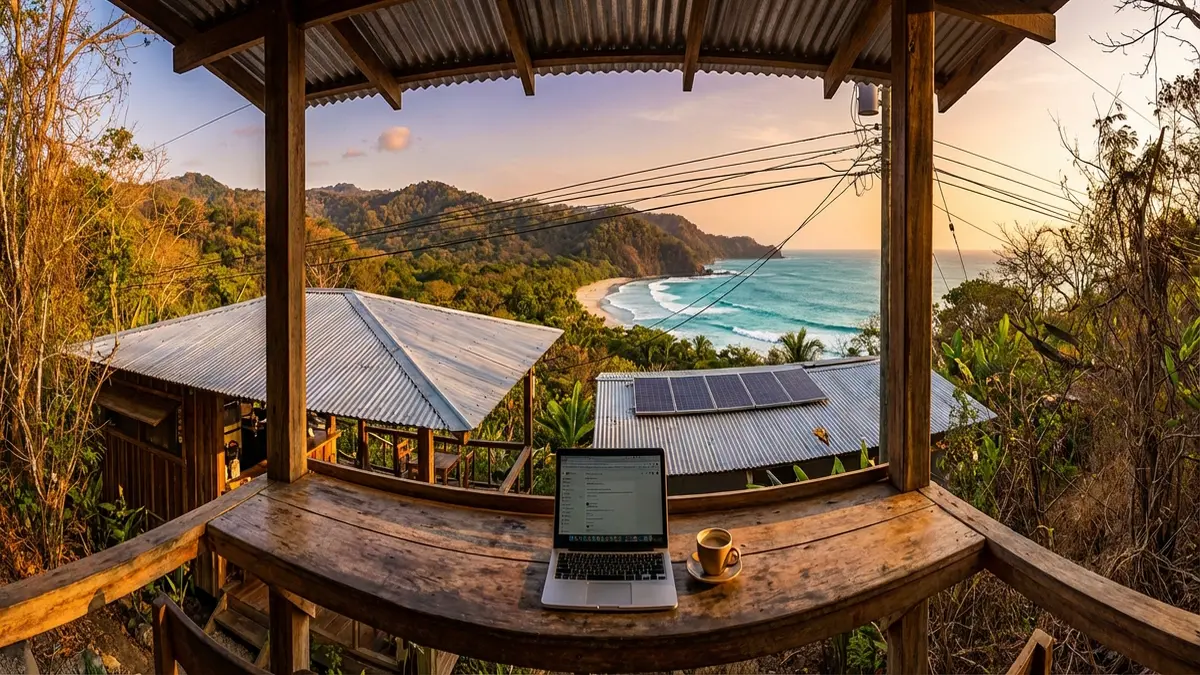
The Real Cost of Living in Santa Teresa, Costa Rica: A 2026 Field Guide for Expats and Remote Workers
The power went out again last Thursday. I was mid-Zoom call with an editor in New York, my laptop running on battery, and the ceiling fan slowly dying above me. My neighbor — a German UX designer who's been here three years — didn't even look up from his laptop at the café next door. He'd already switched to his phone's hotspot. This is Santa Teresa in 2026: a place where your morning surf session is world-class and your afternoon internet connection is a coin flip.
And yet. People keep coming. Not just tourists, but people who sell apartments in Austin and Berlin and Melbourne, pack a carry-on and a surfboard bag, and rebuild their lives on a dusty road at the bottom of the Nicoya Peninsula. The question most of them ask me — usually over a beer at Koji's, usually around their second week — is some version of: Can I actually afford to live here?
The answer is more nuanced than the Instagram accounts suggest. But it's also, for the right person, genuinely encouraging.
What $1,500 a Month Actually Gets You in Santa Teresa
Let's start with the number that matters most. A single person can live comfortably in Santa Teresa for roughly $1,200 to $2,000 per month, depending on how you define "comfortably" and how often you eat at Banana Beach. That range covers rent, food, transportation, a coworking membership, and enough left over for the occasional sunset cocktail that you probably deserve.
For context, that's significantly less than nearby Tamarindo, where expats typically spend $3,300 to $4,250 monthly — a gap explained largely by Tamarindo's more developed (some would say more commercialized) infrastructure. Santa Teresa's lower cost isn't a sign of lesser quality. It's a reflection of the town's identity: less resort, more raw.
Here's how the monthly budget typically breaks down:
- Rent (long-term furnished): $800–$1,800 for a one-bedroom to two-bedroom with an ocean view. Go inland a few hundred meters and you'll save 30%. Long-term furnished ocean-view homes range from $1,500 to $3,500/month, but plenty of expats find solid spots at the lower end, especially in green season (May through November) when landlords get flexible.
- Food: $300–$600. A casado at a local soda runs 3,500–5,000 CRC ($6–9). Cooking at home from the Cobano supermarket or the Saturday feria in town drops this further. Eating out at the nicer spots — Habanero, Drift — will push it up.
- Transportation: $50–$150. Most long-term residents buy a used ATV or motorcycle. Car rentals run $30–$45 per day, which adds up fast. Buses exist ($2–$20 per trip depending on distance), but the schedule is more of a suggestion than a promise.
- Coworking/Internet: $100–$200. Selina and a handful of smaller spaces offer monthly passes. Home internet has improved — Kolbi fiber reaches parts of town now — but don't expect big-city reliability.
- Health insurance: $75–$200. The Caja (Costa Rica's public healthcare system) covers residents for a monthly fee based on income. Private insurance through INS or international providers adds more but buys peace of mind, especially given that the nearest serious hospital is in Nicoya, about two hours on the Cobano road.
That last point deserves emphasis. This isn't a place with a walk-in clinic on every corner. The local facilities handle basics. Anything beyond that means a drive.
The Rental Market: What's Changed in 2025–2026
Two years ago, finding a decent long-term rental in Santa Teresa felt like a competitive sport. Landlords could charge whatever they wanted because demand from remote workers — flushed with pandemic savings and newly location-independent — far outstripped supply.
That's shifted. Inventory across the Nicoya Peninsula expanded significantly between September 2024 and August 2025, with Santa Teresa seeing 133 active property listings during that period. Nearby Tamarindo experienced a 50% increase in listings. The result: more options, more negotiating power for renters and buyers alike.
If you're looking to rent, the sweet spot is arriving in late April or early May. High season crowds thin out, short-term rental owners start thinking about filling gaps, and suddenly that $2,500/month two-bedroom with a pool becomes $1,800. I've watched this cycle repeat every year since I moved here.
The shift from a seller's market to a buyer's market on the Nicoya Peninsula has been the most significant change in the past 18 months. For renters and investors who've been priced out, this is the window.
Buying Property: The Numbers Behind the Hype
Not everyone comes to rent. A growing number of expats — particularly remote workers who've decided this is home, not just a phase — are buying. And the numbers tell an interesting story.
Average active listing prices in Santa Teresa hit $1.67 million in early 2026, up 12.7% year-over-year. Price per square meter sits at $4,251, putting it in the same tier as Hacienda Pinilla ($4,321/sq.m) and well above Tamarindo ($3,332/sq.m). Property values have roughly doubled since 2020, with annual appreciation averaging 10–15% through the pandemic recovery.
Those headline numbers can be misleading, though. The $1.67 million average is skewed by luxury listings — the kind of architecturally ambitious jungle villas that end up on design blogs. The actual range is wide:
- Building lots start under $100,000, particularly on the hills above Playa Carmen or further toward Mal Pais
- Turnkey two-bedrooms in central Santa Teresa list from around $485,000 to $800,000
- High-end retreats with pools, ocean views, and architectural pedigree push well past $950,000
A brand-new 120-square-meter, two-bedroom ocean-view villa delivered in February 2026 listed at $800,000 — no HOA fees, customizable finishes, surveillance systems designed for owners who split time between countries. That's the profile of the typical buyer here: not a retiree looking for a golf community, but a 35-year-old tech founder who wants to check the surf cam between meetings.
Why Prices Hold (and Why That Matters)
Zoning restrictions and environmental protections along the coast limit what can be built and where. You won't see a 20-story condo tower in Santa Teresa. Ever. That's not a bug — it's the feature that protects property values long-term. Scarcity is baked into the geography and the law.
But this same constraint means fewer options for buyers and a less liquid market than, say, Tamarindo or urban Panama City. If you need to sell quickly, that's harder here. Something to weigh seriously before signing anything.
For a deeper look at what's available, Tierra Tropical's Santa Teresa listings are a solid starting point — they specialize in this stretch of coast and know which properties have been sitting and which just hit the market.
How Santa Teresa Compares to Other Expat Destinations
The comparison question comes up constantly. Here's the honest version:
Versus Tulum, Mexico: Santa Teresa offers more authentic surf culture and stronger rental yields (10–15% annual appreciation versus Tulum's more volatile 8–12%). It also doesn't have Tulum's overdevelopment problems or security concerns. But Tulum has better restaurants and a direct international airport.
Versus Medellín or Cartagena, Colombia: Colombia wins on pure affordability — $800 to $1,500 monthly cost of living — and urban infrastructure. But you're comparing a city to a beach town. Different lives entirely.
Versus Bocas del Toro, Panama: Panama offers better retiree infrastructure and tax incentives through its pensionado visa. Santa Teresa counters with Costa Rica's digital nomad visa program, superior surf, and the Nicoya Peninsula's status as one of the world's five zonas azules — regions where people live measurably longer.
Santa Teresa isn't the cheapest option. It's the option for people who've decided that proximity to a consistent left-hand reef break and a 90-second walk to a yoga class are non-negotiable features of their daily life.
The Stuff Nobody Puts on Instagram
I'd be doing you a disservice if I didn't mention the friction.
Roads. The main road through Santa Teresa is paved now (a relatively recent luxury), but turn off it and you're on dirt and gravel that becomes genuinely challenging in rainy season. The drive from the Paquera ferry to Santa Teresa takes about two hours, and the Cobano road — while improved — still demands your full attention.
Healthcare. Basic. The EBAIS clinic handles routine stuff. For anything serious — a broken bone, an allergic reaction that needs monitoring — you're driving to Hospital de la Anexión in Nicoya or arranging transport to San José. Several expats I know keep a private evacuation membership through services like CIMA or Global Rescue. Not cheap, but worth the sleep.
Market risk. Inventory surged across the Nicoya Peninsula in 2024–2025. Early 2026 shows recovery signals — prices are up, transaction volume is climbing — but if foreign demand softens (say, a global recession or unfavorable exchange rate shifts), this market is more exposed than San José or the Central Valley. The 4.4% increase in average national sales prices to approximately $690,000 in 2025 suggests stabilization, not a boom. Know the difference.
Isolation. This is the southern tip of a peninsula. The nearest international airport is Liberia, roughly four to five hours by car (or a short domestic flight from Tambor). If you need to be somewhere fast, plan accordingly.
What 2026 Looks Like From Here
I'm writing this from a café where three people are on video calls, two are waxing surfboards, and someone's dog is asleep under a table. It's a Tuesday. This is the daily texture of expat life in Santa Teresa — not a vacation, but something more sustainable than that.
The cost of living in Santa Teresa in 2026 rewards a specific kind of person: someone comfortable with imperfection, drawn to nature over nightlife, and willing to trade urban convenience for the kind of empty Wednesday morning surf break that makes you wonder why anyone lives in a city. The financial math works if you earn in dollars or euros and spend in colones. The lifestyle math works if you know what you're optimizing for.
The market is in a genuinely interesting moment — inventory up, prices recovering, buyer leverage still real but narrowing. For anyone who's been circling the idea of buying property in Costa Rica or testing the remote work life on the Nicoya Peninsula, the conditions right now are about as favorable as they've been since 2020. Whether you're exploring a long-term move or just running the numbers, the window is worth paying attention to.
The power came back on, by the way. It always does.
Ready to Find Your Dream Property?
Explore our curated selection of properties in Costa Rica's beautiful Nicoya Peninsula.
Explore Properties