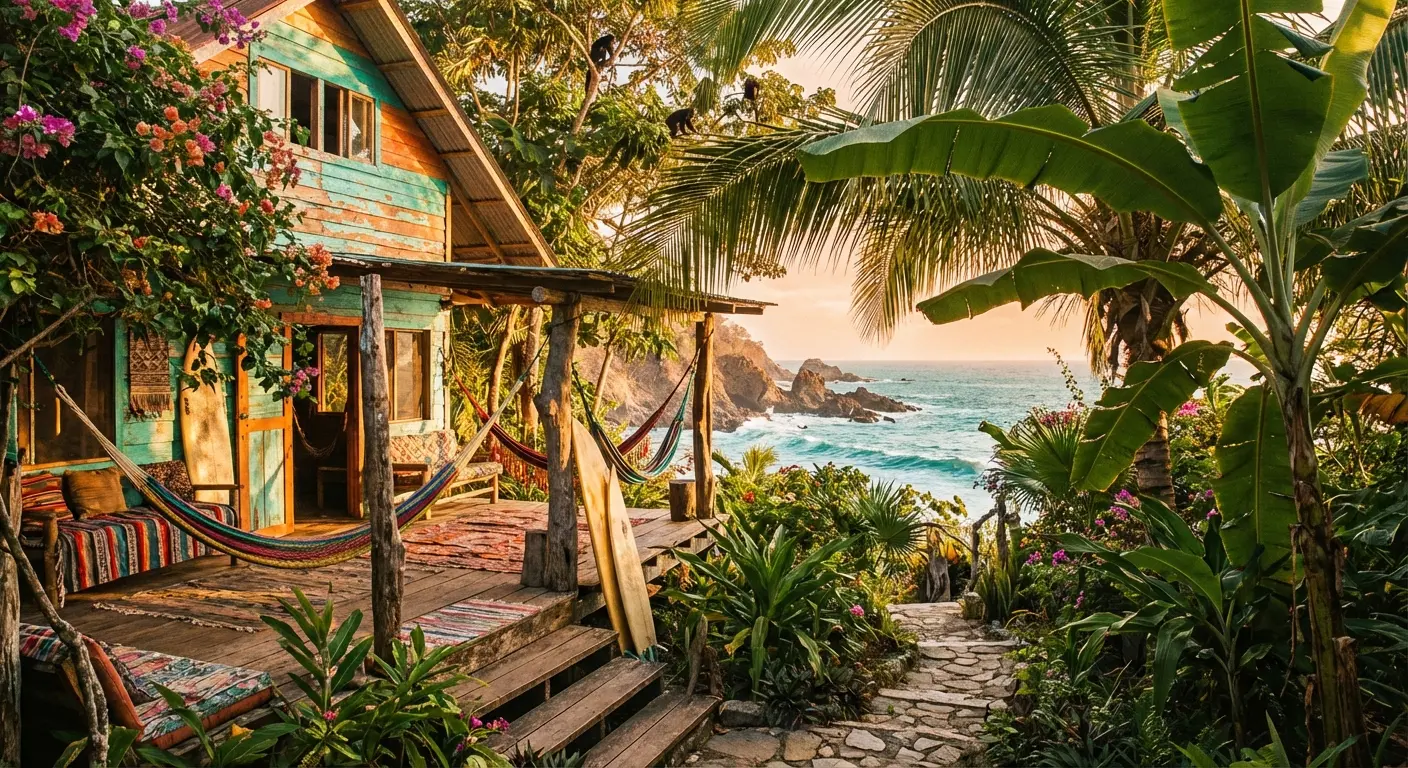
Montezuma Real Estate: What $400,000 Actually Buys You in Costa Rica's Most Bohemian Beach Town

People arrive at the $400,000 question from two directions. Some have seen Santa Teresa prices and want to know whether Montezuma is the same coast at a discount. Others have read something about "beachfront from $400,000" and want to know if that is real. The honest answers are yes, mostly, and no, not the way you are imagining. This is what that number buys in Montezuma right now, using our own active listings rather than a range somebody typed into a template, and with the sources at the end so you can check.
The shelf this month
We have 49 active listings in Montezuma with a median asking price of $499,000. Twenty-six are houses, from $300,000 up, with a median around $707,000. The ten houses with a genuine ocean view sit at a median just over $1 million. Twenty are lots, median $375,000, from $110,000.
So $400,000 is not the middle of this market. It is the entry to the house market and the middle of the land market. Concretely:
- A titled hilltop home with public water at $350,000. This is roughly what the floor for a house with a view looks like.
- A two-bedroom ocean-view house at $396,000, titled, with water.
- A three-bedroom home at $650,000, which is what the median house actually costs.
- A new ocean-view home with a rental apartment at $665,000, the kind of dual-use property investors ask us for first.
- A 5,000-square-meter titled lot with water at $125,000, which is the cheapest way into this town that we would put our name to.
For context, the regional listing service shows around 200 active properties in Santa Teresa at an average asking price of $1.56 million, with inventory there up about a third during 2025. Montezuma's median of $499,000 is the same coast at roughly a third of the price of its famous neighbor. That is the real discount, and it is a house-and-land discount, not a beach discount.
What "beachfront" means here
Of those 49 listings, exactly two sit inside the Maritime Zone. One is a two-bedroom beach house at $400,000 whose title field on our site reads "Beachfront, No Concession Yet," which means you would be buying possession, a building, and the right to apply. The other is a small hotel on the beach at $900,000, where the concession has been applied for but not granted. Everything else we sell in Montezuma is titled land uphill of the zone.
That ratio is not an accident. Under Ley 6043, the first 50 meters from the high-tide line is public and the next 150 is State land held only on a municipal concession of five to twenty years, which a foreigner cannot hold until they have been a legal resident for five years. The Cabuya-Montezuma coastal zoning plan has been in force since La Gaceta published it in September 2016, so concessions here are at least legally possible, but the Procuraduría reminded the Cóbano council in September and October 2024 that it cannot grant or renew concessions on forest or wetland; any concession that turns out to hold either carries real risk. You also pay an annual canon to the municipality instead of property tax, you cannot mortgage it, and a sale needs municipal approval. None of that makes concession property wrong. It makes "$400,000 beachfront" a very different purchase from "$400,000 titled house with a view." Our beachfront guide walks through it in detail.
The rental math, with actual data
The short-term rental story on this peninsula is usually told with a nightly rate and no occupancy. Here is the version with both. AirROI's market data for the Cóbano district, which covers Montezuma, Santa Teresa, Mal País, Cabuya and Tambor, shows 1,555 active listings, an average nightly rate of $291, occupancy of 35.9 percent, and average annual revenue of about $29,000 per listing over the twelve months to July 2026.
Read that slowly. The rate is pulled up by Santa Teresa villas; the occupancy is an annual figure that includes the green season. A property bought at $400,000 that earns the district average grosses a little over 7 percent before management, cleaning, maintenance, tax and the months the road is mud. The hoteliers' association projected 72 percent high-season occupancy for the Puntarenas coast against 88 percent for Guanacaste, and national arrivals grew only 0.8 percent in 2025, so underwrite on the annual number, not the January one.
The rules are national, not local. Under Ley 9742, every short-term rental host must register with the Tourism Institute and with Hacienda, issue electronic invoices, and file returns; from 2026 the platforms report host income to the tax authority automatically under the OECD exchange agreement. There is no Montezuma-specific rental ordinance that we are aware of, and anyone who tells you otherwise should be asked for the decree number.
What it costs to hold
Closing runs roughly 3 to 3.5 percent of the price (1.5 percent transfer tax, about 0.5 percent in registry stamps, 1 to 1.5 percent notary). Annual property tax is 0.25 percent of registered value. The solidarity tax on high-value homes applies in 2026 when the construction value exceeds ₡143,000,000, about $319,000 at current rates, starting at 0.25 percent. Most of what we sell under $500,000 falls below that line; most ocean-view homes do not.
One thing that has moved this year: the colón. It traded near ₡510 per dollar at the start of 2026 and near ₡448 in early September. Property here is priced in dollars, so the purchase does not change, but everything you pay in colones afterward, labor, materials, the municipal tax bill, a caretaker's wage, has quietly become roughly 12 percent dearer for anyone earning in dollars.
Infrastructure, without the promises
The road from Cóbano is National Route 624, 6.6 kilometers, maintained by the Ministry of Public Works. It is passable year-round. The roads beyond it, to Cabuya, Delicias and the hillside lots where the value is, are not paved and turn heavy in September and October. We looked for a funded paving program for this stretch and did not find one; if a seller cites one, ask for the tender.
Fiber has reached the town center and remote work from the village is routine; a specific hillside lot is fine only once you have tested it standing on it. Water is the constraint that actually governs what you can build: a permit needs an availability letter from the local ASADA, the engineers' college reported in May 2026 that missing letters were stalling projects nationally, and Cóbano's own 2025 plan admits some communities are served by informal committees with no legal standing to issue one. That is why the $110,000 lot above is listed with the words "water meter" in its title. Healthcare is a clinic in Cóbano and a ferry to a hospital; we cover that honestly in our guide to living here.
Who $400,000 is right for
It is right for someone who wants a titled house or a serious piece of land in a village that is not going to become a resort, who can work from home on fiber and live with a rough road, and who understands that the ocean view is uphill and the beach is a walk. It is not right for someone who needs the sand under the deck at that price, or a hospital within twenty minutes, or a rental that pays the mortgage from month one.
The town has stayed itself because the forest behind it is protected and the coast in front of it is State land. Those two facts are the reason the prices are what they are, in both directions. If you want to see what a specific budget buys this week rather than this month, ask us; the shelf moves and we keep it current.
Where these numbers come from
- Our shelf: live listings on this site, week of September 8, 2026.
- Santa Teresa comparison: Santa Teresa MLS insights, Aug to Sep 2026 and 2 Costa Rica Real Estate, Market Report 2025.
- Maritime Zone: Ley 6043; Semanario Universidad, December 2, 2024.
- Cabuya-Montezuma zoning plan: ICT, coastal zoning plan status list, October 2018.
- Rental market: AirROI, Cóbano market data, updated July 30, 2026; Cámara Costarricense de Hoteles, December 16, 2025; La Nación, January 15, 2026.
- Rental rules: ERP Lawyers on Ley 9742, July 22, 2025; ICT non-traditional lodging registry.
- Taxes: AG Legal, solidarity tax 2026; LandCo Law, closing costs.
- Exchange rate: Wise USD/CRC history, checked September 2, 2026.
- Road: National Route 624.
- Water: Revista CFIA, May 18, 2026; Cóbano Municipal Council, EXT-16-2025.
Tierra Tropical is a real estate agency based in the Cóbano district of Costa Rica's southern Nicoya Peninsula, covering Montezuma, Santa Teresa, Mal País, Cabuya, Delicias and Tambor. Nothing here is legal or investment advice.
Ready to Find Your Dream Property?
Explore our curated selection of properties in Costa Rica's beautiful Nicoya Peninsula.
Explore Properties