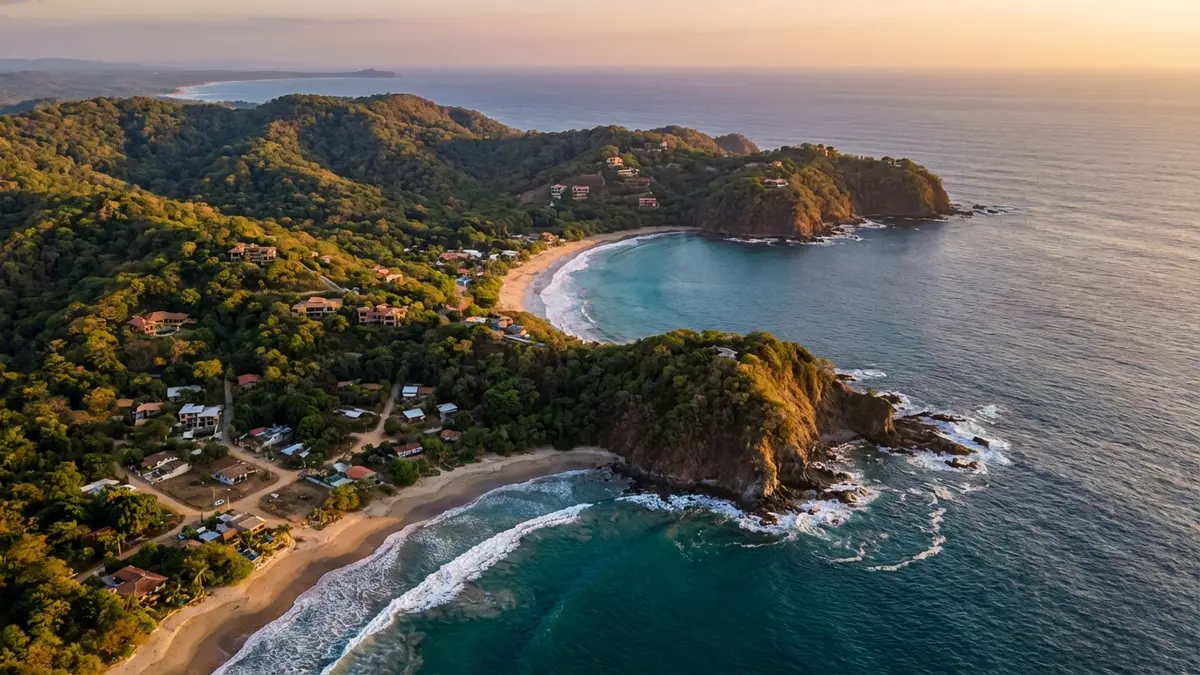
Mal Pais vs Santa Teresa: Where Smart Money Is Landing on Costa Rica's Nicoya Peninsula

Mal País and Santa Teresa are ten minutes apart on one dirt road, share a coastline, a surf culture and a buyer pool, and are two genuinely different purchases. Most comparisons of the two are written from a car window. This one is written from the listing data, the two zoning regimes, the water map and our own shelf, with the "smart money" question answered at the end and the reasoning shown, because on this coast the smart money is the money that checked the title field.
Side by side, from the same dataset
The regional MLS run by 2 Costa Rica Real Estate reports both towns for the period August 6 to September 6, 2026.
| Santa Teresa | Mal País | |
|---|---|---|
| Active listings | 200 | 27 |
| Average asking price | $1,556,379 | $2,523,608 |
| Average per square meter | $4,303 | not published for the segment |
| Month-on-month change in average | down 1.5% | up 27.5% |
| Coastal zoning plan | Adopted January 1999 | Adopted March 2001, plus two Punta Barrigona plans; some sectors have none |
| Maritime Zone concessions | Legally possible, subject to the forest rule | Legally possible inside a plan, subject to the forest rule |
| Our shelf this month | 1 listing, $1.71 million | 4 listings, median $650,000 |
Read the averages carefully. Mal País's is higher because 27 listings include a handful of estates and one of them moved the average by a quarter in a month; Santa Teresa's is lower and far more stable because 200 listings include everything from a studio to a compound. Neither is a sale price. Costa Rica has no public register of what properties actually close for, and anyone who quotes you transaction volumes for either town is guessing.
Our own inventory says something the averages do not: in Santa Teresa proper we have one listing, an eleven-bedroom property at $1.71 million; in Mal País we have a flat titled lot 150 meters from the beach at $525,000, a jungle lot with container homes on a hand-dug well at $550,000, a commercial lot in the village center at $750,000 and a two-home estate 300 meters from the sand at $1.45 million. The entry to Mal País, for a buyer who will build, is lower than anything we can currently show in Santa Teresa.
The legal difference
The first 200 meters from the high tide line is the Maritime Zone under Ley 6043: 50 meters public, 150 meters State land held only on a municipal concession, which a foreigner cannot hold until five years of legal residency. A concession can only be granted where a coastal zoning plan is in force.
Santa Teresa has one; the council approved the Playa Santa Teresa zoning regulation on January 13, 1999. Mal País has one too, adopted in March 2001 and published in La Gaceta that August, with two more plans from 2002 and 2004 for its Punta Barrigona sector, and the council still grants concessions there, including a new twenty-year one in February 2026. The current plans from Mal País to Manzanillo lack environmental viability from SETENA, the national environmental review agency: a councillor said so at a council session in August 2026 and the district intendant confirmed it. No court has annulled or suspended them; whether that matters for a given concession is a question for the buyer's lawyer. The council's March 2025 record shows work started on a single plan for the coast from Mal País to Manzanillo. And the Attorney General's office reminded the council in letters of September and October 2024 that Cóbano cannot grant or renew concessions on land holding forest or wetland, which describes a lot of the Mal País shore.
In practice: a Santa Teresa "beachfront" listing can be a lawful concession with a file number, and should be checked as one. A Mal País "beachfront" listing can be one too if it sits inside a published plan, such as the 2001 Mal País plan; on the stretches toward the Cabo Blanco reserve that no plan covers, it is possession with no lawful route to a concession. In both towns the asset that a bank will lend on, an insurer will cover and any buyer can purchase is titled land above the line, which is what all five of our listings above are.
Infrastructure, honestly
Santa Teresa's main strip is paved, its fiber reaches the hills, it has two supermarkets, a pharmacy, dozens of restaurants and the density of rentals that makes a property manager's route work. Mal País has a village, a few restaurants, a fishing beach and eleven kilometers of unpaved coast road running north to Playa Hermosa that turns to river in October. Water is the sharper difference: Santa Teresa's ASADA serves the strip and most of the hill; parts of Mal País toward the reserve are on wells or on nothing, which is why a lot with a registered meter and a lot without are priced so differently, and why the engineers' college's May 2026 warning about missing water letters applies to Mal País first. Both towns share the Cóbano clinic, the ferry to the Puntarenas hospital and the Sansa or Green Airways flight from the Cóbano airstrip; neither is close to an emergency room.
Mal País has one thing Santa Teresa cannot buy: the road ends at Cabo Blanco, Costa Rica's first protected wilderness, created in 1963. Santa Teresa's edge will keep growing north toward Manzanillo. Mal País's southern edge is a reserve boundary written into law.
Rentals
AirROI's data for the Cóbano district, which covers both towns, shows 1,555 active listings at an average nightly rate of $291 and 35.9 percent annual occupancy, about $29,000 a year per listing. Santa Teresa houses with a pool, a view and a walk to the beach sit above that average; Mal País houses sit above it if they are walkable to the water and below it if they need a car to reach dinner. Liquidity follows the same line: the buyer for a Santa Teresa house exists in every month of the year, the buyer for a Mal País parcel takes longer to find. Our ROI article has the arithmetic including the 13 percent VAT, the 12.75 percent capital-income tax and the manager's cut; it applies to both towns and the inputs differ.
Holding costs, the same in both
Property tax is 0.25 percent of registered value; the solidarity tax starts above ₡143 million of construction value, about $319,000, which most houses in either town exceed; closing runs about 3 to 3.5 percent in tax, stamps and notary. The colón has strengthened from about ₡510 to about ₡448 per dollar this year, which makes building in Mal País, where more of what you buy is land to build on, roughly 12 percent dearer than it was at New Year. The residency-through-property route is in a legal gap since the Law 9996 incentives expired on July 14, 2026; our investor visa guide has the position.
So where is the smart money landing
In Santa Teresa if the money needs to get out again on a known timetable, needs rental income to carry the house, or belongs to someone who wants to walk to dinner. The market is deep, the infrastructure exists and the buyer for your house will exist when you sell. You pay for all of that per square meter.
In Mal País if the money is patient, wants land rather than a finished house, values the reserve boundary more than the restaurant count, and is disciplined enough to buy only titled land above the 200-meter line with a water letter in hand. The entry is lower and the exit is slower, and the beach, whatever the listing says, is not for sale.
The unsmart money, in both towns, is the money that bought inside the Maritime Zone on a handshake, or on a hill with no water, or in February without seeing the road in October. If you want a specific listing in either town read against the zoning plan, the water map and the reserve line, send it to us. Our Mal País guide and our Santa Teresa market piece go deeper on each.
Where these numbers come from
- Listing data: 2 Costa Rica Real Estate market insights for Santa Teresa and Mal País, August 6 to September 6, 2026. Our shelf: live listings on this site, week of September 8, 2026.
- Coast and zoning: Ley 6043; Playa Santa Teresa zoning regulation, 1999; Mal País zoning regulation, La Gaceta 158, 2001; Cóbano Municipal Council, coastal zoning plans; Constitutional Court ruling 2025-021667; Cóbano Municipal Council, acta EXT-16-2025; acta 95-2026; acta 118-2026; Semanario Universidad, December 2, 2024.
- Reserve and road: Cabo Blanco Absolute Natural Reserve; Mytanfeet, Mal País.
- Water and healthcare: Revista CFIA, May 18, 2026; Naviera Tambor; Sansa.
- Rentals and costs: AirROI, Cóbano, July 30, 2026; AG Legal, solidarity tax 2026; Wise USD/CRC history.
Tierra Tropical is a real estate agency based in the Cóbano district of Costa Rica's southern Nicoya Peninsula, covering Santa Teresa, Mal País, Montezuma, Cabuya, Delicias and Tambor. Nothing here is investment advice.
Ready to Find Your Dream Property?
Explore our curated selection of properties in Costa Rica's beautiful Nicoya Peninsula.
Explore Properties