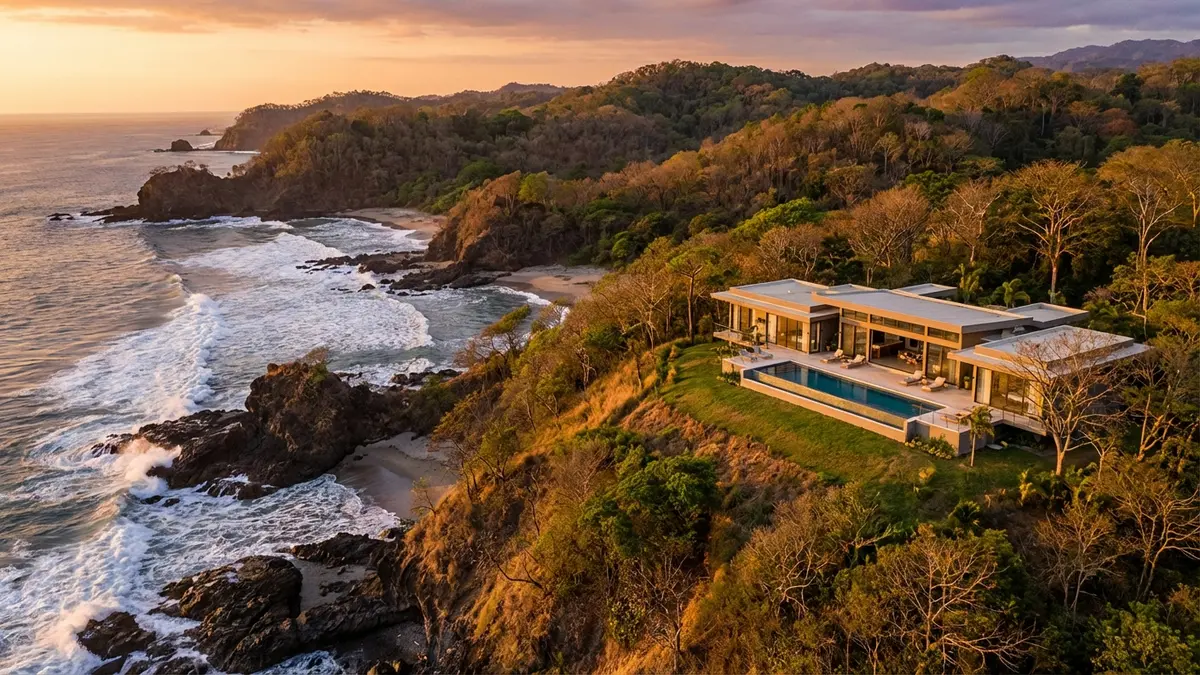
Mal País Real Estate: Why the Quieter Side of the Nicoya Peninsula Is the Smarter Play in 2026

Mal País is the end of the road, literally. The coast road that starts in Santa Teresa runs south through Playa Carmen and Mal País and stops at the gate of the Cabo Blanco reserve, and the land between the last restaurant and that gate is the subject of this article. It shares Santa Teresa's coast, its surf and its buyers. It does not share its zoning plan, its water situation or its price per square meter, and those three differences are the whole case for and against buying here. We sell on this stretch, so read the "for" with that in mind; we have tried to make the "against" just as specific.
What the market data actually shows
The regional MLS run by 2 Costa Rica Real Estate tracks listings by town. For August 6 to September 6, 2026 it shows 27 active properties in Mal País at an average list price of $2,523,608, up 27.5 percent on the previous month, against 200 in Santa Teresa at $1,556,379 and $4,303 per square meter. Two lessons. The Mal País sample is small enough that one estate listing moves the average by a quarter in a month, so treat that $2.5 million as a description of what is on the market this month, not of what land costs. And the idea that Mal País is simply "20 percent cheaper than Santa Teresa" does not survive the data: the estate end of Mal País is the most expensive land on the peninsula, and the entry end is cheaper than Santa Teresa because it is farther from the restaurants and, in places, not yet served by water.
Our own shelf on this stretch, from Mal País north through Playa Hermosa to Manzanillo, is seven listings this month:
- A titled one-bedroom house on 2,115 square meters at Manzanillo, with water, at $365,000. This is roughly what the floor looks like for a house with a view and a meter.
- A flat titled lot of 2,481 square meters, 150 meters from the beach in Mal País, with water, at $525,000.
- A 17,500-square-meter jungle lot with container homes at $550,000, on a hand-dug well, which is the kind of detail this article exists to explain.
- A 922-square-meter commercial lot in the center of Mal País at $750,000.
- A ten-thousand-square-meter commercial parcel at Manzanillo at $925,000.
- A 3.9-hectare estate parcel above Playa Hermosa at $1.2 million, listed without water, priced accordingly.
- A two-home family estate 300 meters from the beach in Mal País at $1,449,000, titled, with water.
Read the water column as carefully as the price column. It explains more of the spread than the view does.
The zoning question nobody mentions
The first 200 meters from the high tide line on every beach in Costa Rica is the Maritime Zone under Ley 6043: 50 meters public, 150 meters State land held only on a municipal concession, which a foreigner cannot hold until five years of legal residency. A municipality can only grant concessions where a coastal zoning plan is in force.
Santa Teresa has one, adopted by the council as the Playa Santa Teresa zoning regulation in January 1999. Mal País has its own, published in La Gaceta in August 2001, and two more plans from 2002 and 2004 cover its Punta Barrigona sector. Manzanillo has a partial plan that stops at boundary marker 302, near the cemetery at the north end of Playa Manzanillo. The Tourism Institute still lists these plans as approved, and the council keeps granting concessions under them, including a new twenty-year concession in Mal País in February 2026 and another in Manzanillo in April 2026. The Cóbano council's own March 2025 record shows work started on a single plan for the whole coast from Mal País to Manzanillo.
Parts of the coast still have no plan, including the north end of Playa Manzanillo beyond marker 302 and, as the council told the Constitutional Court in 2025, some sectors toward the Cabo Blanco reserve. Anything sold as "beachfront" inside the 200 meters there is possession without a legal foundation. The current plans from Mal País to Manzanillo also lack environmental viability from SETENA, the national environmental review agency: a councillor said so at a council session in August 2026 and the district intendant confirmed it. No court has annulled or suspended the plans. Whether that affects a concession you are looking at is a question for your lawyer. On top of that, the Attorney General's office reminded the council in letters of September and October 2024 that the municipality cannot grant or renew concessions on land holding forest or wetland, and the Mal País shore is rock, forest and mangrove for long stretches.
The practical consequence is the opposite of what the brochures imply. In Mal País the value is in titled land above the 200-meter line, with a deed you can mortgage, insure and sell to anyone. That is what all seven of our listings above are. If someone offers you the rocks themselves, ask which zoning plan the concession sits under, and when they cannot answer, walk.
Water, the other price
A building permit anywhere in Costa Rica requires a letter of water availability from the local ASADA or from AyA. The engineers' college reported in May 2026 that missing water letters are the single most common thing stalling projects nationally, and the Cóbano council's 2025 record acknowledges that some communities in the district are served by informal water committees with no legal standing to issue one. South of Santa Teresa this is not theoretical. Parcels above Playa Hermosa and toward Cabo Blanco may sit outside any ASADA's network, which is why a lot on a hand-dug well is priced where it is and a lot with a registered meter 150 meters from the beach is priced where it is. A well can be legalized through a concession from the water directorate, but that is a process measured in many months with no guaranteed outcome. Buy the letter, not the promise.
What you are actually buying: the edge of a reserve
The reason the road stops is Cabo Blanco, Costa Rica's first protected wilderness, created in October 1963 at the initiative of two immigrants, Nicolás Wessberg and Karen Mogensen, and managed today by SINAC. It is an absolute reserve, meaning the strictest category in the system, and it anchors the southern end of the coast permanently: nothing will be built beyond the gate, and the forest that spills north of it is largely protected under Ley 7575, which bars clearing forest cover regardless of what a deed says.
That is the structural argument for Mal País and it is a good one. Santa Teresa's northern edge will keep growing toward Manzanillo; Mal País's southern edge cannot grow at all. A house here is buying a boundary that is sixty-three years old and written into law, not a promise that the next lot will stay empty. It is also the structural argument against: the same protection means a lot that turns out to hold forest cannot be cleared, and the environmental review of anything you build will be real.
Rentals, taxes and the colón
Rentals on this stretch run on Santa Teresa's demand with a ten-minute drive attached. AirROI's data for the whole Cóbano district shows an average nightly rate of $291 at 35.9 percent annual occupancy, about $29,000 a year per listing for the twelve months to July 2026; the hoteliers' association projected 72 percent high-season occupancy for the Puntarenas coast. Mal País houses with a pool, a view and a walk to the water do better than that average; Mal País houses that need a car to reach dinner do worse. Our vacation rental ROI article has the full arithmetic including the 13 percent VAT, the 12.75 percent capital-income tax and the manager's cut.
Holding costs are modest and moving. Property tax is 0.25 percent of registered value. The solidarity tax on high-value homes applies in 2026 above ₡143 million of construction value, about $319,000, which catches most of what is built here. Closing runs about 3 to 3.5 percent in tax, stamps and notary, closer to 4 with your own attorney; our how-to-buy guide has the schedule. And the colón has strengthened from around ₡510 to around ₡448 per dollar since January, which makes labor, materials and every local bill roughly 12 percent dearer for a dollar owner building here this year.
One more thing that changed: the residency angle. The Law 9996 incentives expired on July 14, 2026 and the investor threshold now sits in a legal gap between $150,000 and the regulation's $200,000; see our investor visa guide. Buy the land because you want it, not for the card.
Who this is right for
Mal País is right for the buyer who wants Santa Teresa's coast without Santa Teresa's density, who will build or renovate rather than buy turnkey, who understands that titled land above the road is the asset and the rocks are scenery, and who will not sign for a parcel without a water letter in hand. It is right for someone with a four-wheel drive and a tolerance for the eleven kilometers of coast road that connects Mal País to Playa Hermosa and turns to river in October.
It is wrong for the buyer who wants to walk to a choice of restaurants, who needs the rental to pay for the house from month one, or who is looking for a bargain version of Santa Teresa. At the estate end it is the most expensive land on the peninsula. At the entry end it is cheaper for reasons you can name, and you should be able to name them before you buy.
If you want any of the seven listings above read against the zoning plan, the water map and the reserve boundary, ask us. We will tell you which we would buy ourselves and which we would not.
Where these numbers come from
- Listing data: 2 Costa Rica Real Estate, Mal País and Santa Teresa market insights, period August 6 to September 6, 2026. Our shelf: live listings on this site, week of September 8, 2026.
- Coast and zoning: Ley 6043; Playa Santa Teresa zoning regulation, January 13, 1999; Mal País zoning regulation, La Gaceta 158, August 20, 2001; Cóbano Municipal Council, coastal zoning plans; ICT list of coastal zoning plans in force, August 4, 2025; Constitutional Court ruling 2025-021667, with the council's list of coastal plans; Cóbano Municipal Council, acta 004-2024; acta EXT-16-2025; acta 95-2026; acta 101-2026; acta 118-2026; Semanario Universidad, December 2, 2024.
- Water: Revista CFIA, May 18, 2026.
- Cabo Blanco and forest law: Cabo Blanco Absolute Natural Reserve; Ley 7575.
- Rentals: AirROI, Cóbano, July 30, 2026; Cámara Costarricense de Hoteles, December 16, 2025.
- Holding costs: AG Legal, solidarity tax 2026; Wise USD/CRC history.
- Road: Mytanfeet, Mal País.
Tierra Tropical is a real estate agency based in the Cóbano district of Costa Rica's southern Nicoya Peninsula, covering Mal País, Santa Teresa, Montezuma, Cabuya, Delicias and Tambor. Nothing here is legal or investment advice.
Ready to Find Your Dream Property?
Explore our curated selection of properties in Costa Rica's beautiful Nicoya Peninsula.
Explore Properties