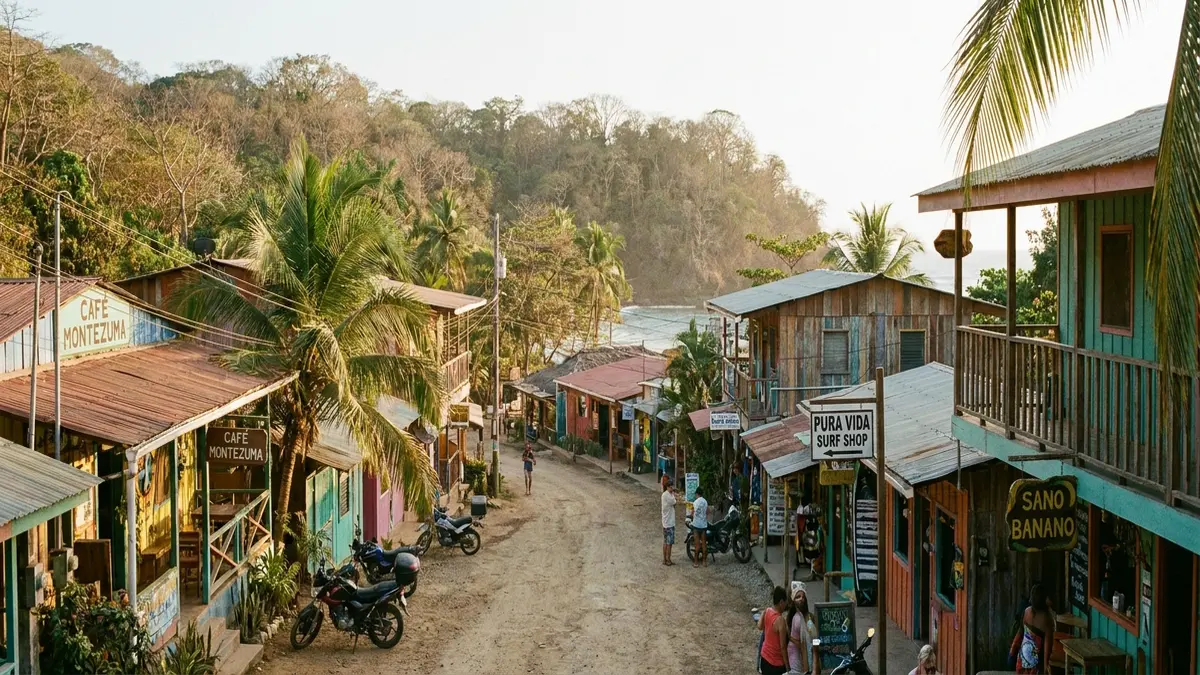
Living in Montezuma, Costa Rica: What Expats Actually Need to Know Before Making the Move

Montezuma is easy to miss. The road in from Cóbano drops through a blind curve and there it is, a few streets of low buildings pressed between the forest and the sea, with a waterfall trail at one end and a protected reserve at the other. People who move here tend to say the same thing afterward: they came for the beach and stayed for the fact that the town never turned into anywhere else.
This is the guide we give buyers who are seriously thinking about living here, not visiting. It covers what it costs, what you can actually buy, how the legal and practical realities differ from the brochure, and where the sources are, so you can check us.
What kind of place it is
The town sits at the southern tip of the Nicoya Peninsula, in the Cóbano district of Puntarenas province. Two protected areas define it. The Nicolas Wessberg Absolute Reserve, 63 hectares of forest and shoreline a kilometer and a half north of the school, was created in 1994 and is managed by SINAC. Ten minutes south, past Cabuya, is Cabo Blanco, the country's first protected area, established in October 1963 after the Swedish-Danish couple Nicolas Wessberg and Karen Mogensen bought up roughly 1,250 hectares at the peninsula's tip to stop it being cleared. Together they mean the jungle behind Montezuma is not going to be developed. That is the single biggest reason the town still looks the way it does.
It is a village, not a resort. One main street, a handful of restaurants, a Saturday market, the three tiers of the Montezuma waterfall a short walk from the center, and a long-standing mix of Tico families, European and Israeli residents who arrived decades ago, and a newer wave of remote workers. If you need a supermarket with imported cheese, a gym, or a coworking space with a receptionist, that is Santa Teresa, forty minutes away on a rough road. Some people find that liberating. Some last six months.
What it costs to live here
We are going to be careful with this number, because most of what is published about Montezuma living costs is either years old or made up.
The best recent external benchmark is The Tico Times' June 2026 expat cost survey, which puts a single person in Santa Teresa at $3,000 a month or more and a two-bedroom near the beach there at $1,200 to over $2,500, against $1,600 to $2,200 for a single person in the Central Valley towns. Montezuma is not in the survey. From our own clients' budgets, it lands between those two: a single person renting a modest place away from the beach can manage on something under $2,000 a month, and a couple who own their home outright spend meaningfully less than that on everything else. Peak-season rentals near the beach have climbed to what a decent Central Valley apartment cost a few years ago, because the same visitors who fill Santa Teresa now spill over here from December to April.
Groceries cost more than in the capital, because everything arrives by truck on the same road you will be complaining about. The rotating farmers' markets in Montezuma, Cabuya and Cóbano help with produce. Electricity is cheap if you live without air conditioning and expensive if you do not.
Healthcare, honestly
This is the part retirees need to read twice.
Day-to-day care is the CCSS clinic in Cóbano, a twenty-minute drive, which handles general medicine, maternal and child health, dental and basic specialty consultations, plus private doctors and a pharmacy or two. A new CCSS health area for the district, with two integrated primary-care teams, was announced in 2022 with a $14 million budget and a 2026 target; as of 2025 it was still on the CCSS project list rather than open, and the latest reporting points to 2027. Plan around what exists, not what is promised.
For anything serious you are leaving the peninsula. The regional public hospital is the new Hospital Monseñor Sanabria in Barranca, Puntarenas, inaugurated in January 2025 and the largest in Central America, though it is not expected to run at full capacity until 2030. Getting there means the road to Paquera and then the Naviera Tambor ferry, a crossing of about an hour and twenty minutes with roughly eight departures a day, or the long drive around the gulf. Either way you are two to three hours from an emergency room. Private clinics in San José are a Sansa or Green Airways flight from the Cóbano airstrip, about thirty minutes in the air. If you have a condition that needs a hospital within reach, that is the fact that should decide whether you live here, and no amount of waterfall changes it.
The road, the rain, the power
You need a four-wheel drive. Not "recommended." The Cóbano to Montezuma stretch is short and mostly tame; the roads to Cabuya, Delicias and Santa Teresa are not, and in the wet months all of them turn to something between mud and ambition. The Tourism Institute's own climate guidance for the Pacific has it right: dry from December to March, rains from May to October with November as a transition, a break in July and August locals call the veranillo, and September and October as the genuinely wet months when getting around is sometimes difficult. Anyone who tells you the green season is a light drizzle has not been here in October.
Power goes out. Less than it used to, more than you are used to. People who work from home keep a battery backup and, increasingly, a satellite dish alongside the fiber. On that: Kölbi's fiber-optic network now reaches the Cóbano district, and connectivity in the town center is fine for video calls. Do not assume it reaches a specific hillside lot until you have tested it standing on the lot.
Water is the constraint that actually matters, and it is the one nobody mentions until you try to build. Building permits require a water availability letter from the local ASADA, the community water association. The national engineers' college reported in May 2026 that missing letters were stalling projects across the country, and Cóbano's own 2025 municipal plan admits some communities in the district are still served by informal neighbor committees with no legal standing to issue one. A lot with a meter already installed is worth a real premium here. A lot where "the neighbor shares water" is worth what the permit office says it is worth, which is nothing.
What property actually costs
Our active Montezuma listings this month: 49 properties, median asking price $499,000. Twenty-six are houses, from $300,000 up, median about $707,000; the ten with a genuine ocean view sit at a median just over $1 million. Twenty are lots, median $375,000, from $110,000. Some real examples, so the ranges mean something:
- A hilltop home with public water at $350,000 is roughly what the entry point for a titled house with a view looks like right now.
- An ocean-view house at $396,000 shows what a step up buys.
- A 5,000-square-meter titled lot with water at $125,000 is the kind of parcel that goes quickly, for the reason in the previous section.
For comparison, the regional listing service shows around 200 active properties in Santa Teresa at an average asking price of $1.56 million. Same peninsula, different market.
Titled land versus the Maritime Zone
Here is the legal fact that separates good Montezuma purchases from bad ones. Costa Rica's Maritime Zone law reserves the first 50 meters from the high-tide line as public land and the next 150 meters as State land that can only be held on a municipal concession, which foreigners cannot hold until they have been residents for five years. Part of Montezuma's beachfront strip sits inside that zone.
The good news is that most of the buildable land around Montezuma sits uphill and inland of it and is fully titled: registered in the National Registry, ownable outright by a foreigner, mortgageable, and cleanly resold. Forty-three of the forty-eight lots on our peninsula-wide shelf are titled. The Cabuya-Montezuma coastal zoning plan has been in force since La Gaceta published it in September 2016, so where concessions exist here they are at least legal, but the Procuraduría reminded the Cóbano council in September and October 2024 that it cannot grant or renew concessions on forest or wetland; a concession that turns out to hold either carries real risk. Ask which kind of land you are looking at before you fall in love with the view. Our beachfront guide goes through it in detail.
Closing costs run roughly 3 to 3.5 percent of the price; annual property tax is 0.25 percent of registered value. Our land guide covers the rest of the due diligence.
Visas, residency and the thing that changed in July
You do not need residency to own property here, and many of our owners never take it. Visitors from the United States, Canada, the United Kingdom and most of Europe get up to 180 days per entry since September 2023, at the border officer's discretion. Remote workers can apply for the digital nomad permit, which requires $3,000 a month in foreign income and grants one year, renewable once; it does not lead to residency, but it is a good way to spend a full green season here before you buy.
If residency is the goal, know that the rules shifted on July 14, 2026, when Law 9996's reduced $150,000 investor threshold expired and the floor is expected to return to $200,000. We wrote up exactly what changed; the short version is to get Migración's current position in writing before you buy for that purpose.
Who does well here
The people who stay are the ones who came for the town rather than the price. They wanted a village they could walk, forest at the property line, a community that knows their name within a month, and they could live with a road that tests the car, a clinic rather than a hospital, and a supermarket run that takes the afternoon. They bought titled land with a water letter, spent a September here before signing anything, and hired a lawyer who had closed on this coast before.
The people who leave usually wanted Santa Teresa's infrastructure at Montezuma's prices, or needed a hospital nearer than the ferry, or bought a view without asking about the water. None of those are Montezuma's fault. All of them are avoidable.
If you are weighing it, talk to us. We live on this road. We will tell you which version of Montezuma you are actually moving to.
Where these numbers come from
- Reserves: SINAC, Plan General de Manejo, Reserva Nicolas Wessberg (2013); Cabo Blanco founding, Wikipedia summary of the 1963 decree.
- Cost of living benchmarks: The Tico Times, 12 June 2026. Montezuma figures are our own clients' budgets, stated as such.
- Healthcare: Cóbano health area, aDiarioCR, 5 May 2022 and CR Hoy, 22 May 2025; Hospital Monseñor Sanabria, El Observador.
- Transport: Naviera Tambor schedule; Sansa, Cóbano route.
- Climate: Instituto Costarricense de Turismo.
- Water: Revista CFIA, 18 May 2026; Cóbano Municipal Council, session EXT-16-2025.
- Maritime Zone: Ley 6043; Semanario Universidad, 2 December 2024.
- Cabuya-Montezuma zoning plan: Instituto Costarricense de Turismo, coastal zoning plan status list, October 2018.
- Santa Teresa comparison: 2 Costa Rica Real Estate MLS, Aug to Sep 2026.
- Visas: The Tico Times, 10 October 2023; Golden Harbors, 26 August 2026.
- Our shelf: live listings on this site, week of 8 September 2026.
Tierra Tropical is a real estate agency based in the Cóbano district of Costa Rica's southern Nicoya Peninsula, covering Montezuma, Santa Teresa, Mal País, Cabuya, Delicias and Tambor. Nothing here is legal advice.
Ready to Find Your Dream Property?
Explore our curated selection of properties in Costa Rica's beautiful Nicoya Peninsula.
Explore Properties