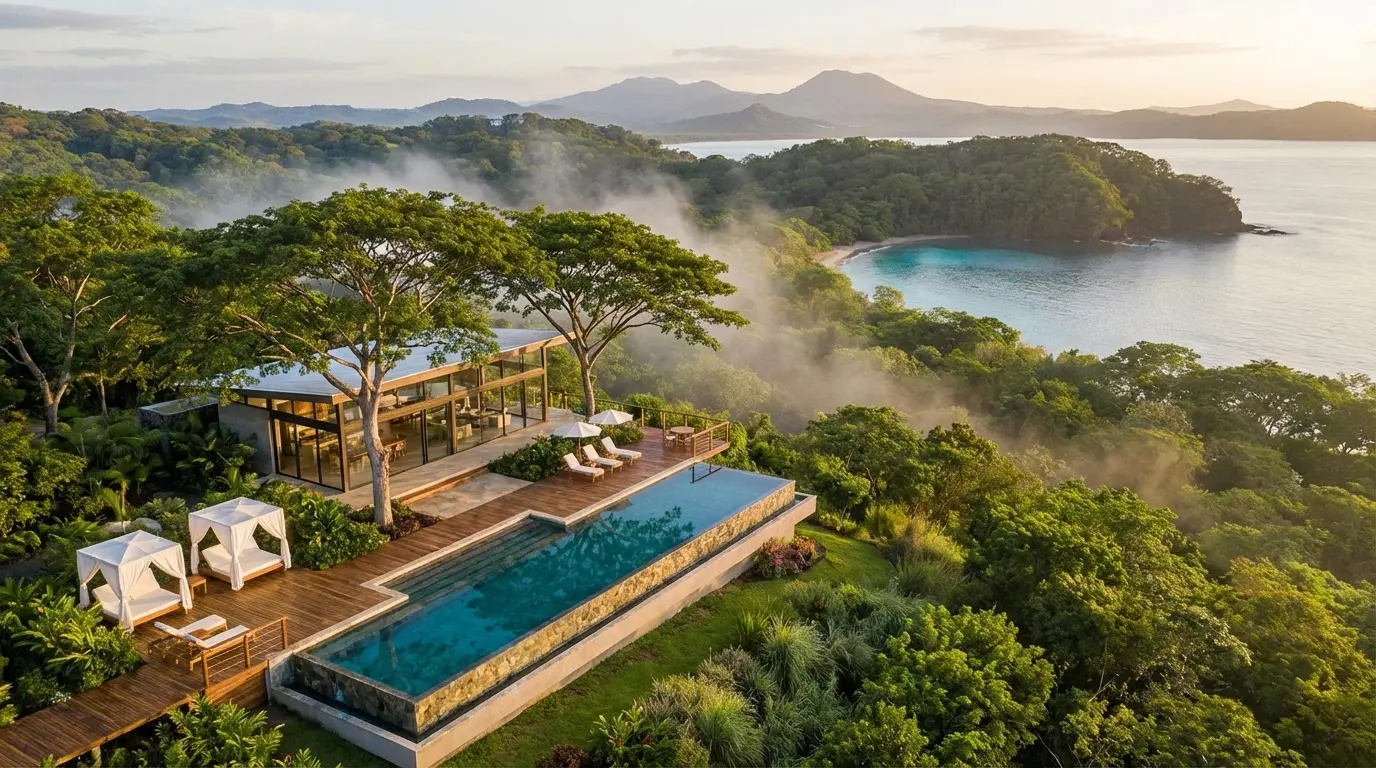
Where Five-Star Meets Rainforest: Costa Rica's $500 Million Luxury Revolution
The howler monkeys begin their dawn chorus at precisely 5:47 AM, their guttural calls echoing across the canopy just as the first rays of sunlight pierce through the tropical forest. But the guests awakening in their oceanfront suites at Nekajui, a Ritz-Carlton Reserve, aren't reaching for earplugs—they're stepping onto private terraces with their morning espresso, watching scarlet macaws glide past while their personal concierge confirms the day's itinerary: a guided hike through primary rainforest, followed by a farm-to-table lunch featuring locally harvested cacao, and an afternoon spa treatment using indigenous healing traditions. This is Costa Rica's new luxury paradigm, where $2,000-per-night accommodations coexist seamlessly with one of the planet's most biodiverse ecosystems.
Welcome to the Papagayo Peninsula, ground zero for Central America's most ambitious hospitality transformation. When Nekajui opened its doors in February 2025 as the Ritz-Carlton Reserve's first Central American outpost, it didn't just add another luxury property to Costa Rica's portfolio—it announced the country's arrival as a global eco-luxury powerhouse. The $150+ million investment represents something far more significant than real estate development: it's a blueprint for how five-star hospitality can amplify rather than compromise environmental stewardship.
The numbers tell a compelling story. Costa Rica's luxury hospitality market is projected to reach $525.6 million by 2030, growing at 7.49% annually—a growth rate that outpaces traditional luxury destinations struggling with overtourism and climate anxiety. But unlike developments in the Caribbean or Mediterranean that often sacrifice ecology for amenities, Costa Rica's luxury revolution is built on a foundation of radical sustainability that's become its most valuable competitive advantage.
The Papagayo Phenomenon: Where Conservation Meets Concierge Service
The Papagayo Peninsula wasn't always synonymous with luxury. This 1,400-acre promontory jutting into the Pacific remained relatively undeveloped until visionary planners established something revolutionary: environmental covenants requiring 70% of land to remain in its natural state. Today, that decision has created one of the world's most valuable luxury real estate corridors, where pristine beaches, howler monkey habitats, and Arnold Palmer-designed golf courses exist in carefully orchestrated harmony.
The peninsula now hosts over 2,100 luxury hotel rooms across properties that read like a hospitality hall of fame: Four Seasons, Andaz, Planet Hollywood Beach Resort, and now the crown jewel, Nekajui. But these aren't isolated developments—they're nodes in a master-planned ecosystem that includes private marinas, beach clubs, and residential communities where ultra-high-net-worth individuals pay premium prices specifically because the jungle remains intact around their villas.
"What we're seeing in Papagayo isn't traditional resort development—it's a new model where environmental preservation becomes the luxury amenity itself. Guests aren't tolerating the rainforest; they're paying $2,000 per night specifically to wake up to howler monkeys."
The region's infrastructure tells this story in concrete terms. Liberia International Airport, just 30 minutes from Papagayo, handled 1.2 million passengers in 2024, including a notable surge in private jet traffic. These aren't budget backpackers—they're travelers who previously defaulted to the Maldives or French Polynesia but are now choosing Costa Rica for its unique value proposition: guilt-free luxury powered by the country's 99% renewable energy grid.
The 2024-2025 Opening Wave
The Nekajui launch caps an extraordinary 18-month period that saw 15 new luxury hotels open across Costa Rica, with Guanacaste claiming the lion's share:
- Waldorf Astoria Guanacaste (November 2024): 177 rooms on Playa Buena, featuring Latin America's first Waldorf beach club concept
- Four Seasons Peninsula Papagayo expansion (October 2024): $40 million renovation adding 20 residences and expanded wellness facilities
- Nalu Nosara, Auberge Resorts Collection (January 2024): 30 suites on the Nicoya Peninsula, integrating surf culture with five-star service
But the pipeline extends well into the decade. 1 Hotels arrives in 2026, bringing their sustainable luxury ethos to Papagayo. Rosewood broke ground in August 2024 on a $200 million, 125-room resort scheduled for late 2026. Aman Resorts—perhaps the world's most exclusive hotel brand—confirmed a 300-acre Nicoya Peninsula site for 2027, their first Costa Rican property. Six Senses follows that same year with a Central Pacific location emphasizing regenerative tourism.
The Peninsula Papagayo development corporation has committed $500 million in infrastructure investments through 2028, including marina expansions and enhanced beach club facilities. This isn't speculative development—it's calculated investment backed by occupancy rates that tell their own story.
The Economics of Eco-Luxury: Why Sustainability Commands Premium Pricing
Traditional hospitality wisdom suggests sustainability costs money. Costa Rica's luxury sector proves the opposite: environmental authenticity generates revenue. Luxury eco-lodges achieve occupancy rates of 75-85% during high season (December through April), compared to 60-65% for standard properties. More remarkably, they maintain these rates while charging average daily rates of $600-$1,500, with ultra-luxury reserves like Nekajui commanding $2,000+ per night.
The mathematics become even more compelling when examining guest spending patterns. Luxury travelers to Costa Rica spend an average of $2,500-$4,000 per trip, compared to $1,200 for standard tourists. They stay longer, book more experiences, and return more frequently. In 2024, the Costa Rican Tourism Board reported a 22% increase in luxury segment bookings compared to 2023, driven predominantly by North American travelers seeking authentic environmental experiences.
What drives this willingness to pay premium rates? Three factors converge:
1. Certification Credibility
Costa Rica's Certification for Sustainable Tourism (CST) program rates over 400 hotels on a rigorous five-leaf scale evaluating everything from water management to community impact. Unlike greenwashing common elsewhere, CST certification requires third-party audits and continuous improvement. Luxury properties compete for five-leaf status the way Michelin-starred restaurants pursue ratings—it's a genuine quality marker that sophisticated travelers recognize and reward.
2. Carbon-Neutral Infrastructure
Costa Rica maintains 25% of its territory under protected status while operating a 99% renewable energy grid—primarily hydroelectric, geothermal, and wind. This isn't marketing spin; it's measurable infrastructure that allows luxury properties to offer genuinely carbon-neutral stays. New 2024 regulations require all luxury hotels to achieve carbon neutrality by 2030 or face tax penalties, ensuring this commitment deepens rather than dilutes as development accelerates.
3. Authentic Integration
Walk the grounds at Four Seasons Papagayo or the new Waldorf Astoria, and you'll encounter wildlife corridors that allow spider monkeys to traverse the property, organic gardens supplying restaurants with heirloom vegetables, and naturalist-led excursions that generate genuine biodiversity appreciation rather than performative eco-tourism. The luxury lies not in isolation from nature but in sophisticated integration with it.
Beyond Papagayo: The Nicoya Peninsula's Blue Zone Advantage
While Papagayo captures headlines, the Nicoya Peninsula—extending south along the Pacific coast—offers a different luxury proposition. This region holds designation as one of just five Blue Zones globally, areas where residents live measurably longer, healthier lives. That distinction has transformed Nicoya into a magnet for wellness-focused luxury tourism.
Properties like Nalu Nosara and the forthcoming Aman resort (2027) emphasize longevity tourism, incorporating local dietary practices—heavy on tropical fruits, wild-caught fish, and heirloom corn—into culinary programming. Guests participate in traditional nixtamalization (corn preparation), learn from centenarian residents about plan de vida (life purpose), and practice sunrise yoga on beaches where sea turtles nest.
📍 Key Nicoya Peninsula Luxury Zones:
- Nosara: Wellness-focused, strong yoga community, properties like Nalu emphasizing holistic programming
- Santa Teresa: Surf culture meets luxury, boutique properties commanding $1,000-$5,000 nightly for private villas
- Montezuma: Bohemian sophistication, attracting creative professionals seeking extended stays
- Mal País: Emerging luxury node with development potential and relative value positioning
The Blue Zone designation isn't merely marketing—it's supported by demographic research showing Nicoya residents' exceptional longevity. Luxury properties leverage this authenticity, offering programming that goes beyond standard spa services to genuine lifestyle transformation. It's the difference between a massage and a meaningful exploration of what creates human thriving.
The Guest Experience: What $2,000 Per Night Actually Buys
At Nekajui's 30 villas and suites, the experience begins before arrival. Guests coordinate with personal concierges who craft itineraries balancing adventure and restoration: perhaps a morning catamaran sail to secluded coves where dolphins feed, followed by a private cooking class with a local chef specializing in pre-Columbian techniques, then an evening treatment at the spa using volcanic mud and indigenous botanicals.
But the real luxury reveals itself in subtler moments. It's the naturalist who identifies the 847 species of birds potentially visible from your terrace. It's the knowledge that your suite's air conditioning runs on geothermal energy from Rincón de la Vieja volcano, 60 kilometers inland. It's the three restaurants sourcing ingredients from organic farms within 50 kilometers, showcasing Costa Rican coffee, cacao, and tropical fruits at their peak.
✅ What Distinguishes Costa Rica's Luxury Eco-Tourism:
- Authentic wildlife encounters without cages or captivity—monkeys, sloths, macaws in natural habitats
- Farm-to-table credibility with ingredients sourced from visible, verifiable local producers
- Adventure accessibility from five-star bases—zip-lining, white-water rafting, volcano hiking within 30-90 minutes
- Cultural immersion through cooking classes, artisan workshops, and community partnerships
- Guilt-free indulgence powered by renewable energy and genuine conservation funding
The Four Seasons Papagayo exemplifies this integration. Their $40 million 2024 renovation added residences and wellness facilities while expanding wildlife corridors and funding sea turtle protection programs on adjacent beaches. Guests participate in nesting season monitoring (July through December), experiencing conservation not as abstract concept but tangible practice.
The Competitive Landscape: Why Global Brands Choose Costa Rica
When Ritz-Carlton Reserve selected Costa Rica for their Central American debut, they weren't following trends—they were making a strategic bet on differentiation. In an era when luxury travelers have visited the usual suspects (Bali, the Maldives, Bora Bora), Costa Rica offers something increasingly rare: authentic discovery potential combined with world-class infrastructure.
The country received 2.4 million international tourists in 2024, but luxury travelers remain a select minority, ensuring properties maintain exclusivity while achieving strong occupancy. Guanacaste province accounts for approximately 40% of Costa Rica's luxury hotel inventory, yet development remains carefully controlled through master planning that prevents the overdevelopment plaguing Caribbean destinations.
⚠️ Critical Success Factors Attracting Luxury Brands:
- Political stability: Costa Rica abolished its military in 1949, redirecting resources to education and healthcare, creating one of Latin America's most stable democracies
- Direct access: Liberia International Airport offers nonstop flights from major North American hubs; private aviation infrastructure continues expanding
- Legal framework: Fee-simple property ownership for foreigners, established tourism law, and transparent regulatory environment
- Climate advantage: Guanacaste's 300+ days of annual sunshine create year-round appeal, though peak season (December-April) drives premium pricing
- Proximity: Four-hour flights from major U.S. markets make Costa Rica accessible for long weekends, not just extended vacations
Brands like Aman, Six Senses, and Rosewood—known for extreme selectivity in site selection—are betting that Costa Rica's combination of environmental authenticity, luxury infrastructure, and cultural sophistication creates a decades-long growth trajectory. Their 2026-2027 openings represent not opportunistic development but long-term strategic positioning.
The Future: Regenerative Tourism and Beyond
As Costa Rica's luxury sector matures, the conversation is shifting from sustainable to regenerative—tourism that actively improves ecosystems rather than merely minimizing harm. Six Senses' 2027 property explicitly embraces regenerative principles, with plans for coral reef restoration, reforestation programs, and agricultural projects that sequester carbon while supplying resort kitchens.
This evolution reflects broader luxury travel trends. Today's affluent travelers—particularly younger ultra-high-net-worth individuals—increasingly evaluate experiences through impact lenses. They're asking not just "Is this sustainable?" but "Does this make the world better?" Costa Rica's luxury sector is positioning to answer affirmatively.
The $500 million in infrastructure investments planned through 2028 includes not just marinas and beach clubs but wildlife corridors, renewable energy expansions, and community development projects in nearby towns. Peninsula Papagayo's master plan explicitly budgets for environmental protection, recognizing that pristine nature isn't an obstacle to luxury development—it's the foundation.
💰 Market Projections Through 2030:
- $525.6 million total luxury hospitality market value
- 7.49% compound annual growth rate
- 12-15 additional luxury properties expected to open beyond confirmed pipeline
- Continued North American market dominance, with growing European and Asian segments
- Wellness and longevity tourism emerging as fastest-growing luxury subsector
The Verdict: Luxury Tourism Reimagined
Standing on a Papagayo beach at sunset, watching scarlet macaws return to their roosting sites while guests sip craft cocktails at a beachfront bar powered entirely by renewable energy, Costa Rica's luxury revolution reveals itself not as contradiction but synthesis. This isn't five-star hospitality imposed on a rainforest—it's five-star hospitality because of the rainforest.
The February 2025 opening of Nekajui marks not an ending but a beginning. As Rosewood, Aman, Six Senses, and 1 Hotels bring their distinctive visions to Costa Rican shores over the next three years, they'll join an ecosystem proving that luxury and sustainability aren't opposing values but complementary ones. The howler monkeys will still chorus at dawn. The sea turtles will still nest on protected beaches. And guests will still pay premium rates—not despite these realities, but precisely because of them.
In an age when travelers increasingly seek meaning alongside luxury, Costa Rica has architected a hospitality model that delivers both. The $500 million revolution isn't about building more—it's about building better, creating spaces where human comfort and natural thriving enhance rather than exclude each other. That's not just the future of luxury tourism in Costa Rica. It's the future of luxury tourism, period.
Ready to Find Your Dream Property?
Explore our curated selection of properties in Costa Rica's beautiful Nicoya Peninsula.
Explore Properties