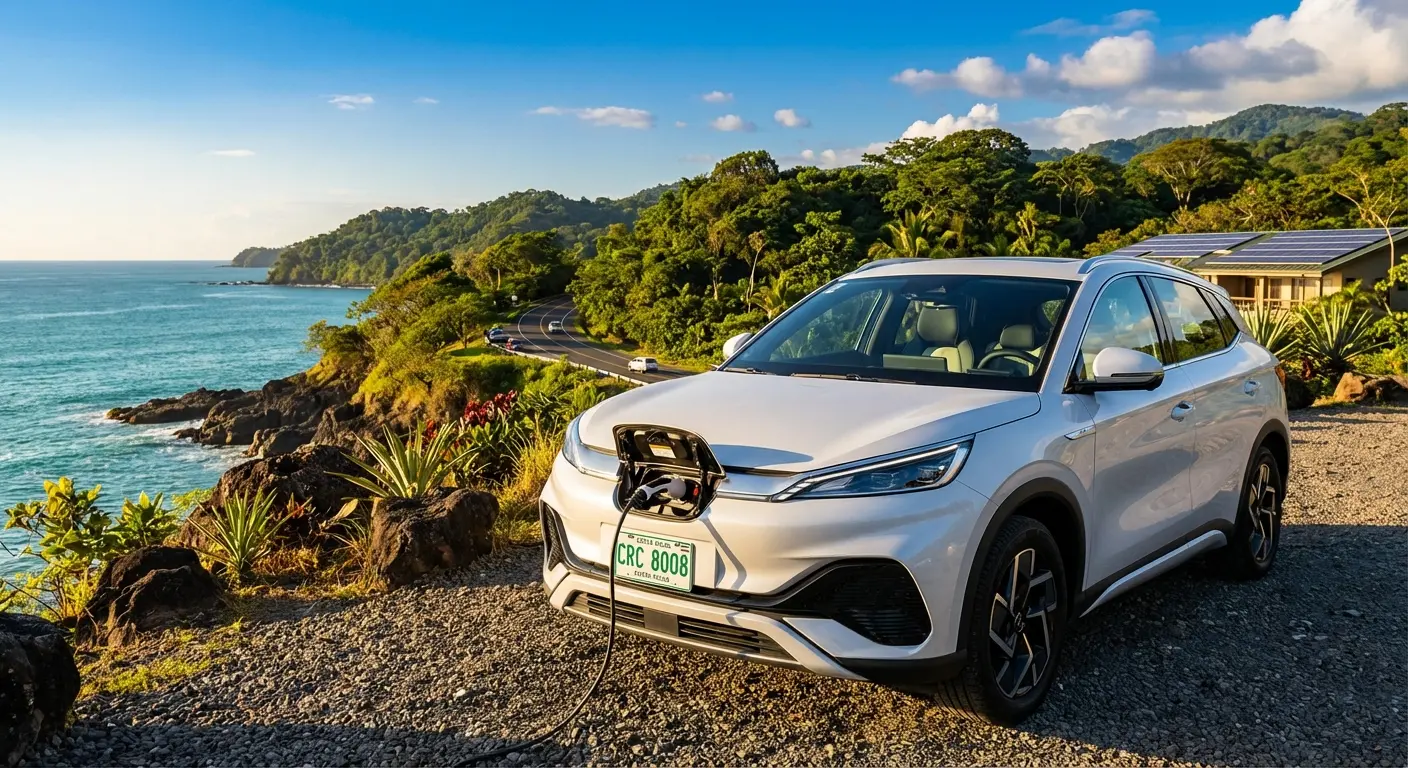
Electric Paradise: Inside Costa Rica's Quiet Revolution as Latin America's EV Capital
Pull into any beach town parking lot on the Nicoya Peninsula these days and count the license plates. You'll spot something unusual: every third or fourth vehicle sports the distinctive green "electric" badge on its plates. In Nosara, where I stopped for coffee last week, six of the eight cars at the café were EVs. Not Teslas driven by Silicon Valley expats (though there are a few of those). BYDs. Nissans. Hyundais. Driven by surf instructors, real estate agents, yoga teachers, and the guy who delivers propane tanks.
This isn't some boutique phenomenon confined to eco-conscious enclaves. Costa Rica has become something genuinely remarkable: Latin America's undisputed electric vehicle capital, with over 35,000 EVs on the road as of 2025 and the highest EV market share in the entire Americas for three consecutive years. In October 2025, 21.7% of new vehicle registrations were electric—a number that would make most European countries jealous and leaves the United States (roughly 8% market share) in the rearview mirror.
But here's what makes Costa Rica different from other EV success stories: this is the only place in the Americas where your road trip actually has a zero carbon footprint. And that's not marketing speak.
The Math That Changed Everything
The transformation happened fast. Eight years ago, Costa Rica had roughly 1,500 electric vehicles puttering around San José. Today? A 2,200% increase that's reshaped how Ticos think about transportation.
The catalyst wasn't environmental guilt or government mandates. It was economics.
Costa Rica exempts electric vehicles from import duties, sales tax, and the annual circulation tax that makes car ownership expensive here. The result: EVs now cost the same or less than equivalent gasoline vehicles when you factor in total ownership costs. A BYD Dolphin—Costa Rica's best-selling EV—lands on the lot for about the same price as a Toyota Corolla, then costs a fraction to operate. Electricity here runs about $0.10 per kilowatt-hour. Fill up a Nissan Leaf for the equivalent of 300 kilometers? Maybe $3.
One local real estate developer in Tamarindo told me he's saving $400 monthly on fuel alone since switching to electric. "I was spending more on gas than my car payment," he said. "Now I plug in at home, and my electric bill went up maybe $30."
The government extended these tax exemptions through 2027, which means the economic advantage isn't disappearing anytime soon. Chinese automaker BYD saw the opportunity and opened Central America's largest distribution center in Costa Rica this year. When a company makes that kind of infrastructure bet, they're not expecting a trend to fade.
The Renewable Energy Advantage Nobody Talks About
Here's the thing that makes Costa Rica's EV story fundamentally different: 99% of the country's electricity comes from renewable sources. Hydroelectric, wind, geothermal, solar. When you charge your car here, you're genuinely not burning fossil fuels. Not offsetting. Not buying credits. Actually not.
I've driven EVs in California, where the electricity mix includes natural gas and coal. The environmental benefit exists but feels diluted, theoretical. Here, it's direct. The electrons flowing into your battery came from a river, a volcano, or the wind coming off the Nicoya coast.
This matters more than you'd think for a country that's staked its identity on environmental leadership. Costa Rica's National Decarbonization Plan aims for 70% of light vehicle sales to be electric by 2035 and complete transport decarbonization by 2050. Ambitious? Sure. But when you've already hit 21.7% in 2025, the trajectory doesn't seem crazy.
"We're not just adopting electric vehicles—we're proving that a developing economy can lead on climate action without sacrificing growth or mobility. The rest of Latin America is watching." — Synthesized perspective from Costa Rica's Ministry of Environment and Energy
The country hosted the first Latin American EV Summit in March 2025, positioning itself as the regional knowledge hub. Ecuador, Colombia, and Panama sent delegations. They're not just curious—they're taking notes.
The Infrastructure That Makes It Work
Costa Rica's secret weapon isn't technology. It's geography.
The entire country measures 51,100 square kilometers—roughly the size of West Virginia. You can drive from the Caribbean to the Pacific in four hours. The Pan-American Highway runs north-south through the spine of the country. Most destinations tourists care about sit within 150 kilometers of San José.
This compactness makes range anxiety obsolete. Modern EVs get 300-400 kilometers on a charge. You could drive from the Nicaraguan border to Panama and back without recharging (though you wouldn't need to, because the infrastructure is already there).
Over 400 public charging stations now dot the country, with strategic density along key corridors:
- Route 27 to the Pacific beaches: Charging stations every 30 kilometers between San José and Jacó
- Pacific Coast Highway (Route 34): Stations every 50-70 kilometers from the Nicaraguan border to Panama
- Nicoya Peninsula: 15 new fast-charging stations added in 2025, covering Tamarindo, Nosara, Santa Teresa, and Montezuma
- Arenal and Monteverde: Fast-charging hubs serving the most-visited tourist destinations
- Caribbean coast: Eight new stations in 2025 connecting Puerto Viejo and Cahuita
The state electricity company, ICE (Instituto Costarricense de Electricidad—yes, the acronym is unfortunate), launched a smart charging network this year with mobile app integration. You can see real-time availability, reserve charging slots, and track exactly how much renewable energy powered your charge. It's the kind of infrastructure that feels five years ahead of where it should be.
The Nicoya Peninsula Advantage
The peninsula deserves special attention. This Blue Zone region—where people routinely live past 100—has become a showcase for sustainable EV tourism. Every major beach town now has fast-charging capability. I've driven the entire peninsula multiple times in a rented EV without once worrying about range.
Nosara, famously protective of its environmental character, installed three charging stations at the town center and two more at the beaches. Santa Teresa, despite its rutted dirt roads (which, honestly, are harder on EVs than the range), has charging at the main intersection and at Playa Hermosa. Even remote Montezuma, accessible only by winding mountain roads, has a fast-charger near the waterfall entrance.
The government announced plans to install charging infrastructure at all national parks by 2026. Imagine exploring Corcovado or Manuel Antonio knowing your vehicle is powered by the same renewable energy the parks were established to protect. It's the kind of circular logic that actually makes sense.
The Democratization Nobody Expected
Early EV adopters in Costa Rica looked like early adopters everywhere: wealthy, urban, tech-forward. San José's Escazú neighborhood—think Costa Rica's Beverly Hills—had the highest concentration of Teslas and high-end European EVs.
That's changing fast.
Used EV imports from the United States increased 300% in 2024-2025, bringing the technology within reach of middle-income Costa Ricans. A five-year-old Nissan Leaf with 80% battery health sells for $12,000-$15,000 here. That's less than a new motorcycle and cheaper than most used gasoline sedans. The tax exemptions apply to used imports too, as long as the vehicle is less than six years old.
I met a taxi driver in Liberia who switched to a used Chevy Bolt last year. "My fuel costs dropped from $600 a month to $50," he said. "The car paid for itself in savings within two years." He's not an outlier. Several taxi cooperatives in San José and Guanacaste have gone partially or fully electric.
Rental companies saw the opportunity. Adobe Rent-a-Car and Vamos both introduced all-electric fleets in 2025, targeting the growing number of tourists who want to experience zero-emission travel. Daily rates run about the same as conventional vehicles, but renters save on fuel. In beach towns like Jacó and Tamarindo, 30-40% of rental vehicles are now electric—higher than the national average.
This democratization matters because it shifts EVs from aspirational to practical. When your taxi driver, your property manager, and the person delivering your groceries all drive electric, it's not a statement anymore. It's just transportation.
The Challenges Nobody's Ignoring
Look, it's not all seamless. The southern zone—Osa Peninsula, Corcovado—remains underserved for charging infrastructure. Uvita got its first fast-charger in 2025, but if you're heading deep into the jungle, you're still planning carefully.
Mountain routes to Poás and Irazú volcanoes drain batteries faster due to elevation changes. The charging stations there account for this, but it's something to know. And while the main highways are well-covered, some secondary roads still require range planning.
Battery disposal and recycling remain concerns, though Costa Rica launched partnerships with European companies in 2025 for battery recycling and second-life battery storage programs. The infrastructure is being built proactively rather than reactively, which is rare.
And there's this: Costa Rica's success isn't easily replicable. The combination of compact geography, abundant renewable electricity, and political will to maintain tax exemptions creates conditions that don't exist in most of Latin America. The country is actively sharing its model with neighbors, but Ecuador's size and Colombia's infrastructure challenges mean copying the playbook isn't straightforward.
What This Means for the Region
The Nicoya Peninsula's transformation into an EV-friendly destination isn't just an environmental win—it's an economic signal. The region is positioning itself as forward-thinking, infrastructure-rich, and aligned with the values of the international buyers and investors increasingly interested in Costa Rica.
Property developments are installing EV charging as standard amenities. Hotels advertise charging availability alongside pool and WiFi. The peninsula's reputation as a wellness-focused, longevity-minded destination now includes sustainable transportation as part of the package.
This matters for anyone considering property here. The infrastructure investments being made now—charging networks, smart grid upgrades, renewable energy expansion—represent the kind of forward planning that protects property values and quality of life. You're not buying into a place that's hoping to catch up with global trends. You're buying into a place that's ahead.
The National Decarbonization Plan's target of 70% electric vehicle sales by 2035 isn't just policy—it's a roadmap for how Costa Rica sees its future. And the Nicoya Peninsula, with its Blue Zone identity and environmental consciousness, sits at the center of that vision.
The Road Ahead
Costa Rica didn't become Latin America's EV capital by accident. It happened through the convergence of renewable energy abundance, progressive policy, favorable economics, compact geography, and a cultural identity that values environmental stewardship.
The result is something genuinely unusual: a developing economy leading the developed world on a technology transition that most experts assumed would flow the other direction. And unlike many environmental initiatives that require sacrifice, this one delivers immediate economic benefits to adopters.
The charging station I pass every morning on the way to the beach in Nosara is usually occupied by 7 AM. Not because people are making a statement. Because it's cheaper, more convenient, and—yeah—because it feels good to know your daily driving isn't burning anything.
That's the quiet revolution part. It stopped being revolutionary and became normal.
Which might be the most revolutionary thing of all.
Ready to Find Your Dream Property?
Explore our curated selection of properties in Costa Rica's beautiful Nicoya Peninsula.
Explore Properties