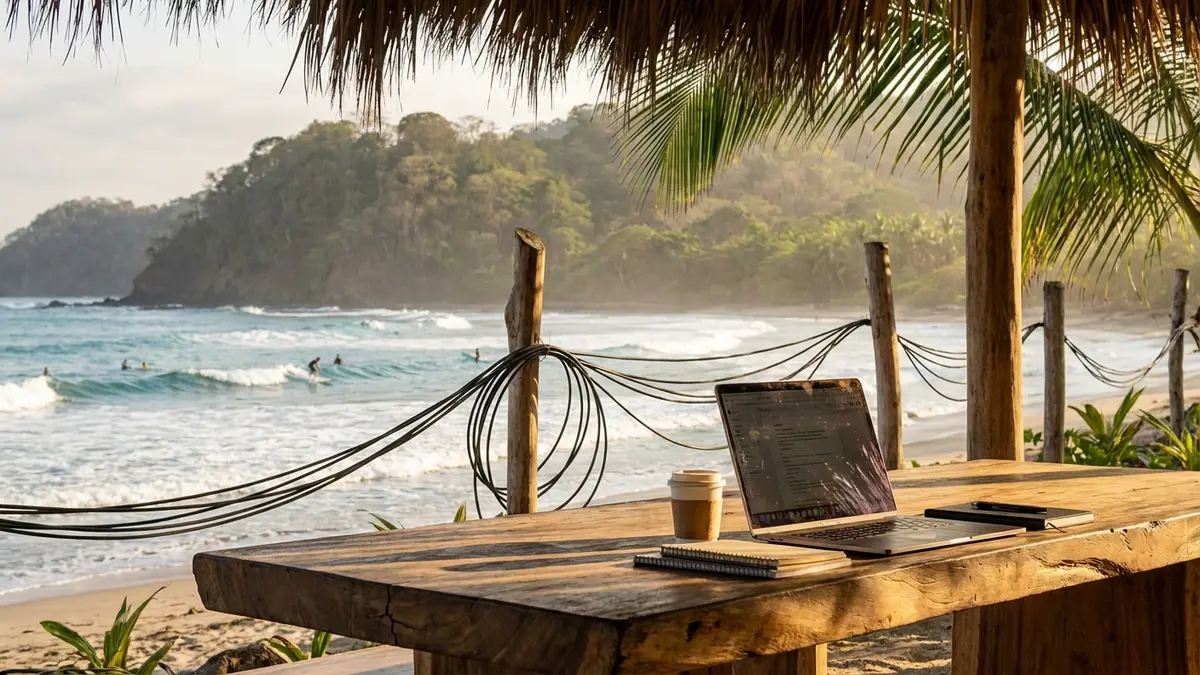
Costa Rica's Digital Nomad Visa in 2026, and What Santa Teresa Is Like to Work From

Costa Rica has had a digital nomad visa since 2021, and Santa Teresa is where a large share of the people who use it end up. Both halves of that sentence get exaggerated online. The visa is a modest, useful permit with a few hard requirements, and the town is a good place to work from with two limits that matter more than any ranking. Here are the rules as they stand in 2026 and the practical picture from the road.
The visa, as written
Law 10008 created a category called "remote worker or provider of international services." The requirements have not changed much since, and the 2026 guides agree on the core:
- Income of at least $3,000 a month from sources outside Costa Rica, or $4,000 if you bring dependents, shown with twelve months of bank statements.
- Health insurance covering at least $50,000 for the whole stay. Travel insurance is rejected.
- A $100 application fee per person, paid to Banco de Costa Rica, plus a document fee of about $90 on approval.
- One year, renewable once, so two years at most. A 2022 amendment, Law 10208, interprets that one year as a ceiling, so applicants can request a shorter visa, and it adds article 11 bis, limiting the immigration paperwork applicants must clear to tourist-level requirements plus the specific items already listed in articles 10 and 11. Article 15 of the law lets a holder apply to change into another migration category before the permit expires, but only if that category's own requirements are met, and it does not guarantee residency.
- Foreign earnings are exempt from Costa Rican income tax for the life of the permit, and work equipment such as laptops and monitors can be imported duty free.
Applications go through Migración's online system, and complete cases are decided in fifteen calendar days, under article 7 of the law. You may not take local clients or local employment on it. Renewal requires having spent at least 180 days in Costa Rica during the first year, under article 15 of the law, so it is a permit for people who mean to live here, and Migración's own page is the place to confirm the current paperwork.
Why most remote workers here do not use it
Since September 2023 a tourist can stay up to 180 days on entry. A remote worker who spends a season here and leaves can come without the visa, since tourists from Group 1 countries can be granted up to 180 days at the immigration officer's discretion. A 2025 DGME directive bars tourists from any activity that involves pay or profit inside Costa Rica, and whether remote work for a foreign employer counts is not settled, so anyone planning to work this way should get legal advice before relying on the tourist stamp. The visa earns its fee in three cases: you want to stay longer than six months without leaving, you want the written tax exemption rather than the practical one, or you want to import equipment without duty. For anyone planning to settle, the Rentista category, at $2,500 a month or a $60,000 deposit, leads to permanent residency and the nomad visa does not. Our investor visa guide covers the property route, which is in a legal gap since July 14, 2026.
Working from Santa Teresa
The connection is no longer the problem it was. Kölbi's fiber starts at 200 Mbps for ₡24,500 a month, about $55, along the main road and up most of the hills behind it. The two limits are elsewhere. Power cuts happen in the wet months, so a house with a battery or a generator is worth the premium if your income depends on being on a call at nine. And a specific hillside house may sit outside the fiber footprint; test the connection standing in the room you would work from, not from the listing. Budget a satellite or mobile backup either way.
Rent is the cost that decides whether the arrangement works. The Tico Times' June 2026 survey puts a two-bedroom near the beach in Santa Teresa at $1,200 to $2,500 and up a month, and a single person's all-in budget on the coast at $3,000 or more. The $3,000 visa threshold is therefore about the minimum on which the town is livable, not a comfortable margin. Sign a lease in the green season, when furnished houses come off the nightly market; in December they mostly do not exist. Our cost-of-living piece has the electricity tariff, the food basket and three added-up budgets, and the neighborhoods guide explains why the flat part of Playa Carmen is the only stretch you can live in without a car.
What remote workers have done for the town is visible in the rental data. AirROI counts 1,555 active short-term listings across the Cóbano district at 35.9 percent annual occupancy; the bookings that fill the wet months are month-long stays by people with laptops, which is why houses with a desk, fiber and a backup rent in September and houses without them sit empty.
If you decide to buy
Nomads who stay usually rent for a year or two and then buy a titled house on the hill with a view and a room to work in. The rules for that are the same as for anyone: foreigners own titled land outright, the first 200 meters of coast is State land under Ley 6043, a building permit needs a water letter, and closing runs about 3 to 3.5 percent. Our how-to-buy guide has the process and the Santa Teresa market piece has the asking prices. Neither the visa nor the tourist stamp is a residency, so buy because you want the house, then let a lawyer sort the category.
Where these numbers come from
- Visa rules: Dirección General de Migración y Extranjería, Nómadas Digitales; CostaRicaBoard, digital nomad visa guide, March 20, 2026; Taxes for Expats, updated June 12, 2026; tourist stay, Dirección General de Migración y Extranjería; Rentista, Golden Harbors, Costa Rica residency 2026; Law 10208, Alcance N.° 79 a La Gaceta N.° 73, April 22, 2022; DGME, Directrices Generales de Visas AJ-484-11-2025, Alcance N.° 148 a La Gaceta N.° 216, November 17, 2025.
- Internet: Kölbi home fiber plans.
- Rents and budgets: The Tico Times, June 12, 2026.
- Rental market: AirROI, Cóbano, July 30, 2026.
- Coast: Ley 6043.
Tierra Tropical is a real estate agency in the Cóbano district of Costa Rica's southern Nicoya Peninsula. Immigration rules change; confirm the current requirements with Migración or a lawyer before you apply.
Ready to Find Your Dream Property?
Explore our curated selection of properties in Costa Rica's beautiful Nicoya Peninsula.
Explore Properties