From Zoom Calls to Jungle Views: How Costa Rica Became the World's Third Digital Nomad Capital
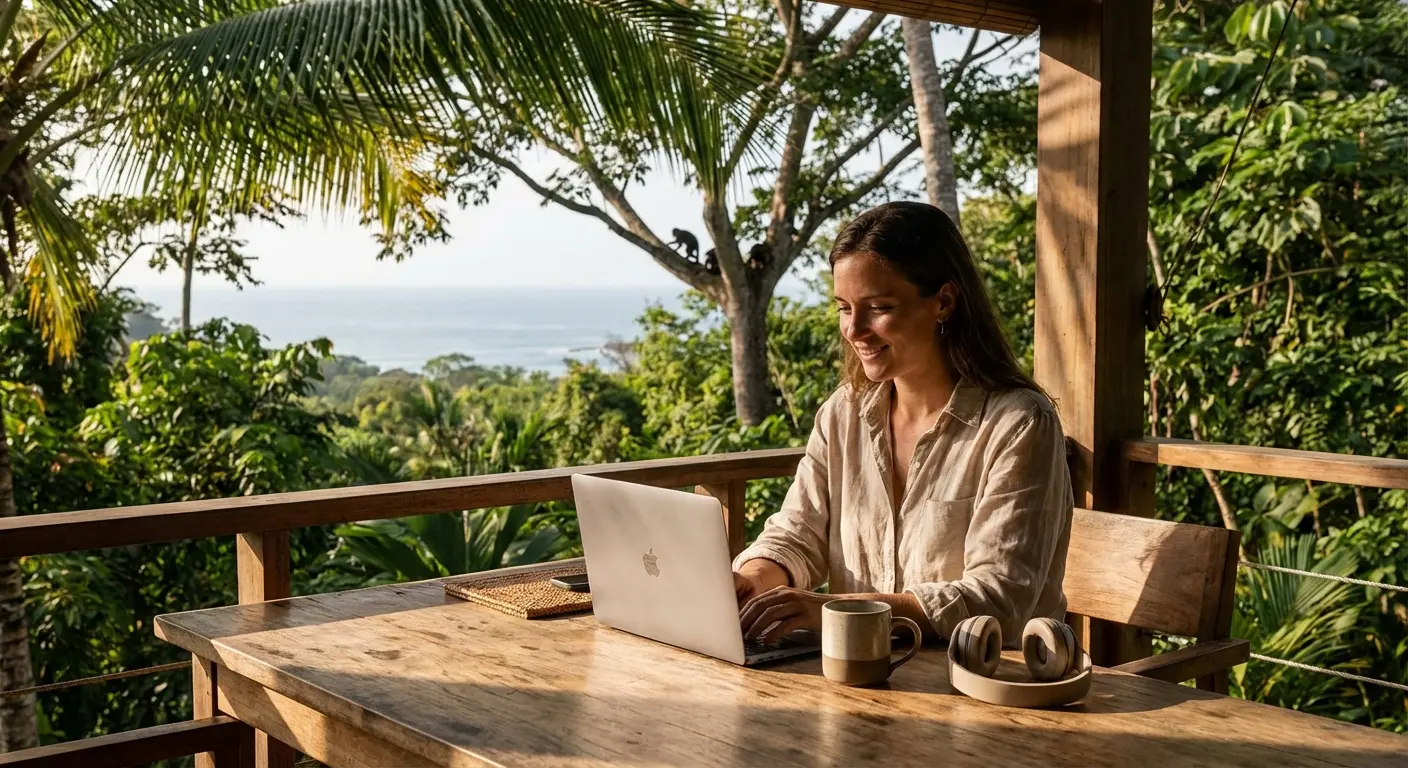
The laptop screen glows against the backdrop of howler monkeys in the canopy. It's 9 AM on a Tuesday, and Sarah Chen is three hours into a product design meeting with her San Francisco team while sitting at a reclaimed wood table in Santa Teresa. When her camera's on, her colleagues see tropical plants framing the shot. When it's off, she's watching a toucan land on the railing six feet away.
This is the new normal in Costa Rica, where the collision of progressive visa policies, rapidly improving infrastructure, and what locals call pura vida living has created something unexpected: the world's third most sought-after digital nomad destination, trailing only Portugal and Spain. Demand for Costa Rica's digital nomad visa jumped 50% in the past year alone, according to Fodor's Travel's 2025 rankings. And nowhere is this transformation more visible than along the Nicoya Peninsula, where four distinct communities have become laboratories for what happens when remote work meets tropical coastline.
The revolution didn't happen by accident.
The Policy Catalyst: A Visa That Actually Makes Sense
Costa Rica launched its digital nomad visa program in August 2021, but it took the infrastructure—and the word of mouth—a few years to catch up. Now the program offers something rare in international visa schemes: clarity and genuine appeal.
The basics are straightforward: Remote workers can stay for up to two years (one year initially, renewable for another) with complete tax exemptions on foreign-sourced income. The income requirement sits at $3,000 monthly for individuals or $4,000 for families—high enough to ensure economic contribution, low enough to be accessible for most established remote professionals. Application processing currently takes 90-120 days, though the government announced plans in January 2025 to cut that to 60 days through a fully digital system launching in 2026.
But the real draw isn't just the paperwork. It's what you get for it.
Costa Rica abolished its army in 1948 and redirected that spending toward education and healthcare. Renewable energy accounts for 99% of the country's electricity generation. Twenty-five percent of the land is protected as national parks or reserves—5% of the world's biodiversity in 0.03% of Earth's surface. The time zone (CST, UTC-6) aligns perfectly with North American business hours. And then there's the Nicoya Peninsula's status as one of only five Blue Zones worldwide, where people live measurably longer lives.
"We're not just offering a place to work remotely. We're offering a place to live differently," explains Marco Badilla, director of Costa Rica's Tourism Board. "The digital nomads who thrive here aren't just chasing beaches—they're chasing a different relationship with time, health, and community."
The numbers suggest people are listening. Digital nomad spending now contributes an estimated $450-$600 million annually to Costa Rica's economy, a 75% increase from 2023 figures.
Four Communities, Four Flavors of Remote Life
Santa Teresa: Where Surf Culture Met Bandwidth
Santa Teresa transformed faster than almost anyone expected. What was a sleepy surf village a decade ago now hosts 2,000+ long-term remote workers navigating the tension between paradise and growing pains.
The appeal is obvious: world-class surfing, a thriving yoga and wellness scene, and that specific beach-jungle aesthetic that photographs well on Instagram. Eight coworking spaces have sprouted up, including Selina, Tribal, and Nomad House. Fiber optic internet arrived in late 2023, and speeds now hit 50-100 Mbps reliably.
But rapid growth has consequences. Property prices jumped 35-40% between 2023-2025, driven largely by digital nomad demand. Average rent for a one-bedroom apartment now runs $1,200-$1,800 monthly—steep for Costa Rica. Water shortages hit during dry season (December through April). The main road remains notoriously rough, requiring 4WD vehicles. And the social scene, while active, can feel transient.
"Santa Teresa is for people who want the energy," says longtime resident and coworking space owner Patricia Morales. "If you need quiet contemplation, look elsewhere. If you want sunset sessions followed by networking over craft cocktails, this is your spot."
Nosara: The Premium Option With Community Standards
Thirty kilometers north, Nosara offers something different: an upscale, wellness-oriented community with approximately 1,500 digital nomads integrated into a well-established expat population that actually talks to each other.
The Nosara Civic Association maintains high community standards—you'll notice it in the better roads, more reliable services, and environmental consciousness. In June 2025, Nosara launched Costa Rica's first Digital Nomad Welcome Program, offering orientation sessions, networking events, and local business partnerships. It's the kind of thoughtful infrastructure that makes the $1,400-$2,000 monthly rent for a one-bedroom feel more justified.
Playa Guiones delivers consistent surf without Santa Teresa's crowds. Yoga Nosara and multiple retreat centers provide the wellness infrastructure. Internet reliability hits 95%+ uptime. And the community skews more family-friendly—you'll see as many kids at the farmers market as you will solo travelers at coworking spaces.
"Nosara figured out how to grow without losing itself," notes digital nomad and freelance developer James Mitchell, who's been based there for two years. "That doesn't happen by accident. It happens because people give a damn."
Tamarindo: The Gateway With Urban Amenities
Tamarindo is the most developed option, hosting 3,000+ remote workers who value accessibility and variety over pristine authenticity. Direct flights from San José, Liberia airport 60 kilometers away, 12+ coworking spaces, multiple banks, medical clinics, and the most diverse dining and nightlife scene on the peninsula.
Average rent runs $1,000-$1,500 for a one-bedroom—the most affordable of the Nicoya options. The tradeoff? Tamarindo can feel touristy and commercialized. Crime rates run higher than Nosara or Santa Teresa, requiring more security awareness (though still low by regional standards). And you won't get the "undiscovered paradise" feeling.
But for first-time visitors to Costa Rica, or nomads who need frequent travel access and urban conveniences, Tamarindo works. The infrastructure is there. The community is large enough to find your people. And Selina CoWork+, which opened in September 2024 with 200+ workstations and 24/7 access, reflects the 300% increase in coworking demand since 2022.
Uvita: The Emerging Contender
South of the Nicoya Peninsula proper, Uvita represents the next wave. Digital nomad population grew 180% between 2023-2025, making it the fastest-growing remote work destination in the country—though still small at around 800 nomads.
The draw is affordability ($800-$1,200 monthly rent for a one-bedroom), proximity to Marino Ballena National Park and Corcovado, and a quieter, more nature-focused vibe. Fiber optic installation completed in March 2025 solved the previous connectivity challenges. The nomad community is small enough that you actually get to know people.
Uvita won't work for everyone. There's less nightlife, fewer coworking options, and you need to be comfortable with a more remote setting. But for budget-conscious nomads or nature lovers willing to trade amenities for tranquility and whale-watching season, it's compelling.
The Infrastructure Revolution Nobody Talks About
The digital nomad boom wouldn't be possible without the unglamorous work of laying fiber optic cable and expanding mobile networks. ICE, the state telecommunications company, completed the 'Fibra Óptica Pacífico Sur' project connecting Uvita, Dominical, and surrounding areas in March 2025. Santa Teresa's fiber optic expansion throughout 2024-2025 transformed connectivity from "pray your Zoom call doesn't drop" to genuinely reliable.
Mobile data from Kolbi, Movistar, and Claro now provides 4G coverage across all major nomad areas, offering essential backup when (not if) power outages hit during rainy season. And in October 2025, the government announced a partnership with Starlink to provide satellite internet backup in the most remote areas.
Banking access improved significantly in 2025 when BAC Credomatic and Banco Nacional launched specialized accounts for digital nomad visa holders, eliminating previous residency card requirements. It's the kind of practical detail that matters more than any beach sunset when you're trying to actually live and work somewhere.
What They Don't Tell You (But Should)
The Instagram version of digital nomad life in Costa Rica is seductive. The reality includes afternoon power outages, roads that require 4WD vehicles, and the fact that petty theft and break-ins increased 15-20% in Santa Teresa and Tamarindo due to tourism growth. Never leave valuables in vehicles. Get a safe for your accommodation. Understand riptides before you surf.
Water shortages affect Santa Teresa and parts of Nosara during dry season. Some properties experience rationing. September and October bring the heaviest rains—beautiful and lush, but intense. High season (December through April) sees accommodation prices jump and requires booking 2-3 months in advance.
Learning Spanish significantly enhances the experience. While you can get by with English in nomad hubs, integration with local Tico communities—and access to better deals, deeper friendships, and actual understanding of where you're living—requires language skills.
And the pura vida philosophy, while genuine, can clash with deadline-driven remote work. The relaxed approach to time that makes Costa Rica appealing is the same thing that makes waiting for the plumber an exercise in patience.
Where This Goes Next
The April 2025 Nomad Summit in Tamarindo attracted 800+ digital nomads, establishing itself as Central America's largest remote work conference. Bill #23.847, introduced in February 2025, proposes tax incentives for property owners who rent long-term to digital nomad visa holders—an attempt to address housing shortages in popular areas.
Santa Teresa faces critical decisions about paving its main road (controversial among residents who fear it will accelerate development). Nosara is implementing stricter building codes to preserve character. Uvita is positioned for significant growth with improved access and infrastructure.
The tension between economic benefits and environmental preservation runs through every conversation about the digital nomad boom. But here's what's interesting: 68% of digital nomads in Costa Rica engage in volunteer work or community projects, according to a University of Costa Rica study from July 2025, contributing an average of eight hours monthly to local initiatives.
This isn't just about people extracting value from a beautiful place. Many are genuinely trying to contribute to it.
The laptop screen still glows. The howler monkeys are quieter now, mid-morning heat settling in. Sarah Chen closes her design files and walks down to the beach for a surf session before her afternoon meetings. Tomorrow she'll drive to Nosara for a coworking day and dinner with friends. Next month, maybe Uvita to check out the whale migration.
She came for six months. It's been eighteen. The visa renewal paperwork sits on her desk, half-completed. She'll finish it this week.
Probably.
Ready to Find Your Dream Property?
Explore our curated selection of properties in Costa Rica's beautiful Nicoya Peninsula.
Explore Properties