Costa Rica's Agrihood Revolution: Where Blue Zone Living Meets Regenerative Investment
Costa Rica's Agrihood Revolution: Where Blue Zone Living Meets Regenerative Investment
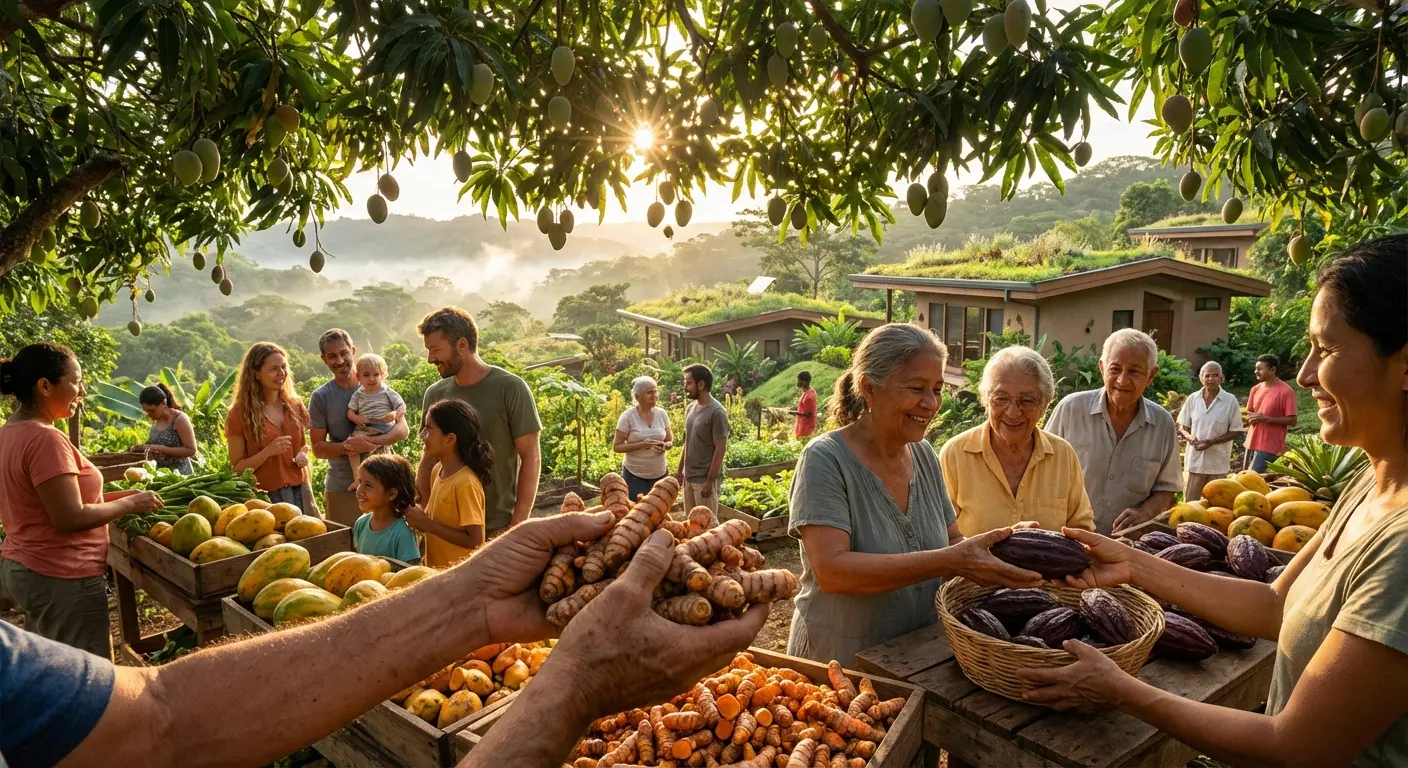
The morning sun filters through a canopy of mango and papaya trees as residents gather at the community farm stand, trading homegrown turmeric for freshly harvested cacao. Children chase chickens between rows of banana plants while their parents discuss water harvesting techniques over organic coffee. This isn't a utopian fantasy—it's Tuesday morning in one of Costa Rica's emerging agrihoods, where regenerative living and real estate investment converge in one of the world's five Blue Zones.
Welcome to the Nicoya Peninsula and its surrounding regions, where a quiet revolution is reshaping sustainable development. As remote work liberates professionals from geographic constraints and climate anxiety drives conscious investment decisions, Costa Rica's eco-communities are experiencing unprecedented demand. In 2024-2025 alone, inquiries for sustainable agricultural properties surged 35%, with foreign real estate investment reaching $2.8 billion—and the regenerative agriculture sector projected to grow 12-15% annually through 2030.
But this isn't just another real estate trend. It's a fundamental reimagining of how we live, invest, and steward the land.
The Blue Zone Advantage: Living Where Life Lasts Longer
The Nicoya Peninsula holds a distinction shared by only four other places on Earth: it's a Blue Zone, where residents routinely live past 100 with remarkable vitality. Centenarians here are 10 times more common than in the United States, and they're not just surviving—they're thriving, working their land well into their 90s with purpose and community that modern life often strips away.
This longevity isn't genetic luck. It's the result of interconnected lifestyle factors that agrihood developments are now intentionally designing into their communities:
- Plant-based diets sourced from regenerative farms
- Purpose-driven living through meaningful agricultural work
- Strong social bonds in tight-knit intentional communities
- Daily physical activity integrated into agricultural rhythms
- Connection to nature as a fundamental design principle
"People don't come to the Nicoya Peninsula just for vacation anymore. They come to transform their lives—and increasingly, they're staying."
Smart developers recognize this Blue Zone status as more than marketing appeal. It's a blueprint for community design. Projects in San Mateo, Nosara, and Santa Teresa are incorporating these longevity factors into their master plans, creating environments where wellness isn't an amenity—it's the foundation.
The Agrihood Model: Real Estate Meets Regenerative Agriculture
Traditional real estate development extracts value from land. Agrihoods regenerate it. These communities typically span 50 to 500 acres, with a revolutionary land allocation: 40-60% permanently protected as conservation areas, creating wildlife corridors while the remaining acreage integrates residential living with working farms, permaculture systems, and community-supported agriculture.
The economics are compelling. Property prices range from $150,000 for small lots to over $1 million for developed homes, with annual appreciation rates of 5-8% in established areas—and several successful communities reporting 90%+ occupancy rates with waiting lists in 2024-2025. But the financial model extends beyond appreciation:
Multiple Revenue Streams
Agricultural Production: Organic farms supply community needs while selling premium products to local restaurants and international markets. The emergence of "agri-preneurship" programs connects residents with distribution channels for everything from single-origin cacao to value-added products like cold-pressed coconut oil.
Carbon Credits: Several 2024-2025 developments introduced blockchain-based carbon credit programs, allowing residents to monetize reforestation and regenerative soil practices. Costa Rica's Payment for Environmental Services (PSA) program adds another layer, compensating landowners for forest conservation.
Regenerative Tourism: The newest trend involves visitors paying to participate in reforestation, organic farming, and permaculture workshops. It's tourism that leaves places better than it found them—and generates revenue while building community awareness.
Solar Net Metering: New 2024-2025 regulations allow communities to sell excess solar power back to the grid, transforming renewable energy from cost center to profit generator.
Location Analysis: Finding Your Perfect Ecosystem
San Mateo: The Accessible Frontier
Positioned in the Central Pacific region, San Mateo offers the sweet spot many investors seek: $20,000-60,000 per hectare—a fraction of coastal prices—while maintaining accessibility to both San José (90 minutes) and Pacific beaches (45 minutes). The area's agricultural heritage and volcanic soils provide excellent fertility for permaculture systems.
📍 Best for: Large-scale agrihood developments, investors seeking land appreciation potential, those wanting proximity to capital and coast
⚠️ Consider: Less established expat infrastructure than coastal areas, more traditional Tico community requiring cultural sensitivity
Nosara: The Regulated Paradise
Since the 1970s, the Nosara Civic Association has maintained strict environmental regulations limiting construction to 30% of lot coverage with mandatory tree canopy preservation. The result? A community that's grown thoughtfully, maintaining ecological integrity while developing world-class infrastructure.
With approximately 40% foreign residents, Nosara offers established international schools, organic markets, fiber optic internet reaching 100+ Mbps, and a multicultural environment that eases transition for newcomers. The regulations that once seemed restrictive now drive premium valuations—scarcity creates value.
📊 Investment Profile:
- Entry point: $200,000-400,000 for lots
- Developed homes: $600,000-1.5M+
- Rental yields: 6-9% for well-managed properties
- Appreciation: 6-8% annually in established areas
✅ Advantages: Proven regulatory framework, established community, excellent infrastructure, Blue Zone location
Santa Teresa: The Boom Town Dilemma
Property values here have increased 300-400% over the past decade, attracting investors and developers in waves. Recent 2024-2025 infrastructure improvements—including road paving and enhanced water management—addressed some growing pains, but the area faces a classic development tension: how to grow without destroying what made it special.
Water availability during the December-April dry season remains critical. Successful eco-communities here have invested heavily in rainwater harvesting systems, greywater recycling, and community water cooperatives (ASADAS). These aren't optional amenities—they're survival infrastructure.
💰 Market dynamics: Higher entry costs ($300,000-800,000), strongest appreciation potential, but also highest infrastructure risk
⚠️ Critical consideration: Water independence systems non-negotiable; verify ASADA access and rights before purchase
Navigating the Investment Landscape: What You Need to Know
Costa Rica's legal framework strongly supports foreign ownership—you can own property with the same rights as citizens. But successful investment requires navigating several critical considerations:
The Legal Framework
✅ Fee simple ownership: Available for most inland properties—you own the land outright
⚠️ Maritime Zone: The first 200 meters from high tide involves concession leases rather than ownership, requiring different legal and financial strategies
📋 Due diligence essentials:
- Surveyor verification of boundaries (GPS-based)
- Municipal records check for liens, easements, and zoning
- Attorney review by Costa Rican real estate specialist
- ASADA consultation for water access rights
- Environmental impact assessment for development plans
The Water Reality
Water scarcity during dry season isn't a minor inconvenience—it's the defining infrastructure challenge for Guanacaste Province developments. Successful agrihoods implement:
- Rainwater harvesting with storage capacity for 4-6 months
- Greywater recycling systems for irrigation
- Community water cooperatives with negotiated access agreements
- Drought-resistant crops and climate-adaptive permaculture design
- Deep wells with sustainable extraction rates verified by hydrogeological studies
Construction Realities
Sustainable construction costs $150-250 per square foot—higher than conventional building due to eco-friendly materials, passive cooling design, and renewable energy integration. But these upfront investments deliver long-term returns through reduced operating costs and premium market positioning.
Factor in Costa Rica's seismic activity: earthquake-resistant construction isn't optional. Building codes require engineered foundations and structural systems designed for lateral forces.
The Digital Nomad Catalyst: Remote Work Reshapes Demand
The 2024 expansion of digital nomad visa programs—allowing remote workers to stay up to two years—fundamentally altered market dynamics. Suddenly, eco-communities weren't just retirement destinations or vacation homes. They became viable full-time residences for professionals seeking lifestyle integration.
Fiber optic networks now reaching rural areas like Santa Teresa and Nosara enable video conferences from jungle canopy offices. Co-living spaces within agrihoods attract remote workers seeking community while maintaining productivity. The result? Year-round occupancy replacing seasonal patterns, stronger rental yields, and more vibrant community dynamics.
This demographic shift influences development design. Successful 2024-2025 projects incorporate:
- High-speed internet infrastructure as baseline requirement
- Co-working spaces and "Zoom rooms" separate from residences
- Flexible live-work units accommodating home offices
- Community programming balancing work and lifestyle integration
Beyond the Marketing: Authentic Regenerative Development
The term "eco-community" risks becoming meaningless through overuse. Authentic regenerative development requires more than solar panels and recycling bins. It demands:
Soil regeneration: Moving beyond organic to actively building soil health through composting, cover cropping, and no-till practices that sequester carbon while increasing fertility.
Biodiversity corridors: Protecting 40-60% of land isn't enough if it's isolated fragments. Successful projects create connected habitats allowing wildlife movement across properties.
Cultural integration: The most successful developments actively participate in local Tico communities—supporting schools, employing local labor, celebrating traditional festivals, and exchanging agricultural knowledge rather than imposing foreign models.
Water stewardship: Treating water as the precious resource it is, with closed-loop systems, aquifer protection, and community governance ensuring long-term sustainability.
Economic viability: Regenerative principles must generate returns, not just require subsidies. The best projects prove that restoration and profit can coexist.
The Investment Thesis: Why Now?
Multiple trends converge to create this moment:
- Climate migration: Wealthy individuals and families seeking climate-resilient locations with stable governance
- Regenerative agriculture mainstreaming: From niche to necessity as soil depletion and climate change impact conventional farming
- Wellness economy growth: The global wellness market exceeding $4.5 trillion, with experiential wellness driving destination choices
- Remote work normalization: Geographic arbitrage allowing high earners to live in lower-cost, higher-quality-of-life locations
- Carbon markets maturation: Making regenerative land management economically competitive with extractive uses
Costa Rica offers the rare combination of political stability, established expat infrastructure, environmental leadership, and legal frameworks supporting foreign investment. The country's commitment to carbon neutrality by 2050 isn't rhetoric—it's backed by decades of conservation policy and 98%+ renewable energy achievement.
The Path Forward: Making It Real
For prospective investors and lifestyle migrants, the path to Costa Rican agrihood living requires both vision and pragmatism:
Start with extended visits: Rent in target communities before buying. Experience the dry season water challenges, the rainy season mud, the daily rhythms that marketing materials gloss over.
Build local relationships: Connect with ASADAS, municipal planning offices, established residents, and local Tico communities. These relationships prove more valuable than any feasibility study.
Verify everything: Property boundaries, water rights, construction permits, environmental compliance. Costa Rica's bureaucracy can frustrate, but proper due diligence prevents expensive mistakes.
Plan for climate resilience: Design for drought, floods, and temperature extremes. Climate change isn't coming—it's here.
Commit to community: Agrihoods succeed or fail based on resident engagement. These aren't gated communities with amenities—they're intentional communities requiring participation.
The Nicoya Peninsula's agrihood revolution represents more than real estate opportunity. It's a laboratory for regenerative living, testing whether modern humans can create abundance while restoring rather than depleting the land. As morning mist lifts over permaculture food forests and solar panels glint above rainwater cisterns, these communities offer something increasingly rare: a vision of the future that doesn't require sacrifice, but integration.
The question isn't whether this model works—established communities prove it does. The question is whether it can scale while maintaining authenticity, whether profit and regeneration can truly coexist, whether these experiments in conscious living can inform development worldwide.
In Costa Rica's Blue Zone, where centenarians tend their gardens and newcomers plant trees they may never see mature, the answer is being written in rich soil and thriving communities. The land is calling. Are you ready to answer?
Ready to Find Your Dream Property?
Explore our curated selection of properties in Costa Rica's beautiful Nicoya Peninsula.
Explore Properties