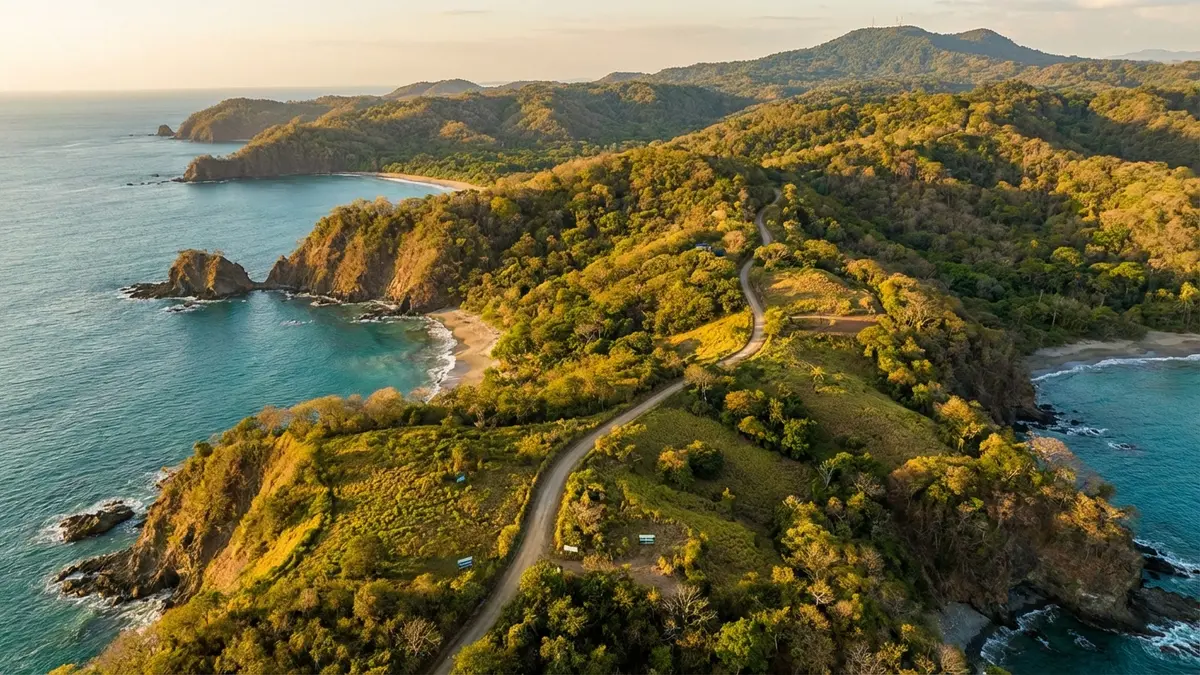
Buying Land in Cabuya, Costa Rica: The Last Affordable Oceanfront at the Edge of Cabo Blanco

The cheapest way to own coast on the southern Nicoya Peninsula is a titled lot in Cabuya, and the most expensive mistake on the same coast is a Cabuya lot bought for its "beachfront" without reading the title field. This page is about the land specifically: what our ten active lots cost per square meter, which of them sit inside the Maritime Zone and which are deeded, what the water letter does to the price, and what you can and cannot build at the edge of Costa Rica's oldest reserve. It replaces an earlier version that led with a per-square-meter figure and the word "oceanfront"; the figure was real, the word was not.
The lots, priced per square meter
We have ten active lots in Cabuya this month, median asking $550,000, from $170,000, plus one flat lot with a small house on it that is priced as land and belongs in the same table. Per square meter they range from about $23 to about $570, and the spread is the whole lesson.
| Listing | Size | Price | Per m² | Title | Water |
|---|---|---|---|---|---|
| Prime Cabuya lot | 300 m² | $170,000 | about $567 | Titled | Public |
| Corner development lot on the main road | 1,235 m² | $280,000 | about $227 | Titled | Yes |
| Flat 1,872 m² lot with a one-bedroom house, 500 m from the sea | 1,872 m² | $280,000 | about $150 | Titled | Yes |
| Eco lot with ocean views | 6,400 m² | $450,000 | about $70 | Titled | Public |
| Beachfront lot, Maritime Zone | 1,997 m² | $500,000 | about $250 | Maritime Zone | Public |
| Ocean-view lot | 12,240 m² | $600,000 | about $49 | Titled | Well |
| 2.8-hectare parcel | 27,827 m² | $640,000 | about $23 | Titled | Not stated |
| Beachfront lot listed as titled | 2,992 m² | $1,500,000 | about $501 | Titled | Yes |
| 10.4-hectare estate parcel | 104,289 m² | $4,693,000 | about $45 | Titled | Available |
Two further lots, one at $360,000 near the beach and one at $1 million on the shore, have blank title fields on our site; we are confirming them with the owners and have left both out of the table rather than guess.
Three things the table says. Small village lots on the main road with public water cost $200 to $570 per square meter and are the ones you can build on next month. Big hillside parcels cost $20 to $70 per square meter and are only as buildable as their pasture, their access and their water. And the beach costs either $250 per square meter as a concession or $500 as a deed, and those are not two prices for the same thing.
Maritime Zone or title: read the field before the view
Under Ley 6043 the first 200 meters inland from the high tide line is the Maritime Zone. The first 50 meters is public and cannot be owned or built on. The next 150 meters is State land used under a municipal concession of five to twenty years, which a foreigner cannot hold until five years of legal residency, cannot mortgage, and cannot sell without the municipality's approval; you pay an annual canon instead of property tax.
Cabuya is one of the places on this coast where a concession is at least legally possible, because Cabuya and Montezuma have had an approved coastal zoning plan since 2016. Mal País and Manzanillo, on the far side of the reserve, have older sector plans from 2001 to 2005, with parts of the coast that no plan covers, and the Cóbano council's March 2025 record shows work started on one integrated plan for that coast. But in two letters in September and October 2024 the Attorney General's office reminded the Cóbano council that it cannot grant or renew concessions on land holding forest or wetland, and the Cabuya shore is rock, reef and trees for much of its length. A lot listed as Maritime Zone is a lot whose concession status you must see in writing, with the municipal file number, before you pay a deposit.
A beachfront lot listed as titled is a different animal and a rarer one. Deeds inside the 200 meters exist where title was registered before the 1977 law or where the zone was measured differently, and they are exactly the documents a lawyer earns their fee on: the survey, the registry record and the official Maritime Zone delimitation have to agree. When they do, you own the beach outright, which is why that lot is priced at twice the concession next to it. When they do not, you own a lawsuit. Our beachfront guide covers the checks.
Water: the other half of the price
Every building permit needs a letter of water availability from the local ASADA or from AyA. The engineers' college reported in May 2026 that missing water letters are the single most common thing stalling projects nationally, and the Cóbano council's 2025 record acknowledges that some communities in the district are served by informal committees with no legal standing to issue one. Cabuya's village lots are on the ASADA; the hillside parcels above it are on wells, or on nothing yet. A well can be legalized with a concession from the water directorate, but it is a long process with no guaranteed outcome, and a lot whose listing says "not stated" is a lot you price as if there is no water until someone shows you the letter.
What you can build at the edge of Cabo Blanco
The road ends at Cabo Blanco, created in October 1963 as Costa Rica's first protected wilderness and managed by SINAC as an absolute reserve, the strictest category. Nothing is built beyond its gate. The hills between the village and the reserve carry forest, and under Ley 7575 forest cover cannot be cleared regardless of what the deed says. In practice a 2.8-hectare parcel is buildable on the part that is already open, along the access that already exists, and an environmental review will look at the rest. Ask for a forest cover assessment before you fall for the acreage; a hectare of protected trees is beautiful and it is not a building site.
There is no boardwalk to the reserve, no eco-resort, no reforestation levy on developers, no "70 percent construction allowance" written into any zoning we can find. Earlier versions of this page said otherwise. If you were told any of it, ask for the decree.
Holding a lot
A lot costs little to hold, which is the honest case for buying land here early. Property tax is 0.25 percent of registered value; the solidarity tax is triggered only when the construction value passes ₡143 million, about $319,000, so an empty lot never pays it. Closing runs about 3 to 3.5 percent in tax, stamps and notary, closer to 4 with your own attorney; our how-to-buy guide has the schedule. Building here got dearer this year because the colón strengthened from around ₡510 to around ₡448 per dollar, which makes labor and materials roughly 12 percent more expensive for a dollar buyer than at New Year. Nobody publishes days-on-market for Cabuya land and we will not invent a figure; plan to hold, and plan to be the one who finds the buyer when you sell.
What we would do
Buy a titled village lot on public water if you intend to build within two years; the main-road corner lot or the flat lot with the small house already on it are the ones we would point a friend to. Buy a hillside parcel only with a water letter and a forest assessment in hand, and price the trees at zero. Buy the beach only with a lawyer who has closed on this coast before, and only after the concession file or the delimitation survey is on the table. And walk the road in October before you sign anything, because the road is the price of the quiet.
If you want the table above re-sorted by what is permittable this year rather than by price, ask us. Our Cabuya guide covers the village, the reserve and the houses; this page is just the land.
Where these numbers come from
- Our shelf: live listings on this site, week of September 8, 2026; per-square-meter figures are asking price divided by listed lot size.
- Coast and zoning: Ley 6043; Cóbano Municipal Council, acta EXT-16-2025; Cóbano Municipal Council, coastal zoning plans; Instituto Costarricense de Turismo, coastal zoning plans in force, August 2025; Semanario Universidad, December 2, 2024.
- Water: Revista CFIA, May 18, 2026.
- Reserve and forest: Cabo Blanco Absolute Natural Reserve; Ley 7575.
- Holding costs: AG Legal, solidarity tax 2026; Wise USD/CRC history.
Tierra Tropical is a real estate agency based in the Cóbano district of Costa Rica's southern Nicoya Peninsula. Nothing here is legal advice; on a specific lot, your attorney's reading of the registry, the survey and the Maritime Zone delimitation is the one that counts.
Ready to Find Your Dream Property?
Explore our curated selection of properties in Costa Rica's beautiful Nicoya Peninsula.
Explore Properties