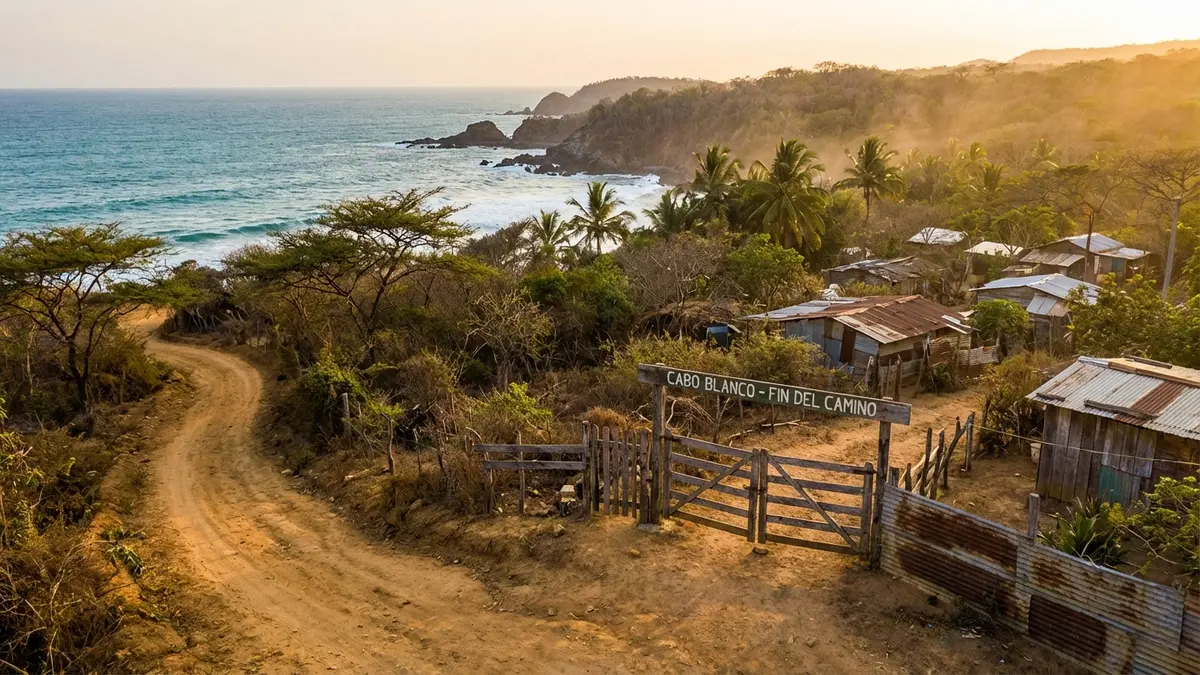
Cabuya, Costa Rica: The Last Quiet Bet on the Southern Nicoya Peninsula

Cabuya is the last village before the forest. The road from Montezuma runs about six and a half kilometers south, unpaved, twenty minutes on a good day, passes a fishing beach, a handful of sodas and a cemetery on an island you can walk to at low tide, and ends at the gate of the Cabo Blanco reserve. It is the cheapest titled coast we sell and the one with the least infrastructure, and both of those facts are worth more than the "next Santa Teresa" line that gets attached to it. We have 28 active listings here, more than anywhere except Delicias, so this guide is built on them and on the public record, not on a prediction.
What the shelf says
Twenty-eight active listings, median asking $360,000. Eighteen are houses, median about $285,000, from $130,000. Ten are lots, median $550,000, from $170,000, with the lot median pulled up by three large parcels and two beachfront pieces. Twelve of the 28 are under $300,000 and eighteen are under $500,000. No other town we cover has that shape.
What the money buys, from the bottom up:
- A titled one-bedroom house on a small lot with water at $130,000, the cheapest house on our books anywhere.
- A titled 300-square-meter lot on public water at $170,000, the entry to the land market.
- A teak-framed two-bedroom with buildable road frontage at $180,000 and a pair of titled twin houses, four bedrooms between them, at $239,000.
- A three-bedroom fenced home near the reserve gate at $265,000, a flat 1,872-square-meter lot with a one-bedroom house 500 meters from the sea at $280,000, and a turnkey house built in 2025 at $310,000.
- Above the median: a three-bedroom island-view home at $450,000, an eight-bedroom property with a pool at $530,000, a three-bedroom ocean-view villa on 1.2 hectares at $660,000.
- The beachfront, which is a separate conversation: a 1,997-square-meter lot listed as Maritime Zone at $500,000 and a 2,992-square-meter beachfront lot listed as titled at $1.5 million. The gap between those two prices is the gap between a concession and a deed, and the next section is about it.
For scale, the regional MLS shows Montezuma with 8 active listings at an average of $637,468 and Santa Teresa with 200 at $1,556,379 and $4,303 per square meter for August 6 to September 6, 2026. Cabuya houses trade at roughly half Montezuma's average and at a small fraction of Santa Teresa per square meter, for reasons this page names.
The coast: Cabuya's plan and the older plans in Mal País
The first 200 meters from the high tide line is the Maritime Zone under Ley 6043: 50 meters public, 150 meters State land held only on a municipal concession, which a foreigner cannot hold until five years of legal residency. Concessions can only be granted where a coastal zoning plan is in force. Cabuya and Montezuma have one, approved by the Tourism Institute in 2016; Mal País and Manzanillo, on the other side of the reserve, have older sector plans from 2001 to 2005, with parts of the coast that no plan covers, and the Cóbano council's March 2025 record shows work started on one integrated plan for that coast. At a council session in August 2026 a councillor said the current plans from Mal País to Manzanillo lack environmental viability from SETENA, the national environmental review agency, and the district intendant confirmed it; no court has annulled or suspended them.
That is why a Maritime Zone lot in Cabuya can be listed with a straight face, and why a Maritime Zone lot in Mal País needs a lawyer to check its plan, its boundary markers and that environmental question before you make an offer. It does not make the Cabuya concession simple. In two letters in September and October 2024, the Attorney General's office reminded the council that it cannot grant or renew concessions on land holding forest or wetland. The annual canon replaces property tax, the concession cannot be mortgaged, and a sale needs municipal approval. Our beachfront guide covers it properly. The short version: in Cabuya the beach is legally reachable, and it is still a different purchase from the titled house three blocks back.
The reserve, and what it does to the village
The road ends at Cabo Blanco, Costa Rica's first protected wilderness, created in October 1963 at the initiative of Nicolás Wessberg and Karen Mogensen, who lived in Montezuma, and managed by SINAC. It is an absolute reserve, the strictest category there is, open Wednesday to Sunday with a $12 entrance and the visitor center in Cabuya itself. Nothing is built beyond the gate and nothing will be.
For a buyer that cuts two ways. The village cannot sprawl south, the forest on the hills behind it is largely protected under Ley 7575, and the reserve brings a steady, modest flow of hikers who need a bed and a meal. It also means a large parcel above the village is only as buildable as the pasture on it, and that an environmental review is real. There is no boardwalk, no eco-resort at $800 a night, no visitor-cap policy in the works that we can find. Earlier versions of this article claimed all three. We have removed them.
Water, power, internet, the road
Water in Cabuya comes from the local ASADA, and most of our listings state it plainly: "public water" or "yes." A few are on a well, and a few say nothing, which you should read as "ask." A building permit needs an availability letter, and the engineers' college reported in May 2026 that missing letters are the most common thing stalling construction nationally. Buy the letter.
Power is grid. Internet is fiber along the main road and not reliably beyond it; test the specific house. The road from Montezuma is unpaved and, in September and October, wet enough that a four-wheel drive is not optional; the road within the village is flat and fine. We looked for a funded paving program and did not find one. Healthcare is the Caja clinic in Cóbano, thirty minutes away, and for anything serious the Hospital Monseñor Sanabria in Puntarenas by ferry, or San José by the Sansa or Green Airways flight from the Cóbano airstrip. Two to three hours to an emergency room, and Cabuya is the far end of that.
Renting here
Cabuya is not a rental market you enter; it is one you build. AirROI's data for the whole Cóbano district shows an average nightly rate of $291 at 35.9 percent annual occupancy; that rate is set by Santa Teresa villas, and a Cabuya house will book below it to a quieter guest, the reserve hiker and the family that wants an empty beach. An eight-bedroom property with a pool or a pair of twin houses can work as a small lodging business; a single house should be modeled to cover its costs and not much more. Our vacation rental ROI article has the arithmetic, including the 13 percent VAT, the 12.75 percent capital-income tax and the manager's cut, and it applies here with a discount.
Holding costs and the things that changed this year
Property tax is 0.25 percent of registered value; the solidarity tax on high-value homes starts above ₡143 million of construction value, about $319,000, which most Cabuya houses do not reach. Closing runs about 3 to 3.5 percent in tax, stamps and notary, closer to 4 with your own attorney; our how-to-buy guide has the schedule. The colón has strengthened from around ₡510 to around ₡448 per dollar since January, so building or renovating here costs roughly 12 percent more in dollars than it did at New Year. And the residency-through-property route is in a legal gap since the Law 9996 incentives expired on July 14, 2026; our investor visa guide has the current position.
Who Cabuya is for
It is for the buyer who wants to own titled land near an empty beach for the price of a condo deposit elsewhere, who will live here or spend real seasons here, who does not need a restaurant choice or a hospital nearby, and who finds a cemetery on a tidal island interesting rather than odd. It rewards people who fix things themselves, keep a truck, and like the reserve's hikers more than Santa Teresa's crowd. It is a hold, not a flip; nobody publishes days-on-market for Cabuya and we will not invent one, but the buyer for a house here takes longer to find than the buyer for a house in town.
It is wrong for anyone who needs the rental to pay the mortgage, who wants to walk to anything after dark, or who has read that Cabuya is "the next Santa Teresa" and is buying the story. The reserve is the reason it will not be, and the reserve is also the reason it is worth buying.
If you want the 28 listings sorted by title status, water and distance to the reserve gate rather than by price, ask us. We will also tell you which of the four with blank title fields we are still confirming, because we would rather say so than let you find out.
Where these numbers come from
- Our shelf: live listings on this site, week of September 8, 2026; 28 active Cabuya listings, median asking $360,000.
- Comparison: 2 Costa Rica Real Estate, Montezuma and Santa Teresa market insights, August 6 to September 6, 2026.
- Coast and zoning: Ley 6043; Cóbano Municipal Council, acta EXT-16-2025; Cóbano Municipal Council, coastal zoning plans; Cóbano Municipal Council, acta 118-2026; Instituto Costarricense de Turismo, coastal zoning plans in force, August 2025; Semanario Universidad, December 2, 2024.
- Reserve: Cabo Blanco Absolute Natural Reserve; Nicoya Peninsula guide, hours and entrance; forest law, Ley 7575.
- Village: Costa Rica Vibes on the Cabuya island cemetery and the road from Montezuma.
- Water: Revista CFIA, May 18, 2026.
- Healthcare and transport: El Observador; Naviera Tambor; Sansa.
- Rentals and holding costs: AirROI, Cóbano, July 30, 2026; AG Legal, solidarity tax 2026; Wise USD/CRC history.
Tierra Tropical is a real estate agency based in the Cóbano district of Costa Rica's southern Nicoya Peninsula, covering Cabuya, Montezuma, Delicias, Santa Teresa, Mal País and Tambor. Nothing here is legal or investment advice.
Ready to Find Your Dream Property?
Explore our curated selection of properties in Costa Rica's beautiful Nicoya Peninsula.
Explore Properties