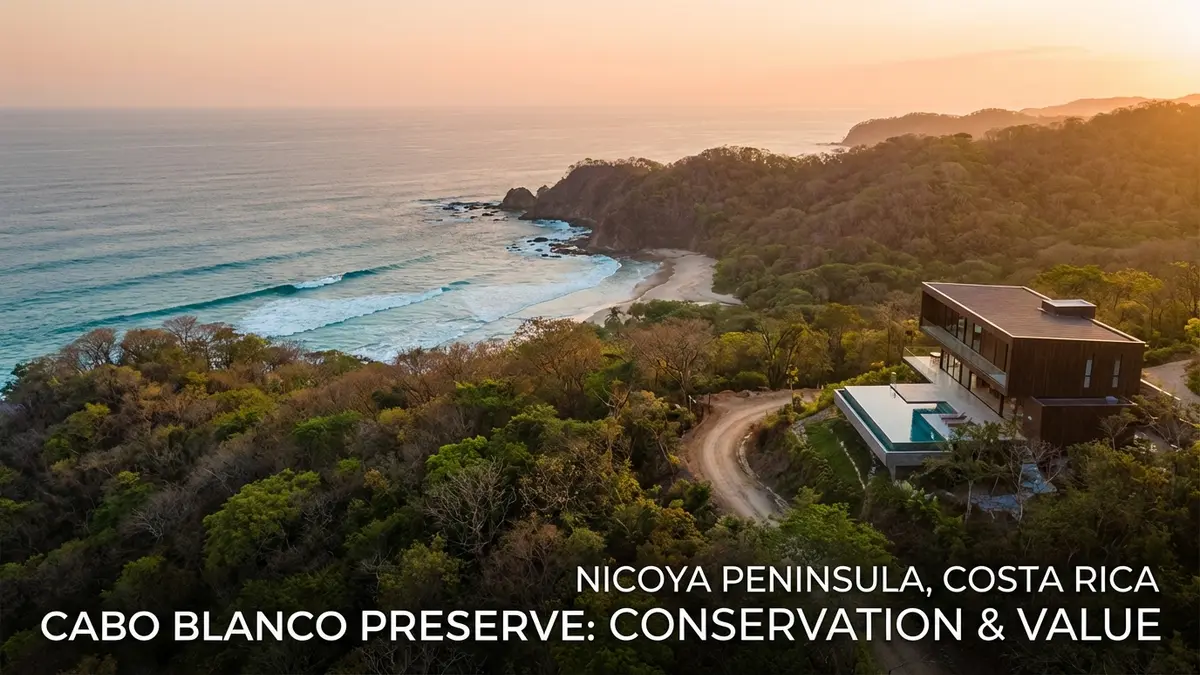
How Cabo Blanco Nature Reserve Quietly Shaped the Hottest Real Estate Market on Costa Rica's Pacific Coast
The first time I drove to Cabo Blanco, I missed the turn twice. The road past Cabuya narrows to something that barely qualifies as a road — more like a suggestion between trees — and my rental's suspension was making sounds I'd rather not describe. That was four years ago. I came to write a travel piece, spent three days hiking through dry tropical forest to empty Pacific beaches, and started asking locals about rent prices before I'd even filed the story.
Here's what I didn't understand then but do now: that difficult road, that remoteness, that feeling of being at the literal end of the peninsula — it's not a bug. It's the feature. And it's the reason property values in Cabuya, Montezuma, and Mal País have been climbing with a consistency that makes other Central American markets look erratic.
Costa Rica's first protected area, established in 1967, has spent nearly six decades doing something no zoning board or master plan could replicate: it made overdevelopment physically impossible in one of the most desirable stretches of coastline in the tropics. In 2025 and into 2026, the consequences of that protection are showing up in the data — and in the number of North Americans and Europeans quietly buying land within a few kilometers of the reserve boundary.
The Scarcity Engine: Why Cabo Blanco Drives Premium Pricing
Let me put this plainly. Cabo Blanco Nature Reserve spans 3,140 hectares at the southern tip of the Nicoya Peninsula. Nothing gets built inside it. Nothing ever will. And the regulations radiating outward from its borders — enforced by SINAC, Costa Rica's conservation authority — create concentric rings of restriction that thin out the buildable land supply in ways most buyers don't fully appreciate until they start looking at survey maps.
In 2025, SINAC approved only 12 new eco-projects in Cabuya and Montezuma combined — a 40% drop from 2024. Structures within 500 meters of the reserve can't exceed two stories. The March 2026 zoning update went further, mandating 30% green space for any new development in Mal País and Santa Teresa, while capping foreign ownership at 10 hectares.
The result is a supply constraint that would make a Manhattan developer weep.
"The reserve's protection effectively functions as a permanent growth boundary. You're not buying proximity to a park — you're buying into a market where the inventory ceiling is fixed by law."
That constraint is showing up in prices. Mal País and Santa Teresa beachfront lots (half-hectare to one hectare) averaged $450,000 to $750,000 in 2025, up 12% year-over-year. Luxury villas in the area averaged $1.2 million. Montezuma, with its waterfall-hiking crowd and slightly more bohemian character, saw 8% growth to $350,000–$550,000 for hillside homes. And Cabuya — the smallest, sleepiest of the three, the one closest to the reserve entrance — posted 10% gains, with eco-lodges pulling 7–9% rental ROI.
For comparison, Nosara's beachfront hit $800,000-plus with 14% growth. But Nosara has more room to build. The towns around Cabo Blanco don't. That's the difference between a hot market and a structurally constrained one.
Cabuya's Quiet Transformation
If you haven't been to Cabuya recently, you might still picture the dusty fishing village where backpackers used to camp on the beach. That version is fading.
The biggest catalyst: a new 1.2-kilometer boardwalk linking the reserve entrance to the center of town, completed in December 2025 through a $1.5 million private-public partnership. It's a simple piece of infrastructure — elevated wood planking through coastal scrub, some interpretive signage, solar lighting — but it effectively turned Cabuya from a place you drove through to reach Cabo Blanco into a destination that begins at Cabo Blanco.
Local property values jumped 7% in the month following the boardwalk's opening. That's not a typo. One month.
The 2025 reforestation mandate adds another layer. Developers seeking approval now must donate 5% of their property land to reserve expansion — a requirement that further limits what can actually be built while simultaneously expanding the protected buffer. It's conservation policy doubling as market protection, whether that's the intent or not.
I had coffee last month with a couple from Portland who'd just closed on a two-bedroom eco-home above Cabuya for $380,000. They plan to live there half the year and rent it the other half. "We looked at Tulum first," the husband told me, stirring his café chorreado. "But it felt like we'd already missed it." They're not wrong. (More on that comparison shortly.)
The Eco-Tourism Flywheel: 45,000 Visitors and Counting
Cabo Blanco's October 2025 expansion of its monkey habitat restoration program closed 20% more trails to foot traffic — a move that sounds counterintuitive for tourism but actually concentrated visitors onto the remaining routes, improved wildlife sighting rates, and drove a 22% increase in annual visits to 45,000.
That number matters for property owners because it feeds directly into the rental economy. Short-term rental occupancy in Mal País spiked 25% following the trail changes. The Nicoya Peninsula tourism board's Q4 2025 report attributed 35% of all peninsula visits to the reserve's draw — a remarkable figure for a protected area with no resort, no zip-line canopy tour, no Instagram-bait infinity pool.
What's Pulling Visitors (and Buyers) In
- The January 2026 eco-resort opening near Santa Teresa — 12 villas at $800/night, fully booked through high season — was explicitly marketed around reserve proximity
- February's surf competition at Mal País beaches drew 5,000 visitors and triggered an 18% spike in sales inquiries across Montezuma and Mal País
- Foreign buyers now represent 60% of transactions, primarily from the US and Europe, with the majority specifically seeking lots within a 5-kilometer radius of the reserve
The flywheel works like this: conservation protects the ecosystem → the ecosystem attracts eco-tourists → eco-tourists fill rental properties → rental yields attract investors → investors buy the limited supply → prices appreciate → the conservation mandate prevents overbuilding that would kill the thing that started the cycle.
It's elegant. It's also fragile, which brings me to the part most real estate articles skip.
The Honest Caveats: What Could Go Sideways
I live here. I love it here. And I'd be doing you a disservice if I didn't mention the friction.
Infrastructure is still rough. The road from Cobano to Mal País has improved — they've paved the worst stretches — but the route from Cabuya to the reserve is unpaved and turns into a creative interpretation of a road during green season (roughly May through November). Power outages happen. Internet is better than it was but still not what you'd call reliable in Cabuya proper. And if you need serious medical care, you're looking at a 2–3 hour drive to San José hospitals. The Blue Zone longevity stats are real, but they assume you're healthy enough not to need a trauma center.
Overtourism is a live concern. If Cabo Blanco visits exceed 50,000 annually — and at 45,000 with 22% growth, that threshold is close — experts anticipate SINAC could impose visitor caps as early as late 2026. Caps would protect the ecosystem but could dampen the rental income projections that make the investment math work for some buyers.
Regulatory tightening cuts both ways. The March 2026 zoning laws and SINAC's permit restrictions are great if you already own property — your asset just got scarcer. They're less great if you're a developer hoping to build inventory, or a buyer hoping for more options. Only 12 projects approved in a year across Cabuya and Montezuma means the selection at any given time is thin. Patience isn't optional here.
And the maritime zone restrictions along the coast — the first 200 meters from the high-tide line are public land in Costa Rica, with the next 150 meters requiring government concessions — add complexity that anyone buying property in Costa Rica near the beach needs to understand thoroughly before signing anything. (Tierra Tropical's FAQ page covers the maritime zone basics well.)
Why This Isn't Tulum — And Why That Matters for Your Money
The comparison comes up constantly, so let's address it directly.
Tulum exploded. Luxury condos went up fast, Instagram influencers arrived faster, and by 2024 the backlash was in full swing: sewage problems, deforestation scandals, a sense that the thing people came for had been paved over. Panama's Azuero Peninsula offers more affordable beachfront — $250,000 to $600,000 — but lacks Costa Rica's established carbon-neutral infrastructure and the zona azul longevity branding that resonates with the 55-and-older demographic making up 60–70% of Nicoya Peninsula buyers.
Costa Rica protects over 25% of its national territory — a stat that sounds like a brochure line until you're standing at the edge of Cabo Blanco watching a troop of white-faced capuchins move through primary forest that's been continuously protected since Lyndon Johnson was president. That protection isn't marketing. It's law, with teeth, enforced by an agency (SINAC) that just demonstrated its willingness to reduce approved projects by 40% in a single year.
CRREB analysts project 12% ROI for Mal País investments through 2027, outpacing Nosara's estimated 10%. EcoRealty's February 2026 analysis sees Montezuma average home values reaching $600,000 by 2027. These are projections, not guarantees — but the structural factors supporting them (fixed supply, growing demand, regulatory protection) are harder to disrupt than in markets where the next condo tower is always just one permit away.
Where This Is Heading
The southern tip of the Nicoya Peninsula is in an interesting moment. Not a boom — booms imply speed and carelessness, and the regulations here won't allow either. More like a slow, deliberate repricing of what it means to own land next to a permanently protected ecosystem in a country that takes conservation seriously enough to limit its own economic growth.
The buyers showing up now aren't speculators. They're people in their fifties and sixties who've done the math on healthcare costs, climate resilience, and quality of life, and decided that a hillside home twenty minutes from an empty Pacific beach and a 60-year-old nature reserve is worth the tradeoff of a bumpy road and occasionally spotty Wi-Fi. The numbers suggest they're making a reasonable bet.
If you're curious about specific properties near Montezuma, Santa Teresa, or the Cabo Blanco corridor, the team at Tierra Tropical knows this stretch of coast about as well as anyone — and they'll tell you the caveats before they tell you the price, which is how you know you're dealing with the right people.
The capuchins, meanwhile, don't care about any of this. They've got 3,140 hectares and a government that keeps making that number bigger. Not a bad position to be in.
Ready to Find Your Dream Property?
Explore our curated selection of properties in Costa Rica's beautiful Nicoya Peninsula.
Explore Properties