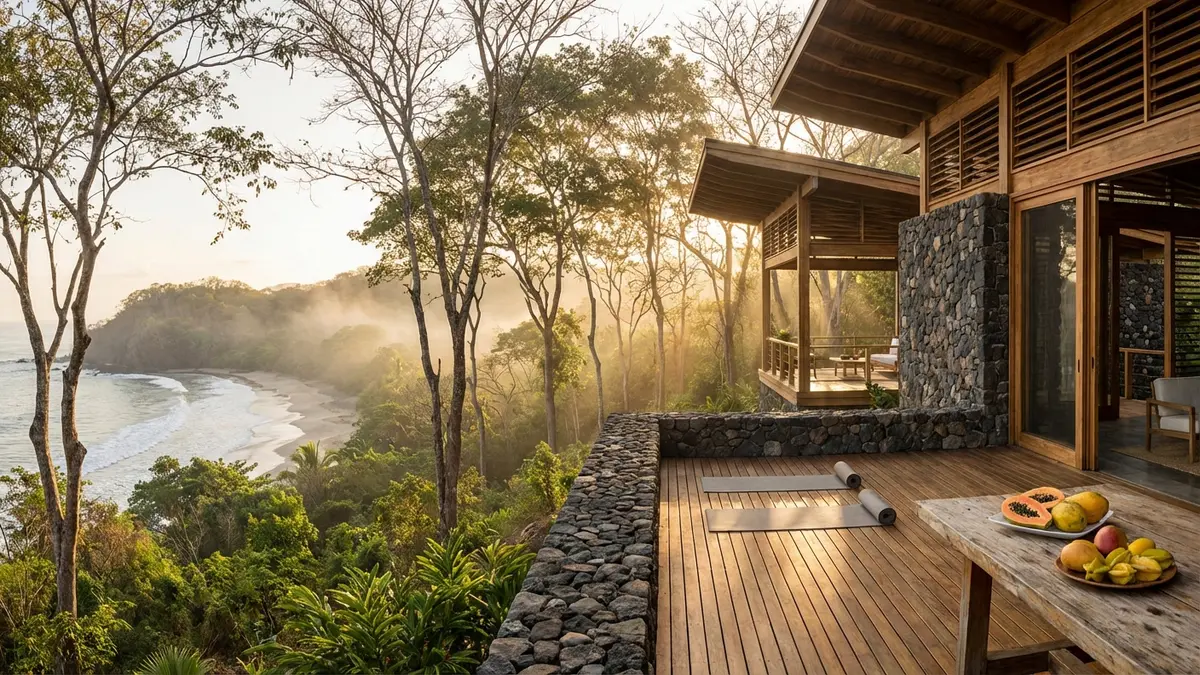
Blue Zone Living Meets Luxury Real Estate on Costa Rica's Nicoya Peninsula
The old man at the feria in Sámara didn't know he was a longevity case study. He was just selling cas juice from a folding table, same as he'd done every Saturday for decades. Eighty-seven years old, he told me, though he moved like someone twenty years younger — hauling coolers, making change, laughing at something his granddaughter said. No biohacking protocol. No optimization stack. Just a life built on physical work, family proximity, and a diet heavy on beans, corn, and whatever fruit was in season.
That interaction, about three years ago now, was the first time the Blue Zone concept stopped being an abstraction for me and became something I could see operating in real time. I'd moved to the Nicoya Peninsula to write a story about longevity tourism. The story ended. I stayed.
What's changed since then — and what's changing fast right now, in early 2026 — is that the rest of the world has caught on. Not just the wellness tourists passing through for a week of yoga and smoothies. I'm talking about people making serious real estate decisions based on the premise that where you live might be the single most consequential health intervention available. And the data, the money, and the science are starting to converge on this narrow strip of Costa Rica's Pacific coast in ways that feel genuinely new.
The Science of Place: Why Nicoya's Blue Zone Status Actually Matters for Real Estate
Let's get something straight. The Nicoya Peninsula is one of only five recognized Blue Zones on the planet — regions where people live measurably, statistically longer lives. The others are Okinawa, Sardinia, Ikaria, and Loma Linda, California. What separates Nicoya from a wellness resort slapping "longevity" on its brochure is a body of peer-reviewed research spanning decades, built around what researchers call the Power 9 principles: natural movement, purpose (plan de vida), stress reduction, plant-based diets, moderate caloric intake, moderate alcohol consumption, faith-based community, family first, and the right social tribe.
Now, an honest caveat. Nicoya's centenarian concentration has declined from its peak levels. Modernization, dietary shifts, younger generations migrating — the forces eroding traditional lifestyles here are real. But the concentration remains elevated, particularly in areas south of the historical core zones, and the underlying environmental and cultural infrastructure that produced those outcomes hasn't disappeared. It's just being understood differently.
The peninsula's authentic plan de vida philosophy — where residents maintain strong life purpose into their 90s and beyond — transforms real estate from simple property investment into measurable healthspan extension.
That reframing is what's driving a new category of buyer to the Nicoya Peninsula. Not someone looking for a beach house that happens to be in Costa Rica. Someone looking for a place engineered — by centuries of culture and geography — to help them live longer and better.
Who's Buying, What They're Spending, and Why the Numbers Are Accelerating
The buyer profile here has shifted noticeably in the past eighteen months. The core market remains affluent North Americans aged 50 to 70, representing roughly 60-70% of wellness real estate purchases on the peninsula. Investment sizes range from $500,000 to $2,000,000 for eco-luxury villas with integrated wellness features — think properties with on-site treatment rooms, cold plunge circuits, organic kitchen gardens, and in some cases, clinical-grade diagnostic equipment.
But there's a newer cohort that's reshaping the demand curve. Younger biohackers aged 40-55, predominantly European, now represent about 20% of the market, investing between $300,000 and $800,000 in wellness retreat properties. These aren't retirees. They're remote founders, tech executives, and health practitioners who view Nicoya not as a retirement destination but as an operating base for a longevity-optimized life.
The numbers reflect this convergence:
- 10-15% annual growth in wellness real estate demand peninsula-wide as of 2025-2026
- 25-35% projected annual rise in longevity-focused property sales through 2026
- 30% year-over-year increase in sales of off-grid eco-homes promoting stress reduction and purpose-driven living
- Properties with integrated longevity services commanding a 20-30% pricing premium over comparable homes without them
And the cost-of-living math sweetens the equation considerably. A luxury expat couple on the Nicoya Peninsula spends approximately $2,500 per month — roughly 40-50% below US averages and about half what you'd burn through in Tulum, which is the comparison everyone makes (and which, frankly, Nicoya wins on almost every metric except nightlife and Instagram saturation).
What "Integrated Longevity Real Estate" Actually Looks Like in 2026
Between October 2025 and now, something shifted from theoretical to operational. High-end Nicoya properties began adopting what I'd call integrated luxury-medical models — and the gap between what's available here versus what existed even two years ago is significant.
The most ambitious developments are clustering AI-powered diagnostics (full-body MRIs, DNA sequencing, continuous biomarker tracking) alongside regenerative therapies including stem cell treatments, hyperbaric oxygen therapy, exosome infusions, and cryotherapy. Add personalized nutrition programs calibrated to individual bloodwork, and you're looking at something that didn't exist in this form anywhere in Central America before 2025.
The Retreat Model Goes Residential
The Andaz Costa Rica Resort at Peninsula Papagayo hosted its second Blue Zone retreat in February 2025, built around plant-based cooking classes, meditation programs, and guided exploration of Nicoya's longevity traditions. Similar programs are planned for additional properties across the peninsula in 2026. But the real story isn't retreats — it's the residential developments that are making these services permanent rather than episodic.
Think of it this way: a retreat is a week. A residence is a life redesign.
Santa Teresa's Accidental Longevity Lab
Down in Santa Teresa, which I've watched evolve from a surf village with one ATM into something considerably more complex, the longevity angle manifests differently. It's less clinical, more embodied. Hotel Fermata, reviewed in early 2026, exemplifies this — emphasizing surfing as ingrained daily physical activity, which aligns directly with the Blue Zone natural movement principle. (I can confirm: there's nothing like paddling out at Playa Carmen at 6 a.m., when the water's still glassy and the only sounds are pelicans hitting the surface, to make the concept of "natural movement" feel less like a wellness buzzword and more like the obvious way to live.)
Santa Teresa's roads are still mostly unpaved. The power flickers during green season storms. The internet works until it doesn't. But that slower pace of modernization — the thing that frustrates people expecting Cancún-level infrastructure — is precisely what preserves the conditions that make Blue Zone living possible. The walk to the beach is the exercise. The soda lunch of casado con pescado is the diet. The conversation with your neighbor is the community.
The Honest Considerations: What the Brochures Won't Tell You
I'd be doing you a disservice if I didn't flag some realities.
Entry costs are real. At $500,000 to $2,000,000, Nicoya's wellness real estate sits well above competing markets. Colombia's emerging longevity properties in places like Cartagena start at $250,000. Panama offers strong tax incentives with investments ranging $300,000 to $1,000,000. If you're optimizing purely for price, Nicoya isn't your market. But if you're optimizing for validated outcomes — and that distinction matters enormously to the buyer profile driving this growth — no competing market can replicate Blue Zone authenticity. Tulum has wellness branding. Nicoya has the science.
Comprehensive 2025-2026 pricing data for specific towns remains limited. Growth statistics are partially inferred from global wellness real estate trends rather than granular local market reports. The trajectory is clear; the precise numbers at the micro-market level are still catching up to the pace of development.
Healthcare is a genuine advantage, but understand the system. Costa Rica's Caja public healthcare covers roughly 90% of expats at low cost, and it's remarkably good for a public system. But wait times can be long, and the most advanced longevity diagnostics are private-pay. The emerging model — private clinics integrated into residential developments, complemented by Caja coverage for everything else — is compelling, but it's still being built out. Check the FAQ for more on navigating Costa Rica's healthcare as an expat.
Safety context. Costa Rica's homicide rate of 11 per 100,000 compares favorably to Panama's 17 per 100,000, and the Nicoya Peninsula specifically feels considerably safer than those national numbers suggest. But petty theft happens, especially in tourist-heavy areas. Lock your car. Don't leave your laptop on the beach. Standard stuff, but worth saying.
Where This Is Heading: Nicoya's Position in the Global Longevity Market
Market projections suggest Nicoya could capture 15% of the global longevity tourism segment by 2030. That's an ambitious number, but the underlying logic is sound. As longevity science moves from fringe to mainstream — as people shift from treating disease to optimizing healthspan — the demand for places that offer both the lifestyle infrastructure and the clinical capabilities will intensify. And Nicoya has a head start that's essentially impossible to manufacture.
You can build a wellness resort anywhere. You can install cryotherapy chambers in Bali or Lisbon or Austin. What you can't fabricate is a multigenerational culture of plan de vida, a population that has been living to 100 at anomalous rates for as long as anyone's been measuring, and an environment where the default daily life — the walking, the eating, the social rhythms — aligns with what the science says actually extends human life.
That's the real asset here. Not the property. The place.
The properties just happen to give you a way in. And for those seriously exploring what buying property in Costa Rica's Blue Zone looks like in practice — the specific towns, the price ranges, the lifestyle tradeoffs — Tierra Tropical knows this peninsula at a level that makes the conversation worth having.
The old man at the feria probably won't be there forever. But the conditions that shaped his life? Those are still here. For now, at least, they're also for sale.
Ready to Find Your Dream Property?
Explore our curated selection of properties in Costa Rica's beautiful Nicoya Peninsula.
Explore Properties